The Wax Marches
I had a chance to run a second session of the Honeybee RPG this past Friday afternoon with my friends Zak (of Bommyknocker Press), Kati (of The Play Reports), and Scott (of XPRolls). Due to the holiday, we had to keep this session a little shorter than I'd normally prefer, but they were good sports and picked up the procedures quickly! This playtest used the same rules for the Resource Expedition and the Hive Expansion phases, but after the session earlier this week I wanted to develop a more robust and interesting set of rules for the Waggle Dance phase than "assemble the best poker hand you can".
In this post I want to talk about my design objectives for the Waggle Dance and how I think it worked out in play. If you'd like to read a writeup from the player perspective, check out Kati's play report here!
The Waggle Dance
The premise of this phase of play is that, like real honeybees, players come back to the hive with brains full of landmarks and directions and information that they need to convey to their sisters in the hive. I constrained my design space to playing cards as both the resource collected and the tool for encoding instructions. I could have opened up the design space some, but I love playing cards!

From Wikipedia
The basis set of instructions I wanted to formalize was something along the lines of Forage, Attack, Defend, Send a Message, Take Action (in the environment), or Tend to the Hive. I thought (and still think) that I wanted resolution of instructed tasks to be pretty deterministic, the way that worker placement Eurogames tend to be. In this basis set, Take Action is sort of the catch-all open-ended instruction while the others are a direct interaction with a keyed feature on the map.
The levers I identified to frame the design space were:
- Task Difficulty. Bees are assumed competent at doing bee tasks, but the more complicated the task is the harder it is to encode into instructions.
- Distance from the Hive. It should be more "challenging" or "costly" to provide instructions for tasks further away from the hive. With the seven-hex starter map, the farthest space away from the hive was either 1 biome away or 5 sub-hexes away.
- Required Population. Should tasks ever require more than one worker to complete? Worth identifying as a lever.
So we have some baked-in assumptions there that are useful to identify. Some tasks should be harder or more costly than others. Attacking a hive three times your size, several miles away, should be more challenging than foraging for honey next door. If we believe that to be the case, then we need to find things that we can normalize around.
High Level Concepts
I noodled on three basic concepts before committing to one for this session.
- Players attempt to assemble poker hands from the cards that they store in their collective memories. Higher quality hands result in better instructions. This is what I brought as an unbaked prototype for the first playtest. Poker is fun to design around and this rewarded players cooperating to find synergistic hands, but I found almost immediately that it had weird interactions with trying to accomplish multiple tasks. Also, hand quality scales really poorly against relative frequency. TABLED.
- I had an idea to do something like the Bakers' Otherkind Dice as a way to handle task resolution. Based on the season, you identify some number of problems in the environment and actions you want to accomplish and players have to find some way to assign workers the the cards in their memory to address them as best as you can. I chose not to explore this further but I think it's a fruitful line of inquiry in a game that is more intentionally about narrative. TABLED.
- I kept saying to myself "what about cribbage". What about cribbage? What about cribbage? What about cribbage? Players still collect pollen cards and memory cards while exploring, sure, but what if cards that players leave on the map represent uncollected resources that the GM, as the rest of the world, can collect and use against the players? This idea really tickled me, and rather than walk through the few iterations that came up this week, here is the version that made it to the table.
Waggle Dance Cribbage
At the beginning of the Season, the GM draws a card from the deck and shares it publicly. This card is compared to a d13 table of Hive Events, which include parasite infestations, large mammal sightings, unseasonable weather, and the Queen Bee experiencing a flight of fancy. This card draw acts as the "cut card" for the purposes of scoring.
The players then play out the Resource Expedition, with the intent of collecting pollen and memories. They have three competing objectives: maximize pollen collected, do not run out of water/nectar, and produce the highest-scoring cribbage hand of memory cards possible. If two players are exploring in the same tile during an Expedition, then they can spend an hour either grooming one another (removing pollen in order to reset their suit preference) or performing trophallaxis to trade water and memory cards. When all players agree to wrap up the Expedition, they reconvene at the hive. Note that at this point, there are likely uncollected or "stranded" resources on the map.
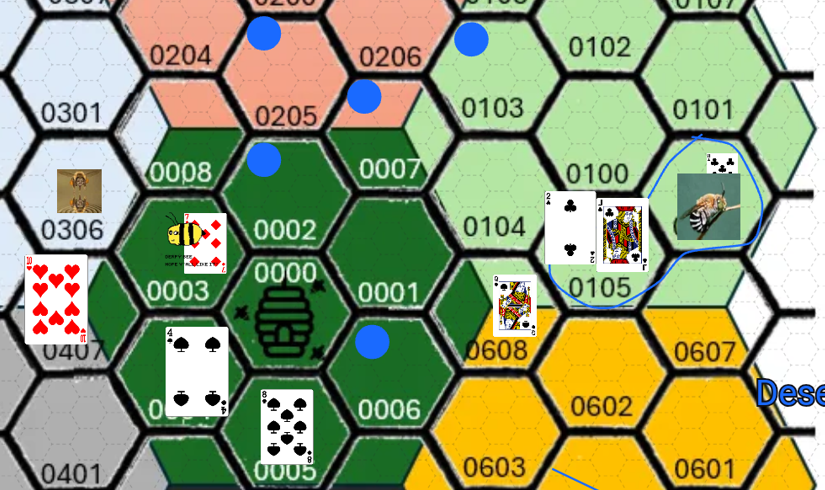 Uncollected resources on the game map
Scoring Procedure
- Players choose up to 4 cards from their Memory inventory to retain, discarding the remainder. Discarded cards are not scored. We ruled that if a player has fewer than 4 cards in their Memory, they may randomly draw from the deck up to 4 cards. Since the goal was to intentionally curate a hand, this randomness feels like a sufficient penalty.
- Players score their hand using the retained cards in their Memory and the Hive Event card as if it were a five-card hand of cribbage. We were on a time crunch for this session so we all used an online calculator to score our hands.
- Players pool their points and assess what they can do with their population of worker bees. I made a "Mission Sheet" that tracks attempted tasks, their distance from the hive, and the complexity of the task. I think this part of the phase needs a lot of tuning to figure out what will feel best, but it feels appropriately scalable! One fun wrinkle is that at this step, players can remove "stranded" resources from the map by sending worker bees out to forage for honey at that specific hex.
- The GM then assembles a hand based on resource cards left stranded on the map. If there are fewer than 4 cards left on the map, then the GM must draw randomly from the deck. This hand is scored.
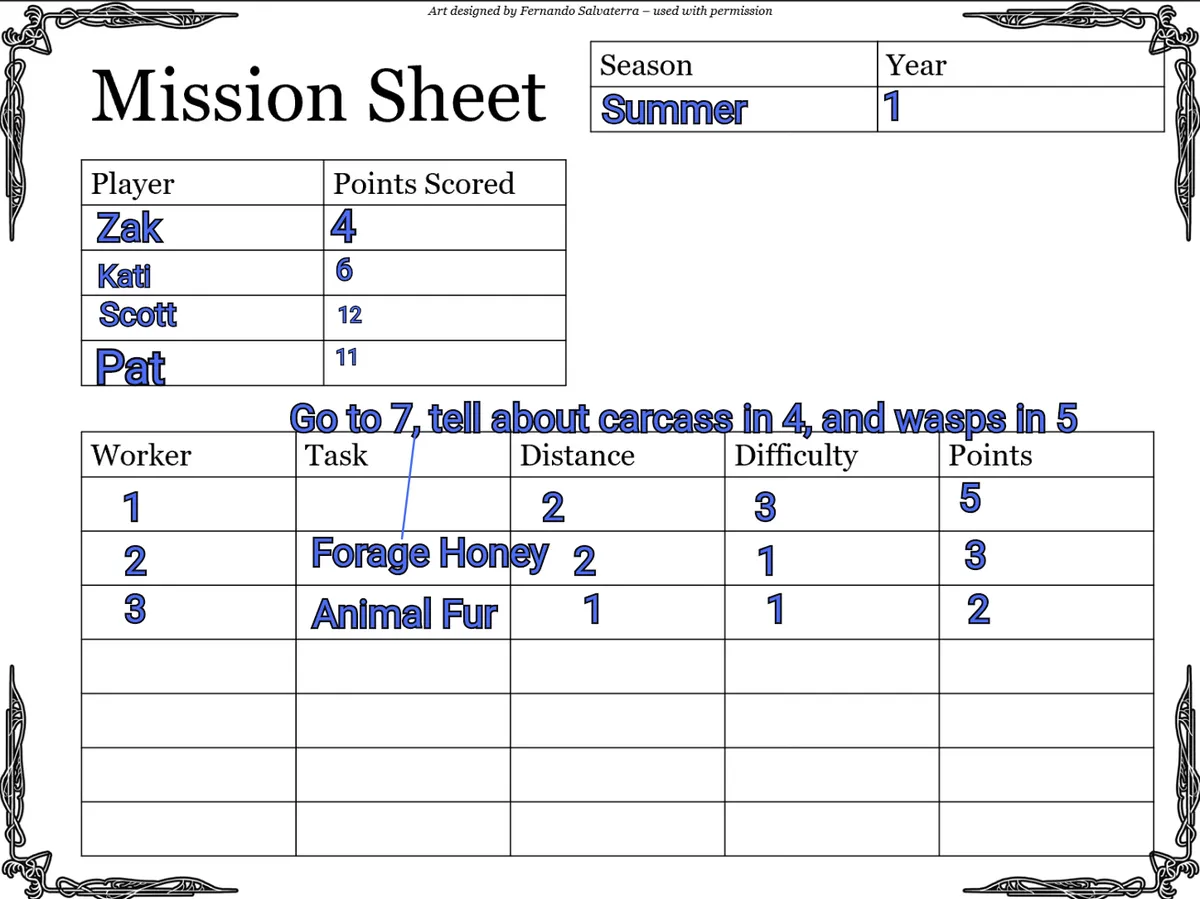
GM Moves
I wanted to test out the basic procedure here before I invested too much time into what the GM can do with their points. In tonight's session, the players had 12 points left over after assigning their worker bees to tasks and my hand only scored 11 points, so we just said that the excess nervous energy of the hive canceled out mother nature's dastardly plans. I can see a world where GM points are used to update the environment, introduce invasive species, or advance clocks created by Hive Events. I think it should be something nasty enough that players are encouraged to think strategically and counteract the GM.
Assessing Difficulty
What I like about the scoring system is that it transmutes "Difficulty" into something that looks suspiciously like "HP".
As a test case, my Tuesday players found a dark-furred possum nest three hexes away from their home hive. I think a medium-sized mammal (larger than a mouse but smaller than a bear) should have something like, say, 3 HP, but opossums are also naturally immune to bee stings. In order to scare the opossums out of that grassland region, players would need to find some mechanism or leverage that their worker bees could apply. The hive began taking on leafcutting adaptations by satisfying Queen Lorraine's fears about winter, so theoretically the players could try to describe something like sending swarms of bees to chew up and destroy the possum nest, and maybe I'd adjudicate that as a Clock for "disrupting the possum nest". If the nest is 3 hexes away and the Opossum has 3 HP, then each segment would take about 6 Waggle Dance points per season.
I need to do some tuning and tweaking around average scoring hands, but this feels legible as a design baseline!
As you saw in the above figure, my players in the Friday game also wanted to warn a local beehive about the wasps in the forest and let them in on the additional deer carcass discovered to the southwest. This hive was 2 tiles away and the party wanted to convey two separate messages, so I ruled that the first message had a difficulty of 1 and the second message had a difficulty of 2 (compounding difficulty for complicated messages seems fair). This cost them 5 points and bought them favor with that hive for future negotiation.
Cribbage Scoring Statistics
Ages ago, I wrote my post about how to use poker hand statistics to model a 2d6 distribution for a tabletop adventure game. This was always a really fragile balancing act because the statistics really only work out for 7 card poker and I wanted to fiddle with hand size as a design lever. After spending some time reading about cribbage statistics, I think we have a less fragile design space with the procedure we've discussed above. For a completely random 5 card hand, there is only an 8% chance of scoring 0 points, which I would consider to be a fail state for a player. The average scoring hand would be about 5 points per player and only about 10% of hands score above 9 points, so we have a nicely constrained statistical space to tune around that allows us to play well with multiple players managing multiple swarms of worker bees.
However! That is assuming completely random hands. If players use the full length of the day to explore the map and pick/choose resources, they conceivably have much better capacity to curate a powerful memory hand...which is why the competing objectives of pollen and water management are so important. Players have a much broader analysis space and have to think critically about whether they want to optimize for pollen collection or a high-scoring hand. That is why the scale of points relative to the theoretical floor is so important - I want there to be a chance of a failed Waggle Dance, but I don't want that chance to be as oppressively high/dominant as the chance of having a dog shit poker hand (17% chance of No pair).
Onto the Play Report!
This was a fun session, I'm really grateful for my friends being so willing to go on this journey with me. I opened with another quick guided meditation to orient players to life in the beehive - this time my focus was on the experience of being born in the spring and only ever knowing the comfort of the hive, and how that comfort and love is what drives you to do the dangerous job of scouting. I think i want to write a handful of meditations for each season for the eventual release of the game so that there's something of a ritual.
The three players largely split into two groups. Zak wanted to spend more time exploring the wetlands, because the wetlands have plenty of pollen resources in the summer. Kati and Scott wanted to scout the rest of the home forest before investigating the mountains to the northwest. This group very quickly picked up on the emergent play pattern of slowly exploring to hoover up as many resources as possible, so I may need to do some tuning around the resource cost/benefit of staying in place or backtracking, but I think the time pressure is probably sufficient. I might reframe the length of days from true hours to an abstract "segment" to tighten things up, but I also need to test out the summer season with a longer time slot so that we don't all feel so rushed.
In general, rushing was sort of the theme of this playtest - my priority as a game runner was to exercise the new Waggle Dance rules, and the role play/interactivity of the space suffered as a result. Neither I nor players had the time to stretch our legs and we all felt it, so I appreciated the players being honest with their wishes for the session. The flip side is that this brisk pace also stress tested the capacity of this as more of a traditional board game, and my players were extremely supportive and receptive to the bones and structure of the system. Scott in particular highlighted that it's a game where the depth of the mechanics and interlocking systems really start to emerge as you work through the first gameplay loop and his wish was either for a second loop or for a better way to communicate that complexity upfront, which is well taken.
I think Kati and Zak shared a point, which I need to meditate more upon, which is that the decisionmaking for the game is currently almost entirely in the "game state" space. There is a keyed map with randomly drawn resources and their decisions this session were "where do I want to go next" and "how am I going to use these resources", not "what do I, as this scout bee, want to do in the fiction". This is tricky! I think going in, I knew that the agentic capacity for a single European honeybee is, intentionally, finite. My vision for the game is that the open-endedness comes into play in the worker placement and basebuilding phases, which we had to abbreviate to fit into the time slot. This is something I will need to really chew on and make a clearer vision decision on moving forward. With the right tweaking and tuning, this could be a tidy boardgame, but for no real rational reason I am more interested in seeing this evolve as an RPG.
That was a point that Dwiz from Knight at the Opera and I talked about after the session - he sat in the playtest as an observer. We talked about Jay Dragon's definition of board game vs RPG, which is essentially that the difference is how you market the game and which audience you target. Dwiz's observation is that the game premise and the way that I ran it still asks players to truly role play as bees and think of themself as non-anthropomorphized insects, which is pretty unique in the space, but that this playtest remained pretty closed-form from a mechanical perspective with only some winks and nudges at openness and role play. Honestly I agree!
Next Steps
The test sessions this week represent two big swings for me. First, I've wanted to just get some version of this game to the table for months. I had a group of friends I wanted to play with in person, but we are all young professionals and most of us have babies who do not want to sit still while their parents pretend to be insects. I'm glad to have such supportive friends and fellow designers who were willing to take the plunge on exercising the core gameplay loops. The second was figuring out the right approach for linking scouting, encoding, and basebuilding - I have a lot of faith in the procedure that we have composed here and I feel like I am solidly into the "refining" zone for the next cycle rather than the "designing" zone.
This is exciting, but I also know myself well enough to know that when I get into the refining space I usually want to fiddle with something else. This is how I ended up with something like six active concepts in work! I've gotten enough encouragement from my peers on this that I feel prepared to buckle down and write.
Iterating on Resource Expeditions
The biggest thing I need to work on here is assessing where there is appropriate space for in-fiction decision making. I previously described the wilderness exploration phase of this game as "Mythic Bastionland without Omens" which, to anyone who has played Mythic Bastionland, sure does sound like moving pieces around a game board. This phase has a few levers that already exist that could be tweaked; there is weather, there is an encounter table, and each subhex is keyed with anchors and descriptors. This is a lot of moving parts that slows down play, for better or for worse. At some point I should make a clearer decision about what relationship I want to have between keys and procedurally generated encounters because if I simplified one or the other I could probably create more space for role play.
I think the mechanical basis otherwise functions extremely well!
Iterating on Waggle Dance
We've talked this one to death, like I said earlier I need to pick a point to normalize around. My gut instinct is to say that the nominal beehive has a population of 4 and there are three players with an average hand value of, say, 6. Thus, the average difficulty of a task should be between 4 and 5. I think we can get there by more heavily weighting distance from the hive when scoring actions, like the bulls-eye figure below.
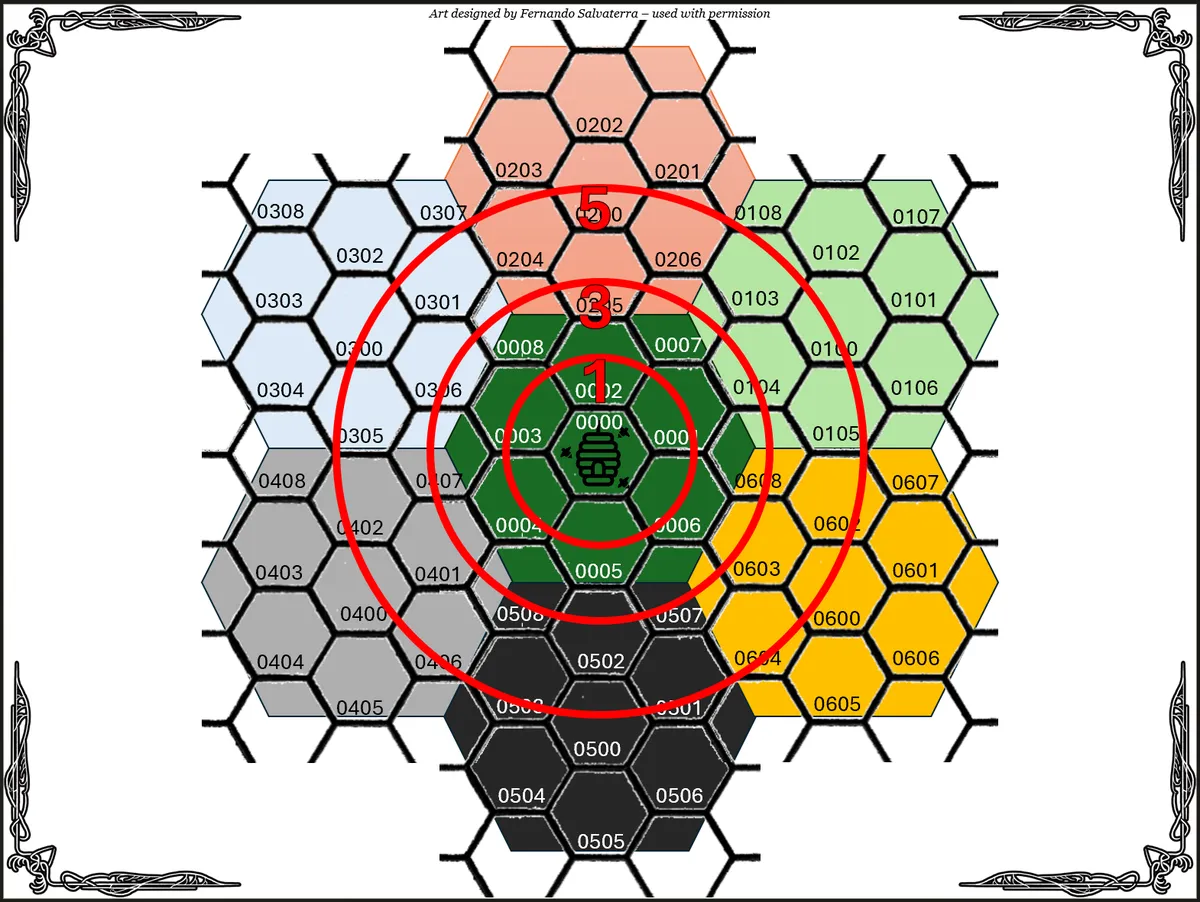
The GM moves need some design work still, but I can probably get through the next round of playtesting by using GM points to fill in adversarial clocks.
Iterating on Hive Expansion
This pillar of the game needs a little TLC. Because it comes last in the game loop, it has the least cumulative design and critical play time. The basic idea of "feed the current population and plan the development of the hive" feels both consonant and correct, but I want it to feel a little bit more engaging. It has been fun, as a GM, to sit back and hear my players discussing how they want to develop the hive. The lowest-hanging fruit here is that it should be carried out as a diegetic conversation between the player bees and the Queen Bee, rather than out-of-character. That was a miss on my part!
My blue sky design space I'd like to explore is finding ways to make relative placement of cells impactful. An idea I pitched to myself in A Miserable Pile of Secrets was that the cells themselves should have characteristics based on when they were built, who built them, and what they are next to, but that feels like a bit of an overwhelming combinatorics problem.
Other Tasks
I want to do some creative writing on the guided meditations on getting into character as a bee so that someone else could feel confident running this game. Similarly, I need to start putting together an appendix of reading material for other aspiring brood mothers. I also need to pick a damn title! If you're still reading, thanks for sticking with this design journal and get in touch with me if you're bee-curious!