Bee-Sized Anchors of Wilderness Play
In a hypomanic continuation of my Honeybee game thought experiment, I'd like to synthesize two texts: one foundational and one that hit me like a bolt from the blue this week.
Foundational
His Majesty the Worm is a game designed to be about delving in dungeons. Rise Up Comus understood and thoroughly documented that, for that to be an engaging pursuit for the length of a tabletop campaign, you need to have both rock-solid play and rock-solid tools for prep. It's not a coincidence that his hefty rules tome has chapters and appendices on prepping and running engaging dungeons, which have since been further appended with a web-based dungeon design course.
I think the key insight that he found, however, is a simple heuristic.
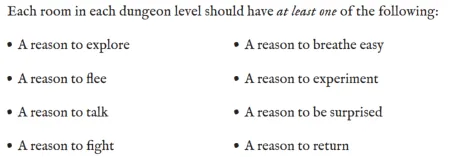
His Majesty the Worm, Page 335
You can get pretty damn far writing a megadungeon if you have this advice and KTrey's Dungeon Stocking Expanded table!
I haven't seen this so cleanly distilled for wilderness travel, and if we want that to be the core of our game we need to find a preppable essence. To be clear, I dig Pris's Hexcrawl Checklist so much that I own it in print. It has still been hard to turn the "Keying Hexes" chapter into advice that is as directly preppable as Josh's 8 reasons above. Just earlier this week, however, Lars at Dice Goblin wrote up a framework that really shook some cobwebs loose!
A Bolt from the Blue
Lars has the insight that your hexes need anchors. He starts from the minimum viable hexcrawl, a central hex with hexes adjoined at each face. Each hex is assigned a biome, and then our prepper:
- Defines each hex with a list of key descriptors (I imagine using something like Chris McDowall's spark tables if I need to jog some ideas)
- Uses these descriptors in conjunction with a list of Anchors
Anchors here serve a similar function to Josh's 8 reasons. When players explore an area, they should be able to learn something about:
- Local Civilization
- A Dungeon
- Mysticism
- A Landmark
- Danger
- Economy
- The "Heart of the Land"
I love this. Pris's checklist gets very close to this; he identifies that each hex should probably have a landmark of some sort, and I'll bet KTrey has a d1000 table of wilderness landmarks, but these anchors feel like they help to provide them same sort of wonder and bite-sized setting building that can be conveyed with the discrete containers that are dungeon rooms.
So let's put it together!
Synthesis
I really like the initial look and pattern of Lars's subdivided 7 Hex Codex - it feels like a good scale and approach for a bee-sized universe. I think his anchors are a perfect fit for lots of fantasy gaming, but as a starting point I want to go for a grounded setting for our game. After some time in deep contemplation, I think we want the anchors for each of our biome hexes to be something like:
- Level of Cultivation. If there is a human presence in this biome, is there agriculture? Is it urbanized? Is it fully wild?
- Curiosity. Something odd or out of place.
- Predation. The more I've been reading about beekeeping, the more it seems like they are nature's pez dispenser. What type of animals are the dominant threat in this biome for our bees?
- Landmark. There's some overlap with Curiosity here, but I am specifically thinking of Landmarks as something that a bee could visually use for navigation, especially natural landmarks.
- Unique Resources. Pollen and Nectar are sort of the cornerstone resources for our gathering minigames, but what other things may be out in the wild that a beehive could use to its advantage? This would be where resin/propolis is more likely to come into play.
- Spirit of the Land. This is a little bit open-ended, but I'm picturing this as larger-scale encounters for biomes. As an example for a Forest biome, the Spirit of the Land could be an old Park Ranger who loves the bees, or the Spirit of the Land could be a superorganism mushroom network. Encounters with the Spirit of the Land should fill the sort of "mysticism" role for the bees.
- Heart of the Land. I love this one and want to bring it to our set of anchors whole cloth. What is the platonic ideal of this particular biome, what is its quintessence?
Again, if we revisit our original goal - we want wilderness exploration to be a core component of this game. There should be encounters and interactions and challenges for our little bees that are role played in parallel with the resource management game element. I think these anchors can provide prompts to make exploring the biomes around our hive feel interesting, unique, and alive.
If I get a full cohesive writeup of the game, I think I'll have spark tables that can help generate top level descriptors of our biomes, and then I'll have some random generation tables that can help with picking fun anchors for those biomes.
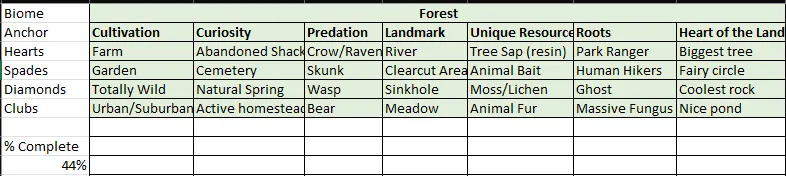
The other element that I'm saving for the next post is how this piece (Biome -> Terrain -> Anchor) then interacts with Seasons, which drive baseline resource availability and weather.
Let me know what you think! I am a total dilettante with exploration games so I'm sure this is a solved problem, but what type of tabletop blogger would I be if I didn't stake my claim in the "YOU'RE RUNNING HEXCRAWLS WRONG" game.