Surveying Game - First Playtest Report
Had a chance to host a couple of friends to try out the survey game! I wanted to compose some reflections while the experience is fresh in my mind. I've previously posted about development here and here.
In today's session, my two players were contracted to survey a 36 square mile "township" a day's travel north of a coastal mercantile city. Their patron wanted them to find a suitably large plot of arable land for a tobacco farm but was interested in any other findings from the region. They established an initial point on Hangman's Hill and started the march across a grassland populated with cassowaries, sheep, and poachers. We wrapped up after three full days of surveying, covering about 10 linear miles.
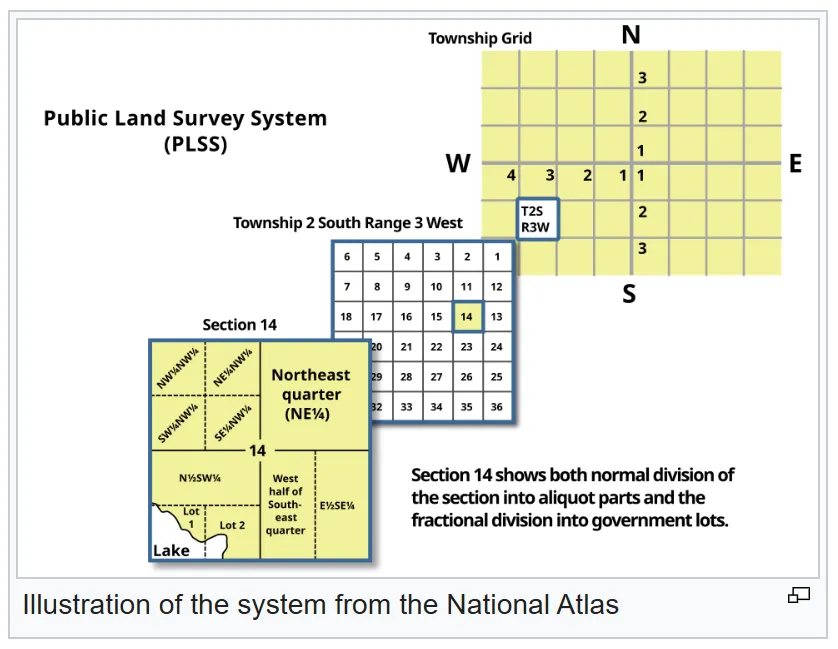 From the Wikipedia article for the Public Land Survey System
Negotiation
I wanted to get right into the action, so we didn't spend too much time negotiating the size of the party. I gave them a free chemist hireling who wanted to join the expedition in search of a special flowering squash with medicinal properties. The players decided they wanted to have their bases covered, so they also hired:
- A bodyguard who only believes in alternative medicine, but we joked that in the late 18th century he probably was the only member of the party who believes in "germ theory"
- A handyman who is also a religious evangelist
- A physician who is afraid of the dark
I adjudicated this as a hand of blackjack where each additional hireling that you want your patron to sponsor raises a target number by 2, starting at a TN of 10. My vision of this would also allow players to reduce the target number by identifying leverage and blackmail against the patron, but I did not fiddle with this in today's game. My players had an interesting idea on how to make this part of the system a little more of a negotiation by adding additional bargaining steps after each card draw, so we may have to revisit that next time.
Once we had defined our party, we skipped over the day or two of travel to get to the initial point and start the expedition.
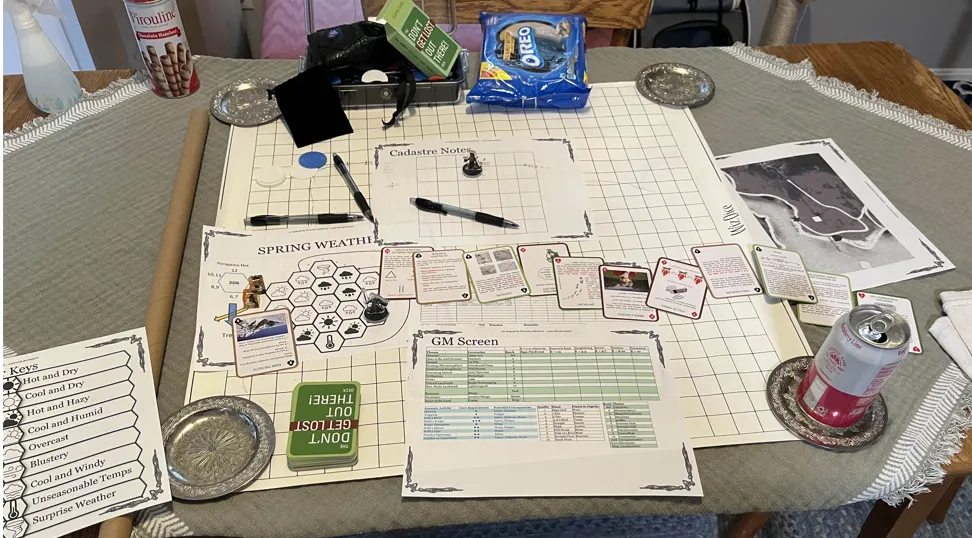 I reused my weather hex flowers from the Honeybee RPG
Surveying
The Orientation and Navigation subsystems worked really well. The players quickly understood the tradeoff between acquiring a negative resource and having a tougher day of travel encounters.
The sloppy thing here is that the players did not have an intuitive sense for how much entropy is "bad", and I hadn't developed a mental model yet. One of my players is a math teacher so we talked about setting up a few simulations in order to set up break points for when encounters go from "normal" to "heightened" to "severe" - in three days of travel, the players consistently racked up about two Entropy per night, so an escalation every 4-5 Entropy would lead to 2-3 days at each breakpoint.
The encounter generation system was a lot of fun to adjudicate. When the party had a really clean alignment score for a day (10-11), they frequently had at least two encounters or signs/spoors to contend with. The interaction between encounters led to some neat emergent play and players got to pick and choose what to interact with or experiment with each day. They only had one travel day where they failed to draw doubles during Line-of-Sight, which triggered an attrition event that made the survey chainer sick. This resulted in a shuffling of hirelings around the caravan to give the chainer a day to rest under the watchful eye of the physician.
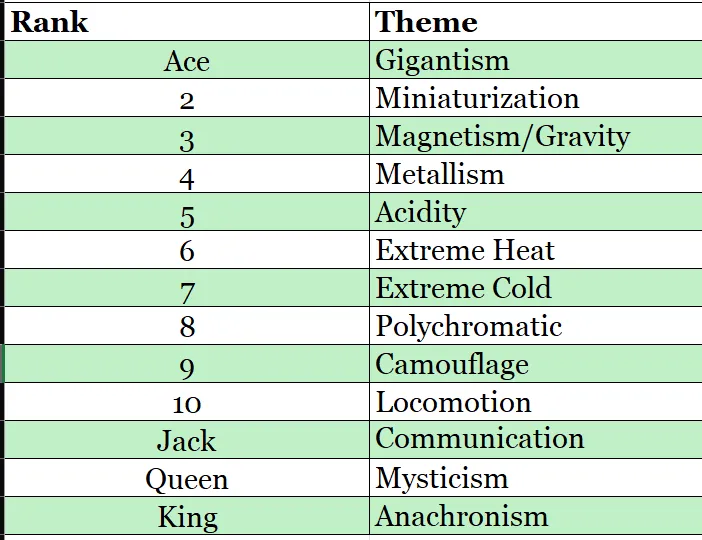 A quick spark table I composed to tag encounters with as Entropy increased
I think this core part of the system is working well, I just need to clean up the Entropy curves (or at least make a decision and test it).
Stewardship
Whew. This is gonna take some work. I decided not to worry about food but asked my players to role play as if the hirelings were mouths to feed and act accordingly. They were good sports!
I have faith in the basic premise of worker placement/troupe play for this game - the players had a lot of fun zooming in and out of first person, acting in character during Activities and managing the whole crew during the other phases of play.
The poker hand resolution had pretty poor gamefeel when working with small numbers of hirelings though. I ran into a similar problem when I worked on the poker hand combat in Hellbenders; hand size is just so critical to any level of predictability. The rule I was using for play today was that, when hirelings were sent on a job, the players were dealt:
- 3 cards by default
- +1 card per worker
- +1 card if that worker had a relevant skill
- The worker can take a condition to change the suit or rank of the card assigned to them
Before we talk about this further, what I wanted to simulate is that:
- More workers applied to a task should make success more likely
- Having the right workers on the task should make success more likely
- You can overwork a hireling for an immediate benefit and pay a consequence
I think what we ran into is that coupling number of workers to hand size AND to flexibility (hand manipulation) led to sort of a double-dipping effect. In fiction, it made sense to send a pair of workers out on a task like chatting with the poacher in the deer stand. Mechanically, two workers on a task had 5-6 cards to work with, which is abysmal odds for any hand better than a Pair. On the other hand, when we had all hands on deck to wrangle the extremophile sheep in the meteor crater, we had 10 cards to work with and five workers who could take conditions to manipulate the cards. We were swimming in high quality poker hands!
This is going to take another pass; I should have been more intentional about only calling for a check when the party was attempting something with an uncertain outcome and it may require a different approach overall. If I stick with poker hands as the resolution mechanic, I think I will stick with a static hand size, like 7 card poker (because I've got the best gut feeling for the distribution of outcomes) and then shift the focus to team composition requirements for certain types of tasks. Then, the number and types of workers on the task will either provide a bonus to the fictional positioning or different ways to manipulate the hand of cards.
This is what playtesting is for! I would not be surprised if I do a hard pivot to something like trick taking, I just worry that that will stretch out task resolution. I still want hireling actions to be something that is resolved quickly and decisively so that we can focus on the survey and role playing.
Conclusions
I'm happy with this so far. With only two players, I did a lot of heavy lifting that I think I could have delegated out to a third player. It was a little bit of an overwhelming gamerunning experience.
My vision of long-term play would put the weather tracking into the hands of a player who assumes a full-time role as the Astronomer and map notation into the hands of a full-time Surveyor. I didn't want to overload my players while I was teaching them a handful of new card games but I think that would be a reasonable allocation of duties.
It was a lot of fun to run a game where 2.5 hours of play resulted in high-res exploration of maybe a third of the area of a six mile hex. There's a lot of refinement and cleanup to be done, but I'm just satisfied to have brought something to the table. This was absolutely my vision for what my Mason and Dixon D&D game should have been, so we will see what the next pass of development and cleanup looks like.
Thank you for reading <3