Stewardship: A Hireling Subsystem
I have been deep in the development mines this month. I've made good progress on a roughly testable version of the Mad Biographers, but I've been recently seized by one of my favorite curiosities: historical wilderness/property surveys. A few years ago, I read Mason and Dixon by Thomas Pynchon and was struck by how adventurous these ambitious field surveys were. I wrote a campaign setting for what ended up amounting to a short-lived 5e game where players were members of a high-profile survey expedition into a wild unknown.
Indeed, a spirit of whimsy pervades the entire history of these Delaware Boundaries, as if in playful refusal to admit that America, in any way, may be serious. The Calvert agents keep coming up with one fanciful demand after another, either trying to delay and obstruct as long as possible the placing of the Markers, or else…giddy with what they imagine Escape, into a Geometry more permissive than Euclid, here in this new World. M&D p. 337.
As a game runner, I found that I wanted the campaign to be more about the unique challenges of executing such a survey than about a ragtag crew of superheroes. I've explored more systems and modes of play since then and have decided to take a crack at developing my own system for telling stories about 18th and 19th century surveys. I've identified and begun to flesh out four key pillars of an expedition:
- Negotiation: Meeting with the parties interested in the survey and understanding their wants and needs in order to secure salary for more schedule and a bigger crew
- Orientation: Astronomical alignment to the local meridian in order to perform more precise navigation
- Navigation: Overland travel and day-to-day surveying
- Organization: Management and quartermastering of the rest of the crew
This Organization pillar is what I want to dig into today - I may blog about the work I've done in the other pillars but those are probably less portable to other systems.
Quartermastery
From what one Surveyor can do, it will therefore appear, that in making a plan, like all other businesses, the more hands are employed in it, the sooner it may be accomplished; likewise, that the director of the Surveyors, will have full employment in making general Observations, and Connecting the different Surveys as they come in, upon one general Map; and, at any rate, that a Correct Plan must be a work of time.
Robert Erskine, 1777
The Mason-Dixon Line may be named for two men, but by June of 1764 the crew consisted of 39 people. The expedition was something of the mobile city that you might read about in works about the 30 Years War; hunters, loggers, smiths, apprentices, priests, and prostitutes helped to draw the border between Pennsylvania, Maryland, and Delaware.
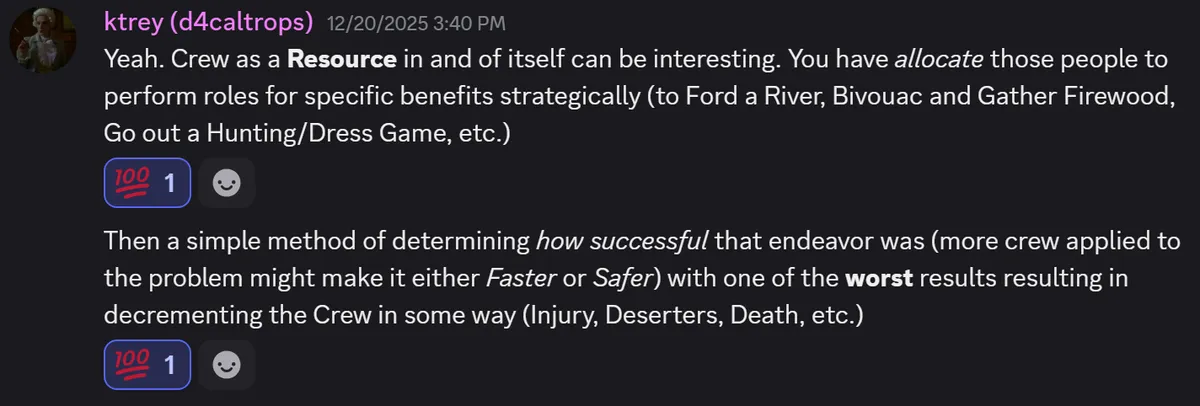
Knowing that, I think that the job of Steward or Quartermaster becomes more of a combination of Euro-style worker placement and non-war wargame. The insight that spurred this system development was Ktrey of d4 Caltrops saying:
To gamify this insight, I needed to boil down a member of the crew to something atomic. They don't need HP, they don't even need stats. That night, I had some terrible insomnia and came to a first draft of what I think they do need.
What Makes a Hireling
Hirelings have four key properties:
- A Function, which is based on a card suit. During the negotiation phase, players need to figure out how big of a crew they want to take on the expedition and what functional composition they want to assemble
 It's fo fun to fee how things were written in the feventeen hundreds
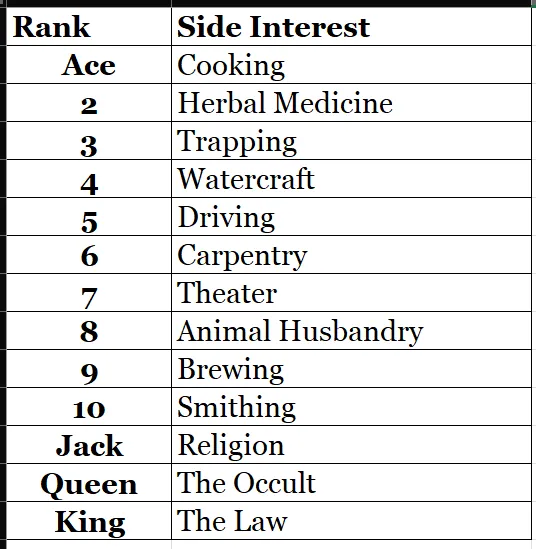
- A Side Interest or hobby, which is based on a card rank. Side interests represent specific skills or interests that hirelings have outside of their primary Function, because even Pikmin should be defined by more than just their job.
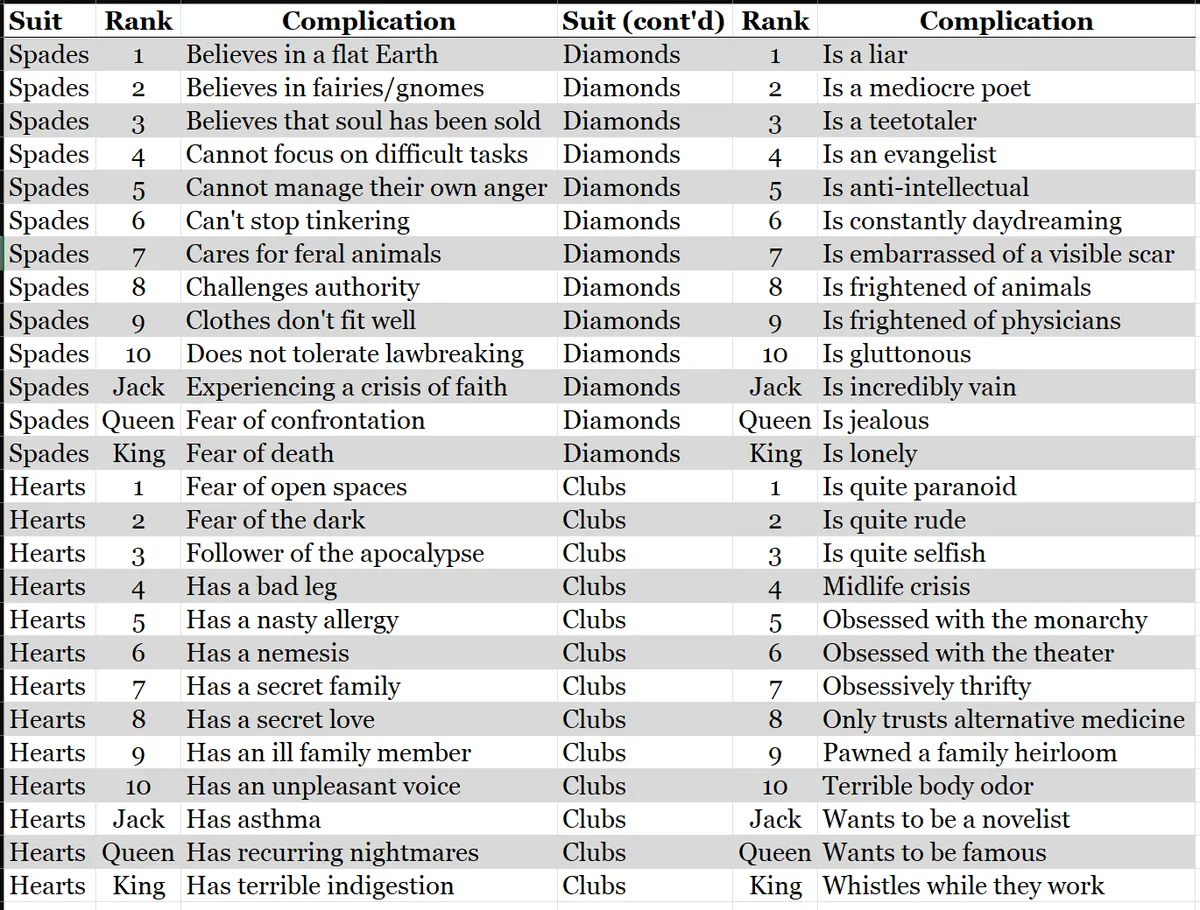
- A Complication, which is based on a unique card. Complications can be asserted by the GM to escalate the tension of a scene in case things are going too smoothly.
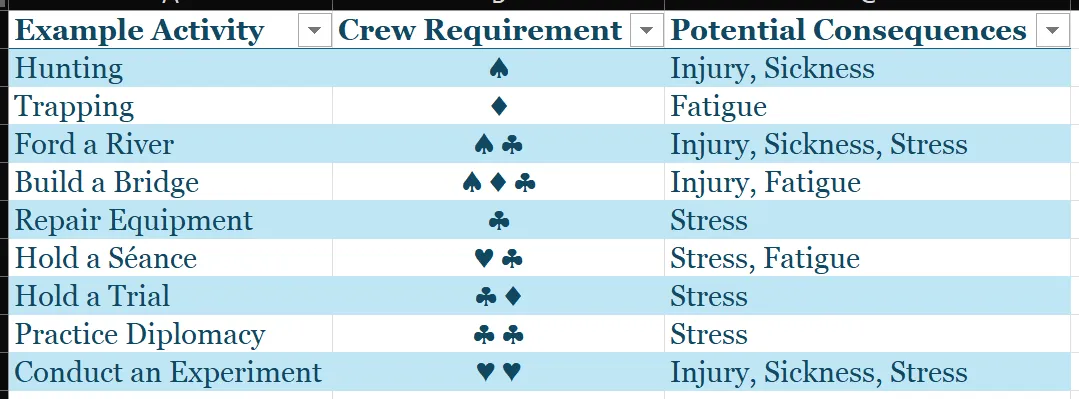
- A Condition. Overextending your hirelings risks afflicting them with a Condition. Different activities that you send the crew out on come with expected risks. Asking them to ford a river risks them being Fatigued. Asking them to Prosecute a Trial risks them being Stressed. Asking them to hunt a large animal risks them being Injured. Once your hireling has taken on a Condition, they need a reasonable amount of time and care to recover to Healthy.
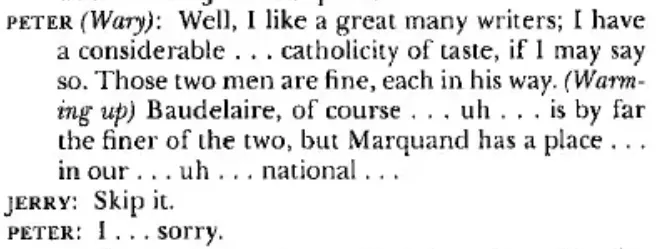 Edward Albee's Zoo Story. Your hirelings should have a catholicity of taste
What do Hirelings Do?
While the crew's Surveyor, Astronomer, and Chainers are all Navigating, the Steward/Quartermaster can send members of the crew out on other excursions in the area to investigate or deal with Encounters. Any uncertain outcomes or conditions encountered during this excursion are resolved by assembling the best possible poker hand, subject to the following procedure.
- Some activities have Crew Requirements, where they cannot be attempted without a minimum set of hirelings of a certain type of function.
Draw 3 cards from the deck
Draw 1 card for each hireling contributing to the activity
Draw 1 additional card for each contributing hireling with a relevant Side Interest
Hirelings can choose to voluntarily take an appropriate Condition to Assert their Function (change the suit of a card in the hand) or their Side Interest (change the rank of a card in the hand). This represents going the extra mile on the job.
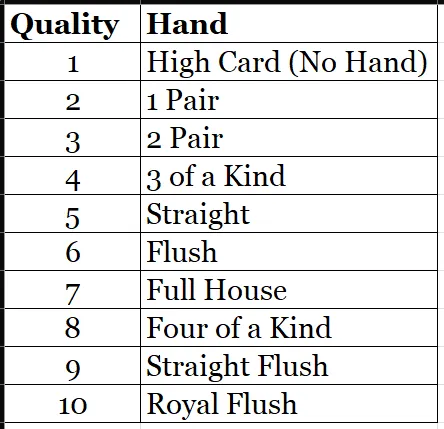
- The Quality of the best-assembled poker hand is then compared to the difficulty of the activity. My intent for my system is that difficulty is a fixed threshold based on other elements of the adventure, but well-constructed plans can help to mitigate consequences of failure.
If the crew fails with no mitigation plans in place, the contributing hirelings are afflicted with a relevant Condition. If the hirelings already had a Condition, then they enter Critical Condition and require some form of intervention or they may Desert the expedition or potentially Die.
Desertion or Death results in the removal of that hireling's Complication card from the deck until the end of the expedition. Success on an activity is recorded as a Deed for all contributing hirelings.
Commentary
I think this accomplishes our goals. Hirelings become a trackable resource that can be applied to relevant excursions outside of what the core survey team is doing. If, during the Negotiation phase of play, you find that you will need to ford rivers, then you'd better recruit some hirelings that can chop down trees and design a bridge. If you find that you'll need to deal with rowdy settlements, you'd better recruit some hirelings with some skill in diplomacy. If you find out that those diplomats also happen to be fans of herbalism, then they'll probably be able to help a stressed out crew member calm down and get back to work.
The other thing worth commenting on here is that I don't intend to make a specific combat engine for this game; if you find a monster that you need to scare off, it'll be resolved the same way as repairing a broken telescope - just with different crew requirements. I still think that this subsystem could be bolted onto a game without other hireling rules - His Majesty the Worm could potentially take this on as a way of managing guild groupies handling business on the surface!
I see potential here for further development to bring in more Balatro-esque elements that apply extra bonuses to certain types of hands during specific activities, but I'm not sure if that should be features of the crew itself or benefits applied by particularly seasoned hirelings. Maybe hirelings with lots of deeds under their belt may take on Joker abilities that upgrade the quality of their outcomes.
Let me know if this feels gameable to you!