Surveyed By the Apocalypse?
Last time we took a step back from the playtested mechanics and meditated on the first principles of this survey game project. We arrived at three major themes for future development:
- Surveying is a tool of the state by which the land is categorized, rationalized, and valued. Surveyors are the hands and feet of the state but they are essentially disposable. Borders and boundaries ontologically imply enforcement and violence.
- Some discoveries are better kept secret. Your patron sees the world through your lens. What are you telling them?
- Nature is a complex system of systems that resists rationalization.
This is a critical step in figuring out what the heck we are playing to find out. I slept on these assertions and let Vincent's blogs rattle around in my skull overnight and I realized two more things.
First, I thought about the Apocalypse World design principle of verb-based games. In my first pass of the Stewardship subsystem, I postulated a small handful of actions to which the crew could be assigned. If we reframe our thinking for this game somewhat, we could marry the Orientation and Navigation pillars of play with the rest of the Stewardship subsystem and generalize our crew actions into something more like Moves.
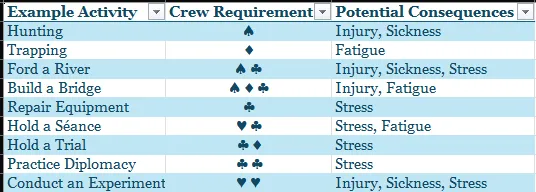
From the original playtests
Second, I remembered that back when I started work on Hellbenders, I worked out a very silly correlation between 7-card poker hand probability and a 2d6 distribution:
High Card (17%) ~~ Rolling 2, 3, or 4 (17%)
One Pair (44%) ~~ Rolling 5, 6, or 7 (42%)
Two Pair (24%) ~~ Rolling 8 or 10 (22%)
Three of a Kind, Straight, and Flush (total 12.5%) ~~ Rolling 9 (11%)
Full House (2.6%) is your highest ranking hand that occurs with any real frequency and it's about equivalent to your chance of rolling 12 (2.8%)
I even made the observation that you could practically run a PBTA game with those odds. Now, that's more of a coincidence than something to act on, but it is a funny full-circle moment.
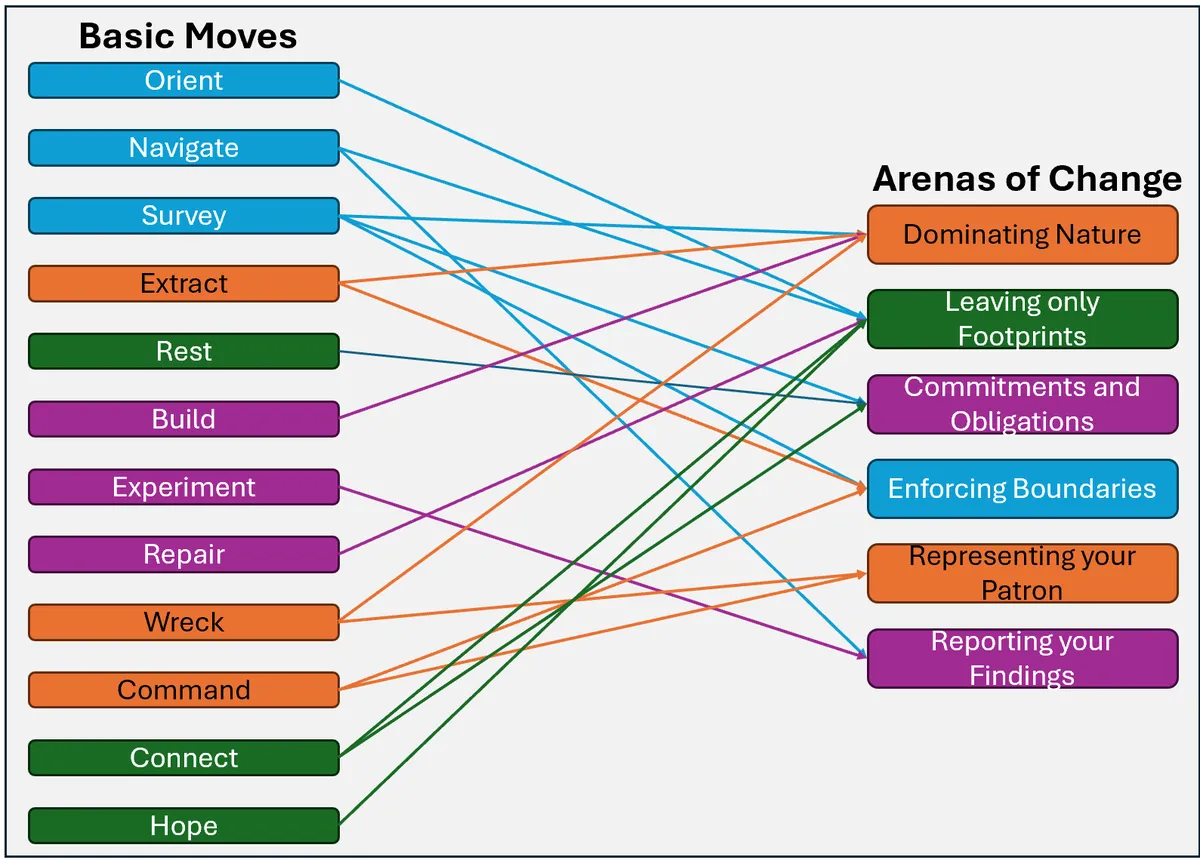
I don't just want Moves, though, I want a model of conflict, dialectic, and change like what V Baker articulates about AW and Under Hollow Hills. Then maybe we can do a fun powerpointy chart to explore that model.
 The Apocalypse World Model of Conflict
Arenas of Change
I have a small handful of arenas of change that are obviously, themselves, subject to change as I work through this exercise. Right now they are loosely coupled and connected because I like symmetry.
- Dominating or Rationalizing Nature. I believe that the act of drawing lines and borders in Nature changes it. This is sort of a hyperbolic and fun extension of the Observer Effect, but really it's a way to heighten the environmental consequences of the other arenas of change. If the survey crew is going to accomplish their task, they will have to change the place that they are surveying. In the playtested version, this was supposed to be the give and take of Entropy, but I am not married to that because I don't think it worked very well. In addition to the basic act of surveying though, the crew may find it prudent to hunt game, drain marshes, and clearcut woods to achieve their goals and this should provoke more extreme change.
- Leaving Only Footprints. I see this as the intentional and unachievable counterpart to dominating nature. This may incur other costs that change the survey crew!
- Commitments and Obligations. This is straight out of Apocalypse World, and I love it. What promises does the survey crew make to their patron? To themselves? To the people they meet in the Cadastre? What are the consequences of breaking those promises?
- Enforcing Boundaries. I like the word choice for this because I think it's equally applicable to the violence of geographic borders and to the relational process of interpersonal boundaries.
- Representing Your Patron. How does your behavior change when you act with the material and reputational support of the state? Of the wealthy? How does that change how people relate to you? How does that change when you realize that you are a tool to meet their needs?
- Reporting Your Findings. The mandate to Public Land Survey System crews in the 19th century was to take notes "to establish the position of any important object which you may see on either side of your line, that your field notes may afford a full and accurate topographical description of the country surveyed by you". What if you find something that you don't want to report to your patron? What if it's more valuable to conceal the truth?
Crew Moves
Some day I'll find a snappier term for this. For now though, I started from the "Crew Actions" that I proposed in Stewardship and, with the help of my friends Avery, Lusunati, and Blazer19 from the HMTW discord, I've distilled to a basis set of Moves. I feel strongly about worker placement as our mechanical core, but I'd also like to keep some card games in the tank.
In the playtests, we sort of assumed that the astronomer was always doing astronomy and the surveyors/chainmen were always surveying, but my vision for a more "apocalyptic" surveying game is that the players are more intentionally deciding which crew to allocate to which Moves at each phase of the day.
- Orient. In the playtest, this was a standalone subsystem. It generated entropy and interconnected with navigation, but it was otherwise just a thematic minigame that took place once per day. For the sake of this apocalyptic experiment, let's zoom out and just consider it to be a move involving stargazing and orientation. I think this could also be used for generally reading a situation.
- Navigate. In the playtest, this was our encounter generation subsystem. I loved this and even if I end up rewriting it for the sake of this game, the basic idea was really fun and I will find a way to hack it into other games. This is a move for non-surveying traversal.
- Survey. In the playtest, this was sort of assumed to be happening in the background alongside navigation. I think moving forward this should be an intentional decision, I just need to think about how to model it.
Now, for our more interesting Moves
- Extract. I think this is the general Move for things that involve harvesting resources from nature. Hunting, trapping, logging, mining, theft.
- Build. If you need to make something useful, be it a tool, a bridge, or an outpost.
- Repair. Maintaining your equipment rather than building something new.
- Rest. Rub some dirt in it, sleep it off, if I can find a clever way to enforce that each worker needs to Rest once per day then I'll be happy.
- Experiment. If you've found something odd, you can spend some time to fiddle with it and figure out what makes it tick.
- Wreck. Alter the terrain in some way. Clear cut some woods, burn some grasslands, drain a marsh, build a bridge. (I know this is the term from BITD, it is subject to an update).
- Command. Speak on behalf of your Patron. Flex that you are a state actor. Demand the respect due to your station.
- Connect. Speak on personal terms with someone. Read the situation and understand their perspective.
- Hope. This was the hardest one to name, but I'm specifically thinking of what it takes to ford a river. There's strategy, there are ways to try to maximize safety, but fundamentally you are choosing to subject yourself to the whims of nature rather than try to dominate her.
Now how does our model look in a Baker-esque diagram?
An Aside
I think part of what unlocked the PBTA blog series was the application of these principles to a blackjack based game, Murderous Ghosts. You all already know my love for card-based games, but more importantly it showed me in no uncertain terms that there is room for this set of design principles outside of the Magpie Games 2d6+mod house style that Vincent refers to as an "Accident" of Apocalypse World.
As I've worked through the Moves and the Arenas of Change, I see a lot of potential to maintain a focus on worker placement, i.e. Crew Requirement to attempt a task, and to continue to use various card-based resolution methods as appropriate for what is being done. For example, I think a betting system like the 7-card poker rounds from the second playtest still makes sense for the Extract move. The player triggering that move is wagering the health, time, and equipment of the hirelings against nature in exchange for resources! Perfect ludonarrative consonance.
This doesn't make sense for every move though, so I don't see a need to force it. Attempting to repair something shouldn't waste nature's resources and it should probably just cost the crew time if they have the right person doing it. This is where I think the framework of Moves interacting with Arenas of Change helps to drive thought - if a Move relates to Dominating or Rationalizing Nature, then it should interact with Entropy or whatever other resource drives Nature's immune response. If a Move relates to Representing your Patron, then maybe it interacts with something like Reputation, or some other diegetic way to accidentally overplay your hand. I also see a world where we keep things like Side Interests for hirelings which then become special Moves that can only be attempted when that person is assigned to a task.
I've been framing this game as a Post-OSR inspired experiment, so maybe it's fitting that it's circling around to an iteration that is heavily PBTA-inspired. To my knowledge, there is not a lot in the way of worker placement in either of those two spaces, so maybe I'm striking out into uncharted territory. Regardless I feel incredibly supported by my friends and hope that people are still interested in hearing me talk about the 18th century.
So What are we Playing to Find Out?
I think we've finally gotten there - we are playing to find out how the crew of surveyors changes and are changed by the environment that they survey. I think that feels like a gameable mission statement as we move forward. Let me know what you think!