A Reputation System for Surveyors
This post was originally titled "A Lightweight Reputation System" and it turned out to be truly anything but. Meta Image courtesy of DesertUSA.
I've been sharpening up the major gameplay systems for the next round of playtests of the 18th century survey game. In so doing, I'm working to clarify the two main social moves, Command and Connect.

The idea here is based on our first Principle/Assertion from Surveyed by the Apocalypse:
Surveying is a tool of the state by which the land is categorized, rationalized, and valued. Surveyors are the hands and feet of the state but they are essentially disposable. Borders and boundaries ontologically imply enforcement and violence.
Thus, if members of the survey crew meet someone in the cadastral plot and decide to Command that person to do something, we should have a mental model of that person's relationship to the crew's patron. This relationship should inform the likelihood and cost of compliance to that Command.
Now, I've been mildly agonizing about this all morning. This doesn't just feel like a reaction roll like we discussed with Velocitree the other week (spoilers: it is). The NPC exists in this world, for some reason they are encountered in a poorly-mapped area that the crew patron intends to rationalize. Their reaction to the players should not just be the mood they are in that day, it should be governed by whether they even recognize the patron as a voice of authority and whether they respect the ability of the survey crew to speak with that voice!
So I summoned a brain trust (thanks to Velocitree, Nael, Binary, and Conghal) to talk me off the ledge. My first idea was to place every NPC on some granular political compass with two axes. The first axis would be Respect for State Authority and the second axis would be Self-Conception as a Subject. This was just too abstract to be gameable. Nael recommended thinking about it as some interplay of NPC economic status and whether they are in a cultural in-group or out-group. We agreed that these things do factor in to how a random person may interact with the survey crew, but it did not feel like the final answer. Over the course of the conversation I realized that I had crossed some wires and needed to decouple my thoughts. Really I was trying to answer two questions:
- When players meet someone in the survey area, the GM needs to be able to quickly tell how the NPC feels about encountering state actors - this is just a reaction draw, which we will discuss in a moment
- When the PCs try to Command NPCs to do something, I want that NPC's respect for the authority of the survey to play into the likelihood and cost of that compliance beyond just position and effect - there should be a mechanical effect
The Reaction
Thankfully, we have already developed a pretty good tech for card-based reaction draws. For this, I am leaning on "Extension 1: All Four Suits are Axes". In this case, when players meet a new NPC, the GM draws two cards. The suit tells you a predominant mood/relationship to the patron and the rank tells you how strongly they identify with that mood. If the NPC represents a faction, you can reasonably assume that the average member of that faction falls on those two spectra. As an example:
| Suit | Mood | Range |
|---|---|---|
| Spades | Respect | Indifferent (Ace) to Deferential (King) |
| Hearts | Loyalty | Indifferent (Ace) to Passionate (King) |
| Clubs | Fear | Indifferent (Ace) to Terrified (King) |
| Diamonds | Distaste | Indifferent (Ace) to Hateful (King) |
This does end up putting us basically on a 2d alignment chart if you think of Fear<->Respect and Distaste<->Loyalty as lines, but it's also not impossible to imagine being loyal (or at least compliant) to a state that also disgusts you. Ahem.
The Command
When I originally pictured this move, you can see (above) that I envisioned it resolved as a hand of poker between the initiating player and the Speaking Person. The premise was that the player is trying to extract/coerce something (goods, labor, compliance, etc) from the NPC, and that the player is risking time, clout, and the risk of an ass-kicking in order to get it on the authority of the survey patron.
Time is intuitive; treat each phase of the day (8-ish hours) that you are willing to spend arguing as a poker chip in the pot. Extent of an ass-kicking is also intuitive enough; hireling health is treated as a stack of poker chips, so if you have more workers at the negotiating table you can basically bet their wellbeing in the pot and diffuse the total volume of injury sustained across the group. Clout and reputation, though, is a hard nut to crack. How do you simulate wagering your (and your patron's) credibility in exchange for coerced goods and services? I posit there are a few ways to go from here.
Blind Bets
One idea I've been fiddling with for other poker hand resolution is bringing "blinds" into the bet. In Texas Hold 'Em, the blind is a mandatory bet that certain players must make on top of the ante in order to play the hand. It changes the incentive structure for that player by encouraging them to stay in rather than fold. As an example, I want to use poker to resolve player attempts to Extract resources from Nature (logging, hunting, mining, trapping), so I am going to use a simplified weather system to set a blind bet for the initiating players. This should simulate the extra challenge and risk associated with trying to dominate Nature in nasty weather.
Similarly, if we are trying to boss an unwilling NPC around by invoking the authority of our patron, we are steering into significant relational headwinds and it will be reflected by how costly it is to Command them. If we again funge things down to poker chips, we can think of the results of the reaction draw as setting something like table stakes for demanding things of strangers, with each predominant mood ranging from 1-3 chips.
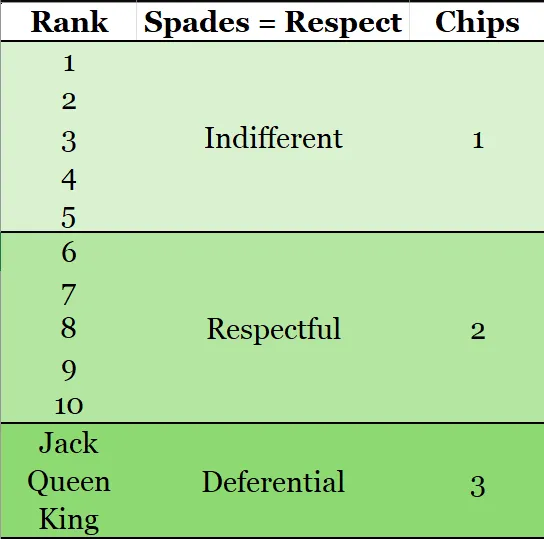
If players demand something from an NPC who has Respect or Loyalty for for the crew patron, this is favorable! They can deterministically Command the NPC to yield their time or resources to the survey at an exchange rate of 2 chips worth of positive reputation for 1 chip worth of resources (food, lumber, tools) or 8 hours of labor. This can also be deterministically resolved if the NPC is Fearful of the crew patron, but rather than reducing Fear the NPC automatically accrues Distaste at the same rate of 2:1. Don't sweat the economics of it yet :) This exchange rate does mean that swinging your patron's name around can get you what you need in the short term but will leave the people of the area resentful of you.
If the NPC has Distaste for the crew patron, then the party can only Command them at a risk, with a hand of poker. Each chip of Distaste reflects a blind bet that the party must wager in time, wellbeing, or resources. Once they are in a "Risky Command", players can also wager any positive feelings or Fear that the NPC has toward the crew patron at a normal exchange rate of 1:1. If the players win the hand of poker, they receive the labor or resources demanded and the NPC accrues 1 Distaste, but any wagered good feelings are set back to their initial values.
Players could also choose to Command at a risk if they do not want to immediately incur costs to their employer's reputation - if the NPC does not have any Distaste for the patron, then there is no blind bet. On a successful Risky Command, the NPC either accrues 1 Distaste or 1 Fear.
Aside: after the initial reaction is drawn, NPC attitudes can deteriorate past 3 Distaste or, by other means, improve past 3 Respect or Loyalty.
Does this Meet our Design Objectives?
Let's zoom out for a moment. Ludonarratively, we want there to be a cost to demanding things of strangers in the name of someone you represent. We can play this out deterministically, and it's costly. We can also play this out at risk with a hand of poker; this simulates more of a negotiation (betting rounds) and allows for a chance that the NPC will simply concede to the Command at a relatively slight cost. I think this is worth a playtest!
The Unspoken Alternative
Just kidding, we are speaking it now. There is another Move for social interaction in this game: Connect. If Command uses the authority of your patron to elide true negotiation in good faith, then the alternative is to attempt to Connect with the NPC. The NPC still has their general disposition with respect to your patron, but you can attempt to relate, discuss, and negotiate terms with an NPC. This, however, must be played out in the fiction. There is no elision, you must promise them something worth their time if you are going to ask for their assistance, and pay the consequences if you can't meet your end of the deal.
Does this all make sense? I think I just need some table time with it, and then I can write up a case study based on how it went! I feel like I have a clear mental image of how this should go.