Overloaded Reaction Draws
My friend over at A Shrike for my Dreams made a very fun post last week about the Overloaded Reaction Roll. It's an awesome post, so this is a pretty paltry contribution to the conversation but anyone who has read this blog knows that I don't write games with dice, I write games with cards. Conveniently, a standard deck of cards can masquerade as a typed d13 roll, so I don't have to do much fiddling to make this work as a hypothetical reaction draw.
The basic idea is that, if you needed to check the reaction for an encounter, then draw two cards and first check the suits.
- If both cards are Black suited, then treat the higher draw as the curiosity value (vertical axis) and the lower draw as the anxiety value (horizontal axis). Alternately, treat the anxiety value as 1-3 and just use the higher draw. Use your instincts, Dealer.
- If both cards are Red suited, then treat the higher draw as the anxiety value (horizontal axis) and the lower draw as the curiosity value (vertical axis). Same alternate ruling applies.
- If cards are opposing suits, then map the value of the draw to the suit.
- If you draw double 7s, then that's lucky baby, for some reason the encounter contains a clue for whatever the party's current goal is.
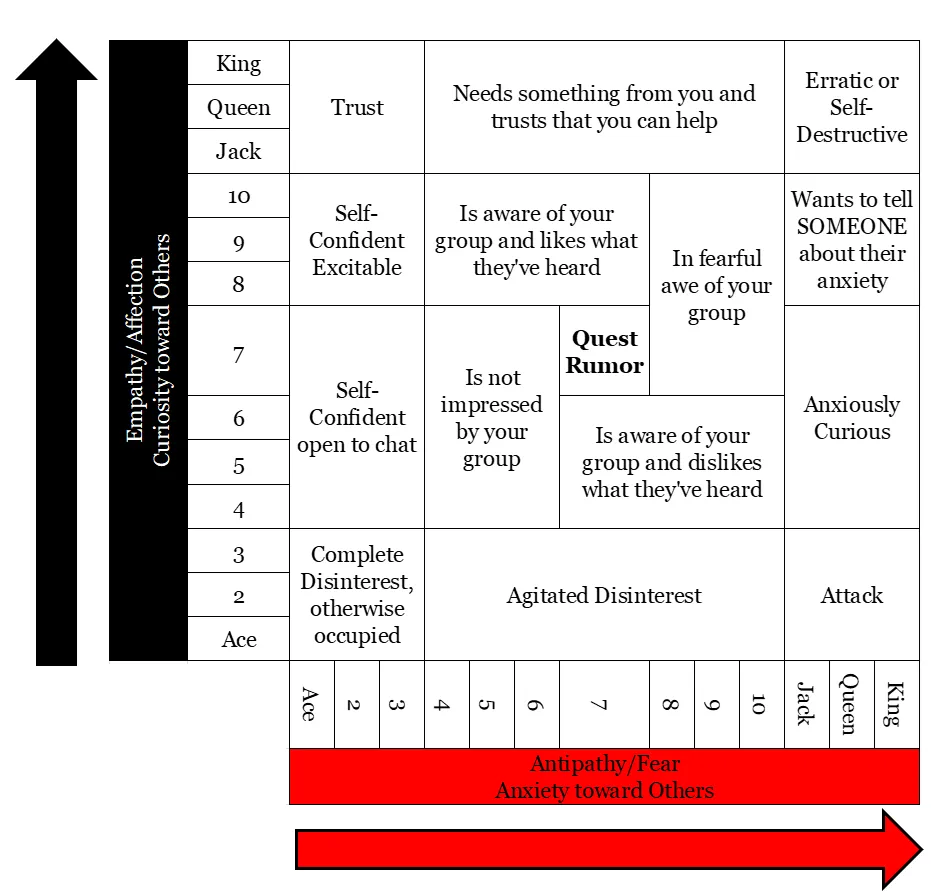
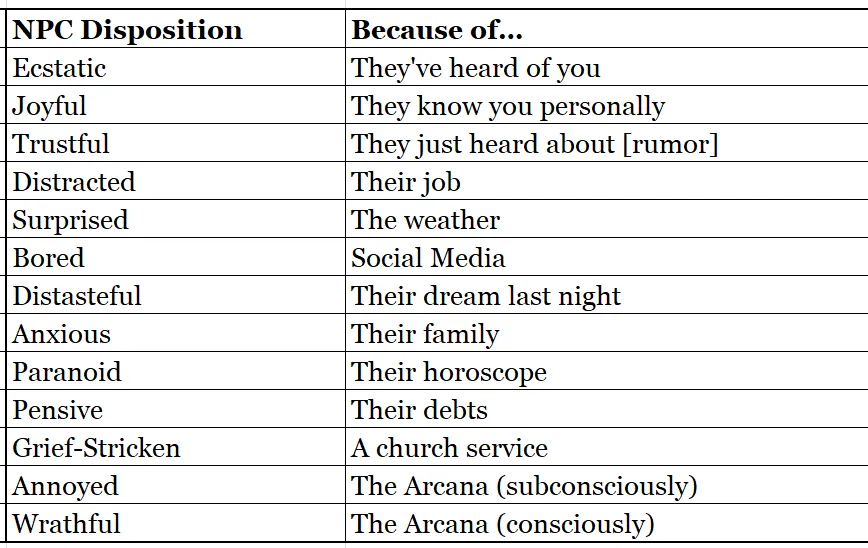
I have a semi-baked reaction draw that I designed for Hellbenders, but it is extremely non-fungible to other games without some massaging. I like that it's a slightly different prompt, where one card is the disposition and the other card is the reason, but dreamshrike's approach is nicely generalizable.
I can see two extensions to this concept that may be fruitful for further inquiry, whether or not I am the one to pursue them. Today I am too busy working on Crew Moves for Cadastre.
Extension 1: All Four Suits are Axes
In the version above, we have a 2D surface that defines the general reaction to the party. One axis is Empathy/Curiosity, the general "good vibe" axis. The other is Antipathy/Anxiety, the general "bad vibe" axis. This is a pretty complete approach, but I think it would be fun for specific suits to map to specific feelings or specific families of verbs. It's one thing for you to draw two prompts for how an encounter subject is feeling, it's a totally different thing for two prompts on what an encounter subject is doing.
Or, hell, the first draw gives you a mood and the second draw gives you an action and you treat the relative rank of each draw as the intensity with which they are feeling/doing that thing (and thus whether they are likely to notice the group or not).
Example:
| Suit | Mood | Action |
|---|---|---|
| Spades | Curious (range: Dullard to Inquisitive) | Experimenting |
| Clubs | Ornery (range: Annoyed to mid-Tantrum) | Hunting |
| Diamonds | Greedy (range: Emptyhanded to Avaricious) | Seeking Assistance |
| Hearts | Prideful (range: Anxious to Cocksure) | Eating/Resting/Repairing |
Extension 2: Stripping the Deck and Card Counting
Decks of cards have memory, and you can manipulate the order and contents of the deck to suit your needs. One thing I am thinking about for Cadastre is starting the game with no face cards and either using the face cards as the hirelings or shuffling in face cards as a deckbuilding element with some corresponding gameplay effect. Similarly, both the GM and the players can take advantage of changes to the game state to predict or manipulate reaction rolls. If you found a ludonarratively consonant reason, you could even allow certain players to keep cards in hand to manipulate the reaction draw in real time!
I want to keep this one quick, but thanks again to A Shrike for my Dreams for such an exciting post!