What Makes a Honeybee Queen?
A few fellow bloggers and I held a Work in Progress show-and-tell last weekend, and I was excited to talk through some of the development work that I had come through on Honeybees. I talked through the last two playtests and shared some observations that elicited some constructive and supportive feedback, but the topic that we spent the most time on (other than my technical difficulties) was advancement.
My mental model for advancement of the hive, and eventually hive network, centered this idea of adaptation and taking on new traits as environmental problem-solving tools. In particular, what kept my attention was the idea that adapting in certain ways made your hive less bee-like. This idea didn't really gel with my audience or my playtesters because it drew the emotional center of the game away from the core fantasy of being bees.
The audience was much more interested in the hive's Queen Bee as a character with a "temperament" and an "ambition". They recommended that I think about the tendencies of the Queen Bee as the core pathos that shapes play, which was an exciting change of pace! I noodled on this with Zak at Bommyknocker Press for an evening and came to what I think will make for an exciting next playtest draft.
Queen(s) of Royal Badness
First, let's take a look at the version of Queens that we took to the first playtests.
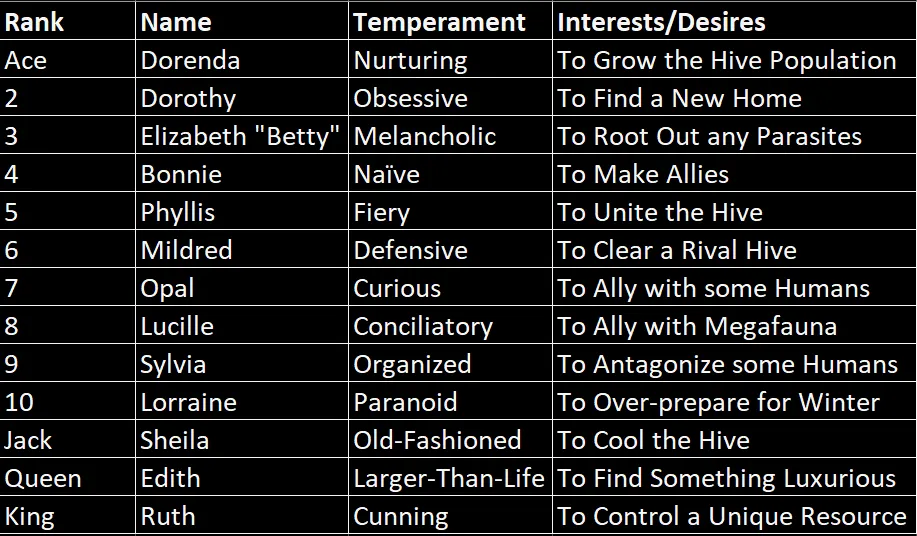
Pretty bare bones! Let's work on that.
Ambitions
My original list of Ambitions and Temperaments was a pair of d13 tables. The Temperaments were discrete personality traits and the Ambitions were semi-open-ended but limited-scope desires for the hive. I took these 13 Ambitions and took a pass at making them a little more general. For example, "Grow the Hive" becomes something more like "Growth" or "Spread" while "Root Out any Parasites" becomes "Purity" or "Cleansing". I clustered these more general themes into meta-themes, eventually settling on:
- Resource Scarcity
- Territory
- Community
- Actualization
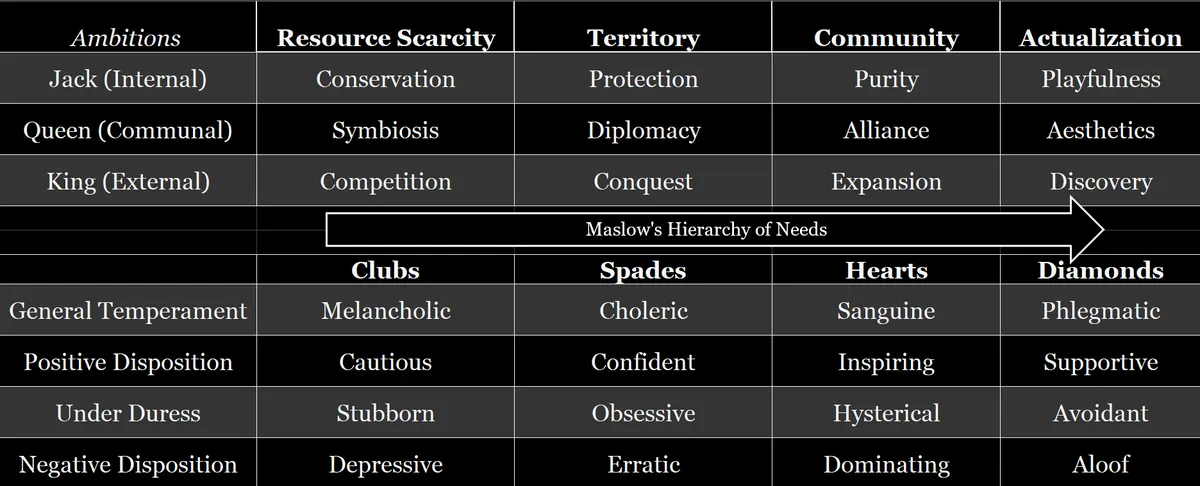
These clusters or meta-themes were a useful structure for an observation that Zak made next - each of the smaller themes presented as the core idea either projected inward or projected outward. This lens helped me to rein in the scope of the possible options, so it was obviously time for a table. This game already uses cards, so I decided to map meta-themes to card suits and the focal point of the ambition to face cards. A Jack would mean the internal-facing version of the theme, a Queen would mean a communal-facing version of the theme, and a King would mean the external-facing version of the theme.
Temperaments
I took a similar approach to the list of 13 temperaments; a 13-entry list invites a level of specificity that I thought was not appropriate for a core shaper of play. I turned to an unlikely inspiration, the work I did for my Sitcom RPG concept! I had experimented with card-suited temperaments for this Sitcom game and, specifically, the idea that temperaments really reflect how people behave in response to different stimulus. It's not just personality or mood, it's the lowest-potential-energy state for someone facing duress or bad news. My favorite lens for temperament is humour theory, so you'll see in the resulting table that the card suits correspond to a Humour, a Positive Disposition, behavior Under Duress, and a Negative Disposition.
I think this is gameable twofold. First, it means that we have 48 possible combinations of Queens, which feels like plenty of variation for our beehives. Second, it means that we have a guide for how the Queen should act when the players are meeting or failing the expectations that she sets for the activity of the hive.
Putting it Together
In the first two playtests, it was fun to know that Queen Lorraine the Naive wanted to over-prepare for winter, but that did not drive player decision making and it did not feel meaningfully different than if their hive had been run by Mildred the Nurturing who wants to Grow the Hive Population.
Shaping Role Play
You probably saw the arrow in my table pointing left-to-right showing Maslow's Hierarchy of Needs. While I was working through this with Zak, it occurred to me that the clusters of ambitions pretty tidily mapped to Physiological Needs (Resource Scarcity), Safety Needs (Territory), Love and Belonging (Community), and Self-Actualization. I think there is a fruitful space here for role playing the friction between the actual circumstances faced by the hive and the queen's ambitions.

From Brian D. Colwell
This was the moment where it felt like I finally had an answer to the eternal question: what are we playing to find out? I think we are playing to find out what it means for a colony organism to have a personality and what it means to be a member of that organism. What happens when a community has a mismatch between its ambitions and its material needs?
Example Ambition: Conservation
I worked through a sample case today to see what ideas might get knocked loose. I started with a general writeup on what it might mean for a Queen Bee to have an ambition rooted in Resource Scarcity and then proposed some mechanical effects for the specific ambition of Conservation. One idea I scratched at that I want to explore next is that each cluster of themes is articulated slightly differently; a Resource Scarcity Queen issues Seasonal Edicts for her hive, while an Actualization Queen might start her reign with a handful of competing clocks for players to work against. I think this is a fun design space!
One idea I nod at in the writeup here is that Queen Bees are measured by their "age". In the wild, a healthy Queen can live for 2-5 years, so for simplicity I am going with a reign of 2 years, or 8 seasons.
Resource Scarcity
Resource Scarcity is the fundamental challenge of life on Earth. There is only so much sunlight in the day, there is only so much water in the watershed, and there is only so much nitrogen in the soil. For a honeybee, this means that there is only so much nectar and pollen available in the environment and they are not the only animal on the hunt for it.
When a Queen Bee turns her ambition on Resource Scarcity, she may be seen as pragmatic and practical. She may be seen as fretting and paranoid. She may guide a hive through lean times and she may stifle the burgeoning creative and expansive energy of her sisters.
A Queen Bee articulates her Resource Scarcity ambitions through Seasonal Edicts.
INTERNAL: Conservation
Real-life inspiration: The Detritus of Brood Rearing: Reduce, Reuse, Recycle - Honey Bee Suite
General Tendency: A Conservation-oriented Queen Bee tends to run a reserved hive. The hive population tends to be low and efficient. She does not necessarily ask her sisters to find everything in the environment, but she challenges them to be smart with what they do find.
Healthy Expressions of Ambition: Stewardship, resourcefulness, frugality.
Pathological Expressions of Ambition: Hoarding, stinginess
Initial Adaptation: During the Waggle Dance phase, worker bees can be deployed internally to the hive to recycle an empty cell of one type into an empty cell of another type. This costs 10 points.
Edicts:
- Spring: Thou shalt end the season with more surplus bee bread than the age of thy queen
- Summer: The adult population of the hive shall be equal to or lesser than the age of thy queen
- Autumn: Thou shalt reinforce thine hive in preparation for the coming winter
- Winter: Thine hive shall reserve more full cells of honey than the age of thy queen
Fulfilled Adaptation: If the hive can satisfy 5 of the Queen Bee's Edicts, then the hive network becomes much more efficient with their consumption of resources. Example - 2 bee bread can feed 3 adult bees.
We Report, You Decide
This feels like a really fruitful design space for the game! I've been excited by this direction all day - I think it's a workable structure for the next playtest draft.
The other fun thing is that, while this game is about bees, this feels like a pretty tidy oracular system for something like figuring out the deal with the NPC rulers in your fantasy RPG. I tailored my themes here to be applicable to bugs, but I won't stop you from rolling a d12 and a d4 in your DIY elfgame of choice. Let me know what you think!