Object-Oriented Conversations
Last year I wrote a couple of essays wrestling with the concept of Narrative in tabletop RPGs. In the first, I waddled through the delineation of diegetic and non-diegetic objects, eventually arriving at a weak thesis:
Narrative is the synthesis of the Game State interacting with the Imagined Space in response to the actions of the Players (to include the GM) over time.
I delineated between a few broad categories of game to postulate whether players acted in the Imagined Space to initiate changes in the Game State or vice versa. I'll return to this idea shortly!
In the second, I proposed that Narrative in tabletop games is a historiographic process of fact creation, fact assembly, fact retrieval, and retrospective significance.
In the third, I looked at the relationship between "table" structure and the types of narrative conflict that are or are not enabled by those play structures.
These three meditations were useful stumbles into the theoryslop space because they inspired me to read more from established thinkers in the hobby; anyone who has followed the blog can see how much my output has changed since I sat down with the Bakers' series on Powered by the Apocalypse.
Part of why I call my above thesis "weak" is that I tried to make an assertion that felt broadly representative of TTRPGs. Embedded in that attempt is the idea that TTRPGs are an umbrella category of activity called Tabletop Role Playing Games. If you are reading a hobbyist blog about this medium then you have probably participated in an interaction online or at a game store where you realized that, despite both of you playing a game that you identify as a tabletop role playing game, or even both of you playing a game that you call D&D, your Central Lusory Project is fundamentally divergent.
How does that happen?
Vincent Baker obviously wrote about this far before the thought ever occurred to me in an essay about RPG Essentialism and RPG Exceptionalism. RPG Exceptionalism is the idea that
"deep down, rpgs are fundamentally unlike all other games, or aren’t games at all".
RPG Essentialism is the idea that:
"deep down, all rpgs are the same game. Like, “in all rpgs…,” “rpgs are designd for…,” or “in ttrpgs…” without any further qualifying...It’s the idea that different rpgs aren’t different games, they’re different approaches or tools you can use to play what is essentially the same game."
Essentialism is the thread I want to tug on today, and in particular I want to tackle a definition that I have received from some of my favorite games, my favorite designers, and my favorite thinkers.
Conversation Games
Indulge me for a moment.

His Majesty the Worm, Joshua McCrowell
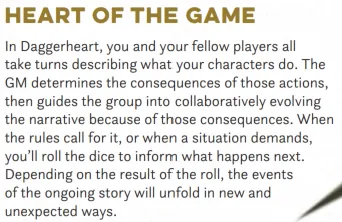
Daggerheart, Darrington Press
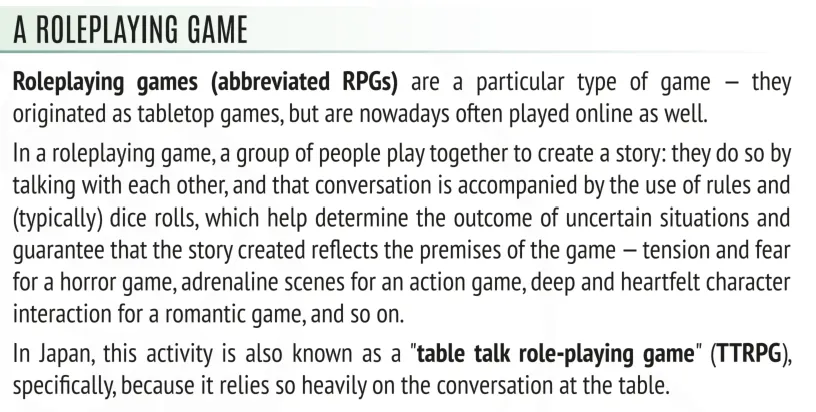
Fabula Ultima, Emanuele Galleto
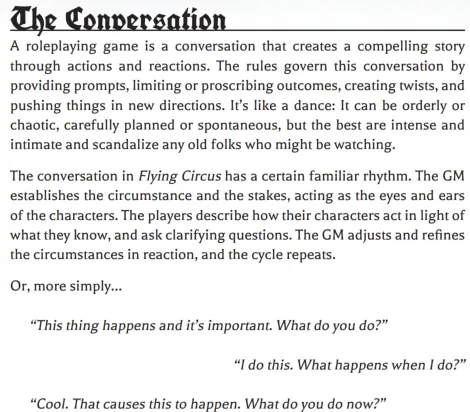
Flying Circus, Erika Chappell
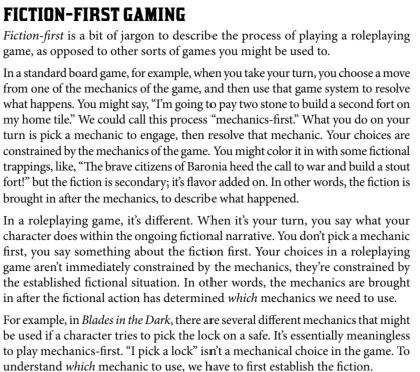
Blades in the Dark, John Harper
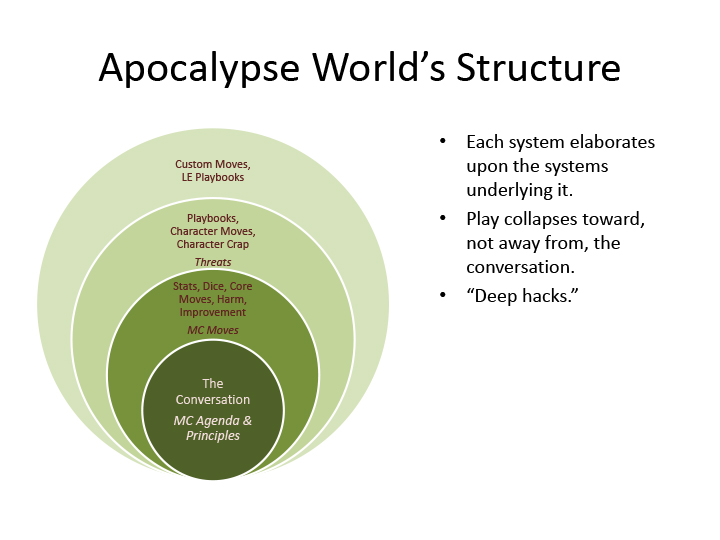
Apocalypse World via Powered by the Apocalypse Part 1, Vincent Baker
What do these games have in common? Aesthetically, almost nothing. We have a tarot card dungeon crawler, a heroic fantasy combat storytelling game, a tabletop JRPG, an interwar Dogfight Simulator, a skulking gothic heist, and a postapocalyptic hellscape. We aren't talking aesthetics, though, we are talking games which, on their own terms, are constructed on a foundation of conversation. I included the PBTA "Onion" model last because it is the clearest and most intentional articulation of this constructivist idea:
A crucial feature of Apocalypse World’s design is that these layers are designed to collapse gracefully inward:
- Forget the peripheral harm moves? That’s cool. You’re missing out, but the rules for harm have got you covered.
- Forget the rules for harm? that’s cool. You’re missing out, but the basic moves have got you covered. Just describe the splattering blood and let the moves handle the rest.
- Forget the basic moves? That’s cool. You’re missing out, but just remember that 10+ = hooray, 7-9 = mixed, and 6- = something worse happens.
- Don’t even feel like rolling the dice? Fair enough. You’re missing out, but the conversational structure still works.
To varying degrees, this is what our brief survey of games all claim. The rules contained in the rulebook are toys that shape play, but the play is mediated and articulated through a structured conversation, which is treated as the threshold for "still playing the game".
Toyetic Rules
David Prokopetz made a short thread of posts on Bluesky that I have not stopped thinking about. I've screenshotted it below just in case bearblog's image hosting outlives Bluesky's existence.
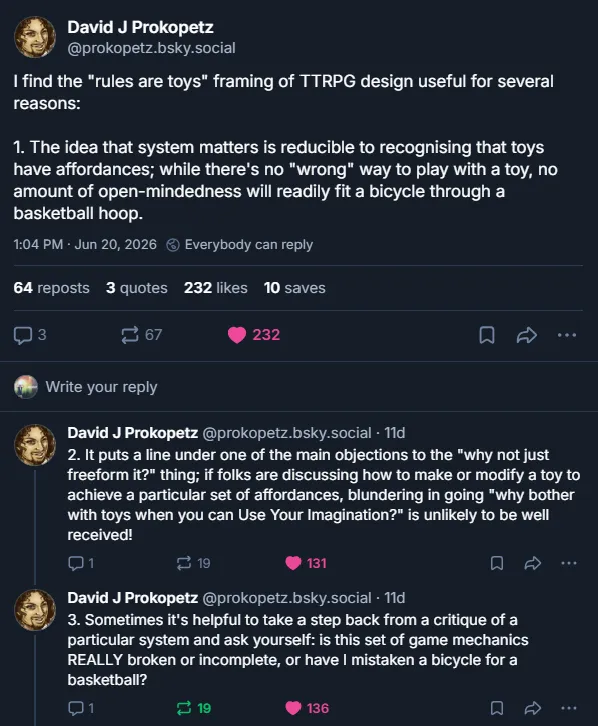
I want to especially highlight David's second post here as a companion to the recurring theme of Conversation Games. The idea of a conversation game is that a group of friends could sit down and start using their imaginations to explore a dungeon, dogfight, do awesome anime ultimate moves to each other, or be sexy frog people, but games provide scaffolding, boundaries, procedures, and permission to perform this imagination together. Conversation Games take the base layer of potentiality and help us to negotiate that imagined space.
Conversation on its own is not necessarily play, the same way Jay Dragon discusses the point at which grocery shopping becomes a game in Aldi's Razor. Conversation Games build on the non-play activity and shape it into play.
To return to my original weak thesis, Conversation Games are a game where players act in the imagined space (through conversation) to instantiate changes in a game state (through procedure), which creates narrative momentum. In this Conversation Game paradigm, players must reach some form of equifinal agreement on the state of the imagined space (the "fiction") for play to continue effectively.
Journaling Games
I have a few solo journaling games on my hard drive, and I would consider them to be an extension or otherwise a close cousin to Conversation Games. Take, for example, Asa Donald's Rust Never Sleeps:
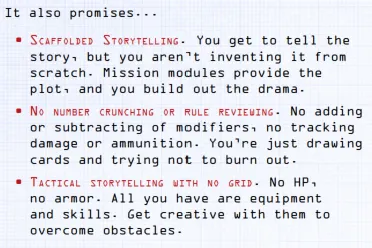
The language of "Scaffolded Storytelling" here, in my opinion, is the same permission structure as the structured conversation of our multiplayer games. Specifically, the rules of Rust Never Sleeps are used to build from the base activity of creative writing into a lusory project, into play. I would even go as far as to say that this type of solo play is, at its core, a conversation between the reader-player and the game-book-object.
Conversation Essentialism
As you can hopefully see from the survey of games I pulled from, there are a lot of games in many genres that are fundamentally conversation-shaped. These games are popular! I specifically didn't cite the Seattle game because I want to return to it, but the shape of play described in many of these games is probably very familiar to anyone who primarily plays it.
When I have seen people talk sweepingly about all TTRPGs, I find they are often operating from this "lead with the conversation" assumption that then is extended to all facets of the hobby, which then puts us in the territory of the semantic drift that has emerged from Fiction First. After all, these games make a normative claim that "A roleplaying game is a conversation", sometimes verbatim!
If that is the case, then we have (unintentionally or otherwise) arrived at a fundamentally essentialist argument. Even if we agree that system matters, we are saying that TTRPGs are different ways to shape the base activity of conversation.
This is an unhealthy argument for the medium!
Against Conversation Essentialism
I'm willing to bet that you, the reader, can think of games that they would consider part of the activity of roleplaying on a tabletop and that don't fit neatly into this paradigm. Conversation is probably an important component to the central lusory project, but it is hard to argue that it is the foundation of play.
The most popular strain of roleplaying game that I would argue does not build on conversation-as-foundation is what you may call the "4e-like", exemplified by Tom Bloom's ICON, Miguel Lopez and Tom Parkinson Morgan's Lancer, and MCDM's Draw Steel.
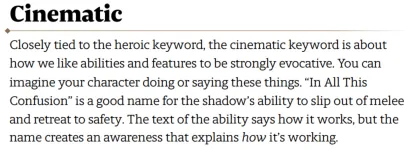
Draw Steel, MCDM
ICON, Tom "Abaddon" Bloom
Lancer, Miguel Lopez and Tom Parkinson Morgan
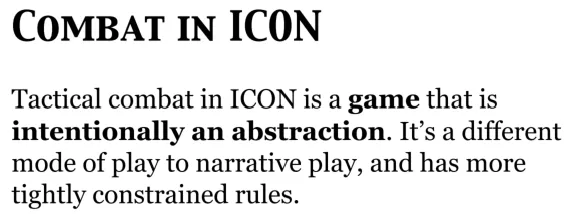
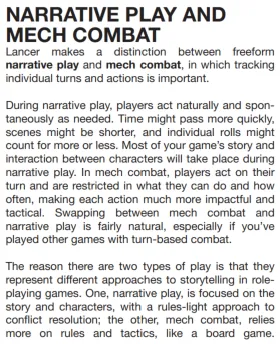
What is different here from our Conversation Games? Lancer and ICON both explicitly nod to freeform conversational narrative play, but they are not bashful about the mechanical focus of their game: a tactical combat system in which players are encouraged to make mechanical decisions to yield mechanical outcomes which only then may be interpreted as results in the imagined space. Similarly, Draw Steel's Cinematic pillar of design is one in which players make mechanical decisions which are intended to evoke a cascade of imagery which is consonant with the mechanical outcome.
There simply is not an effective mode of play in these games wherein players narrate action in order to trigger a procedure; unless your game manager has memorized the player options, the player must intentionally invoke abilities to precede fictional consequences.
This is no less a role playing game! As Magnolia Keep deems Combat as Characterization, the players are still acting in their role as a character who is executing the depiction of these mechanical decisions, but it's a different dog wagging a different tail than a Conversation Game. To return to the dry well of my weak thesis, players are initiating a change in game state which has consequences in the imagined space and results in narrative momentum.
So what is this if it is not a Conversation Game? For my money, these are Object Games. The central lusory project is not constructed on top of the conversation, it is constructed on top of non-diegetic game objects like a tactical grid, a character sheet, or a GM's preparation document.
Solo Object Play
Just because I think it's nice that it rhymes with Solo Conversation Games, Solo Object Games certainly exist. In fact, Asa Donald of Rust Never Sleeps has also put out probably the quintessential solo Object Game in Spine. Rather than play building upon the activity of creative writing via conversation between player-reader and game-object-book, play in Spine builds on the very act of reading and modifying the physical game-object-book.
Synthesis
I don't actually think that Conversation Games and Object Games are thesis and antithesis, but there is still synthesis to be found and I think it is in levels of abstraction. Here I'll turn to a few examples.
The Faction Game
Mausritter and Blades in the Dark both have robust faction mechanics with deep fictional implications, but they can be played essentially as Object Games at the level of GM prep. I want to be clear here that a game being an Object Game rather than a Conversation Game has no direct relationship to "fiction first" or "fiction last"; the faction game of Blades or Mausritter can be completely led by player decisions in the Conversation of play-at-the-table, but faction management can also be done independently in a fully toyetic or Object-driven procedural play between sessions.
Dungeon Stocking
Game prep is absolutely play! And I think it can just as easily be solo Conversation Play in the way that a journaling game is a conversation with a game book as it can be purely procedural Object Play. I certainly treat it as both!
Mythic Bastionland
Mythic Bastionland is probably my favorite lens for contrasting Object Games and Conversation Games. Chris McDowall's games and their cousins are often the first games cited as easy-to-learn, right-sized rulesets that can be adjudicated with no more than the basic Action Procedure or Information, Choice, Impact doctrine. And the moment-to-moment play of Mythic Bastionland is...mostly like that! But there's a reason that some people bounce off of it, saying that it's just a board game pretending to be an RPG. The interaction between Myths and navigation of the Realm is an almost pure Object Game which then seamlessly transitions into Conversation Game within a single hex.
The only way for players to advance Myths is to interact with the Game State - either triggering omens by moving between hexes or intentionally finding the home hex of the Myth. Once you are in that moment, experiencing that Omen, it is Conversational Play, but you can't seek that moment without playing with the Game Object.
The Seattle Game
I don't have anything interesting to say about fifth edition; I've played it as both a Conversation Game and an Object Game because fundamentally this is not intended to be a taxonomy. My goal with the last few examples was to highlight that, like Lancer and ICON, the actual system in motion for lots of games often shuffles between these modes. Conversation Play and Object Play support each other! If I were going to be RPG Exceptionalist, it would be the fact that roleplaying games can be both modes of play and that rocks. I do hope that there is some insight here that helps people talk about this hobby that we love, that we love to talk about, and that we love to hate taxonomizing. Let me know what you think!