Megadungeon Restocking
Meta image for this post courtesy of DUNGEON WEED at bandcamp
Over on the His Majesty the Worm Discord, one of the perennial pairs of questions is:
- How the hell do I restock effectively without wanting to die?
- What's your process for keeping track of these things?
I've offered my process in short form a few times but, with the benefit of hindsight from my 2025 HMTW campaign, I wanted to draft something a little clearer and more permanent. Before I get into the specific advice, I want to frame the advice with the philosophy I used for my game prep, then I'll answer question 2, then I'll button up with question 1.
Megadungeon Philosophy
"What is a Megadungeon" is an annoying question that is still very fun to engage with. It's obviously not one million dungeons. I do like the term "Kilodungeon" as a more reasonable middle ground between the 5 Room Dungeon and, like, Stonehell, but I don't think you need 1000 rooms for a dungeon either. The functional definition that I use is that a Megadungeon is a large and varied enough space to support an entire campaign's worth of gameplay. The megadungeon I used for my HMTW campaign is mapped out below, with the approximate number of rooms per level included in the title blocks. That's how much material I had prepped for a good year of play (27 sessions by my count).
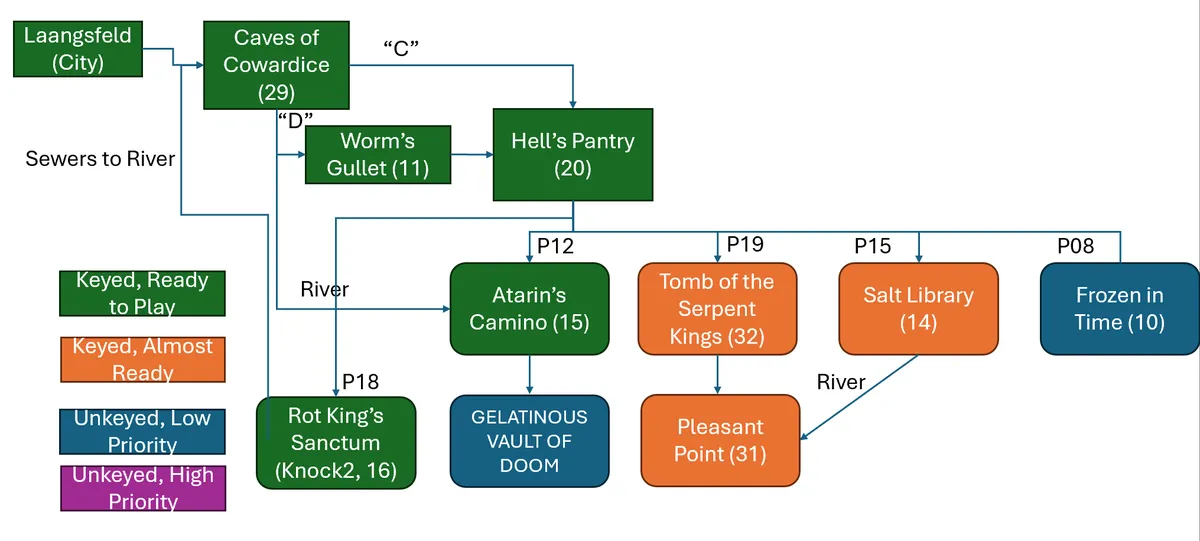 My Megadungeon is a collage of modules, DCC adventures, homemade dungeons, and unfulfilled promises. One day I will write the Gelatinous Vault of Doom
Megadungeons are also the most fun (in my opinion) when they have some level of "Mythic Underworld" to them - a magical realism even by the standards of the fantasy setting's logic. The megadungeon should have some level of intelligence and character to it! Mutability! This is why it changes in response to the actions of the players! I like to think of this as the dungeon's "immune system"; monsters, traps, and treasure alike are all different forms of white blood cells and t-cells reacting to the players as pathogens.
The final philosophical point behind this approach to restocking is that time in the dungeon is abstract relative to time on the surface. In His Majesty the Worm, players go through a structured downtime phase that is something like a week or a month of working on personal projects and licking your wounds. That amount of time does not elapse 1:1 in the megadungeon, so you can get funky with your restocking.
What's your Process for Keeping Track of these Things?
I am not a super thorough notetaker during the session - running the game takes too much of my available cognitive capacity to also record notes. I have a pretty good memory, so at the end of a session I make it a practice to record the best notes I can of events that have happened. My only exception is that I stop the game any time a new named NPC is introduced so that I can record their name, where they were met, which session they were met, and 1-2 notes about them.
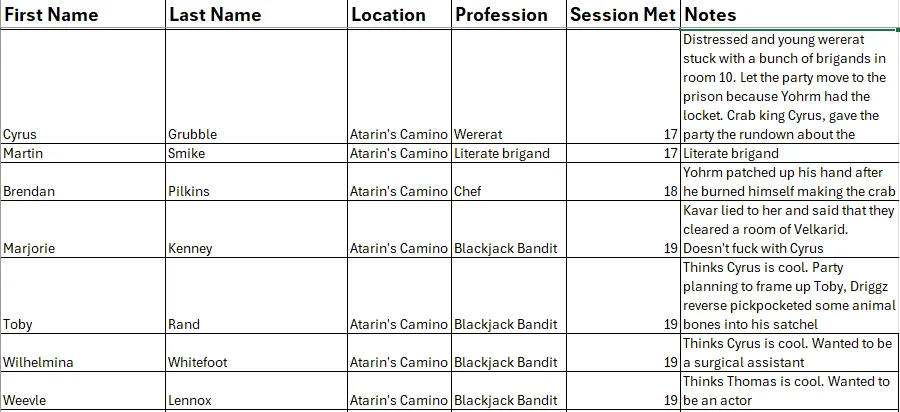
The thing I am actively tracking while players delve is the route they are taking through the dungeon and what parts of the room keys they are interacting with. I need to know what the players have seen because that informs what is interesting when it changes. It's important for my preparation to know whether players have fully ransacked a room or if they failed to discover a trap or a secret. At its simplest, this is keeping a list of the order in which rooms are visited and highlighting parts of the prep that are exhausted.
 A key I updated after a session where my thief player baited some giant crabs into a brigand hideout
I also use this process to clear out the Meatgrinder, HMTW's random encounter table. When an event is triggered, I strike it through so I know what has been encountered already. My room keys and my Meatgrinder tables both live in a campaign prep document, my NPC database is in a spreadsheet that can randomly generate names for me based on a database I have created of:
- Named Charles Dickens characters
- Named Thomas Pynchon characters
- The American Horseshoe hall of fame
- Funny names I have encountered in the wild
How the Hell do I Restock Effectively Without Wanting to Die?
First: Reframe your thinking. Not a joke! The point of our prep is for it to be used, right? Your players got through enough of your prep and want to come back for more than you need to restock! That kicks ass, congratulations.
Second: During the crawl, you hopefully highlighted a few key things. You recorded people that they met in the dungeon and have some notes on their deal. Do they live in the dungeon, or do they live in the City? Would you expect them to still be in the dungeon after some time has passed? Maybe they should be on the random encounter table if previously they were a static part of the room key. You also recorded the rooms that the players explored. Did they miss anything? Did their incursion embolden any other adventurers to dig deeper or die trying?
The questions that I'm asking here are really, how have the players affected the state and the nature of the space. Having considered that,
Third: Think about your mental model for the logic of the dungeon. What could reasonably change over the course of a week or a month of the dungeon immune system reacting to the delve. What larger events have been set in motion by the players, what precarious balances of power have been thrown off?
As an example, my players disrupted a fragile ecosystem of little froglike gremlins called Velkarid hunting adventurers by sabotaging a key bridge over a river. The party convinced the Velkarid that Baelgrim, a daemon, knows that they are the ones sabotaging the bridge, so they have had to find other ways to catch their food. The result is that there are a lot more lazy and conspicuous traps around the dungeon from these desperate critters.
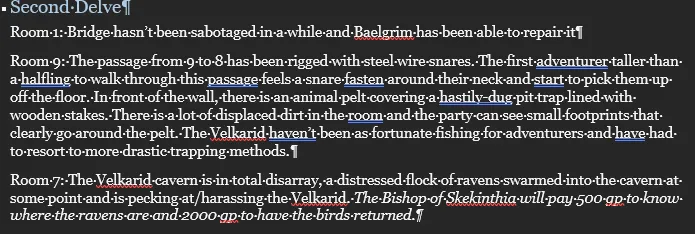
The following delve, I wanted to put a little pep in my players' step, so I decided to take a loose end that they never followed up on and bring it back. They had caused some problems for a rival gang of adventurers on their first delve, so by the third delve I had those gangsters roam back up to the surface to kidnap an ally of the party. I had to think about how the gang could get back to the dungeon entrance and what knock-on-effects that would entail. It ended up that they summoned a hellish squid, surfed it up an underground river, and unleashed it on the dungeon while they imprisoned the ally back on the fourth level down.
Small disruptions, like a faction needing to change tactics to survive, make sense for a single Downtime phase. Once multiple Downtime phases have elapsed though, it's fun to add some wild elements that really show the megadungeon changing in front of the players' eyes. This also keeps the megadungeon dynamic as an adventuring location rather than stagnating. As we always say, players will optimize the fun out of anything - if you find that your players are just hovering around familiar spaces, make those familiar spaces a nightmare haunted by squids from hell. That's the TBR promise.
Finally: This is the methodical piece once you've done your conceptual work. Step through the explored rooms one-by-one and make gut checks about physically updating your keys. Think about how unexplored adjacent rooms might bleed into the ransacked rooms. Then zoom out and think about how unexplored floors may start to bleed into the areas that the players have seen.
I tend not to do too much to keys that the players haven't seen yet unless facts uncovered in play have highlighted that there is new, true lore that should be reflected elsewhere in the dungeon.

If I am really stumped on how to update a key, then I refer to d4Caltrops' Dungeon Stocking Expanded. I roll on this and it prompts me to figure out what is new in the space.
I also work through this same methodical step to update the random encounter table. Some "Travel Events" just reflect the hostile ecology of the space and don't need to be replaced, but named NPCs make great new encounters.
Conclusion
Dungeon restocking is fun. It should feel fun, even when it's a little overwhelming! Like I said earlier, I think of it as a privilege that my players want to see more of the space that I've prepped for them. I hope this is a useful writeup to spur some thoughts and that any enterprising megadungeon GMs feel inspired to revisit their material.