Goodbye Hexes, I'm Flying Over You
Another design journal, another sequel. About a week ago I was 7 or 8 days into working on the Community family of Queen Bee Ambitions. I'd been reading about Drone Congregation Areas, an incredibly weird phenomenon, and thinking about their implications on the game map and structure. I let the idea percolate long enough that I told my friends David and Zak that it was time to move away from the 7 Hex Flower that I'd playtested and maybe move toward a more traditional hexcrawl map. Maybe something more like the size and shape of a Mythic Bastionland realm.
I'm probably going to eventually retool how maps work and move from the 7 Hex Flower to a more traditional hex map (but still use something like the bee-sized pillars of exploration for keying different biomes). This should allow for more empty hexes and let encounters drive interactions during exploration
5/7/26
Once I had broken that dam though, I wasn't satisfied and I decided to really revisit some core assumptions about the exploration pillar of the game. Something that gets discussed frequently in tabletop spaces is how map play is fairly divorced from the average person's first person perspective on their lives. Hexcrawl play that leans heavily on a player-facing map can be described as board gamey and it encourages a "Distant" Playstyle as Patchwork Paladin describes her experiences with Mythic Bastionland. There were a lot of reasons that the first playtests of Honeybees looked like a board game, but I don't think the hex hopping was a small contributor to it.
The ironic thing is that, if you are playing a flying insect, you do literally have more of a bird's eye view of your environment than if you are a rugged adventurer at ground level. But still! My third, fourth, and fifth eyes were opened and I wanted to start from first principles to think about how real bees make decisions about where and when to travel to see if there was anything gameable to be gleaned. It turns out: bugs are weird and experience the world in a different way than people do!
The Basics
So when I started writing the Waggle Dance part of the game last year, I saw that most of the information was communicated as a combination of Distance and Orientation Relative to the Sun, yknow, a vector. It didn't click for me until this past week that this means that the bees must be sensing the position of the sun all the time. I looked into it, and this paper makes a pretty compelling case that honeybees are basically always navigating relative to a pattern of polarization in the sky as clearly shown in Figure 2.
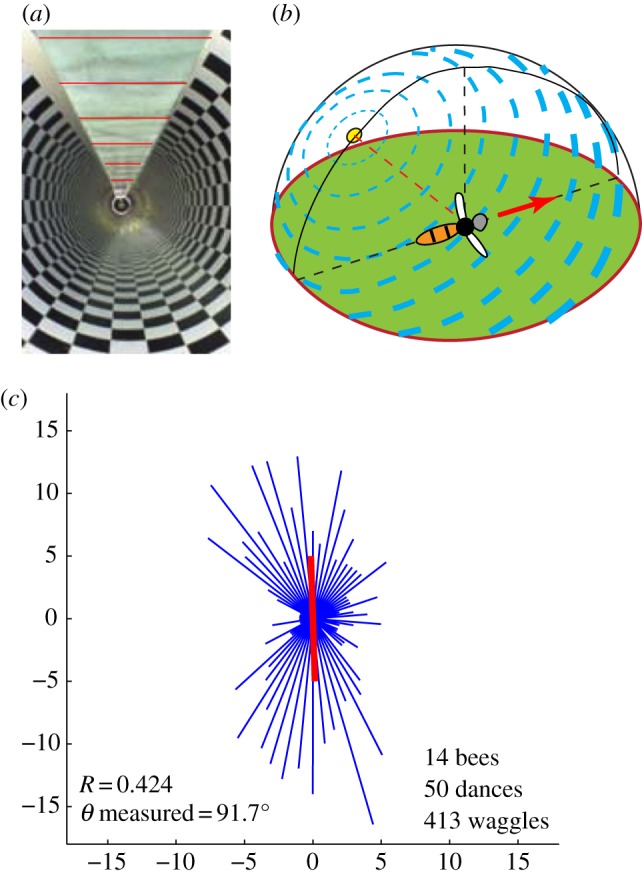
Figure 2
Is this gameable? I think so. In our first playtest, I tracked the elapsed hours in the day but it didn't really interact with the players other than as a timer. My brainwave this past week, however, was that the elapsed hours in the day is a good proxy for the current position of the sun. So what if our hour-by-hour navigation mechanism is constrained by the current position of the sun? How would we represent that? My current experiment is the Sundial.
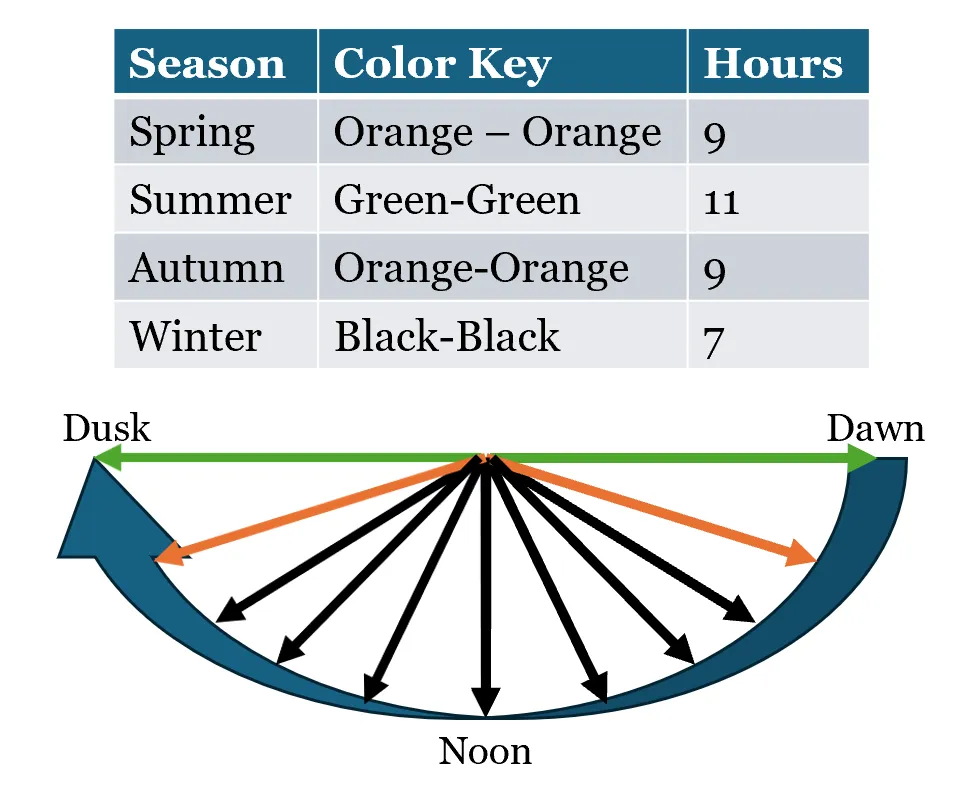
My intent is that this is a compact way of identifying the relative length of days in the Season and showing the current orientation of the sun. The idea, then, is that at each "hour" timestep, players can move toward the sun, away from the sun, or transverse (at a 90 degree angle) to the sun, where "the sun" is the current hour's arrow on the dial.
This idea is what convinced me to kick hexes for this round of testing. The granularity of the Sundial is incompatible with the faces of a hexagon! And after all, what is the function of the hex in tabletop gaming? As Dwiz puts it, hexes are either containers or rulers. I realized that I don't need either of those functions if my game subjects can already fly and I want to move to a different model of spatial containment. I decided to move further back into the history of the tabletop hobby and work with absolute distances like a wargame.
Give Them an Inch, They'll Take a Mile
The sort of common wisdom with honeybees is that they mostly prefer to forage within 1-2 miles of their hive but may range up to 5 miles. That means that we can create a local area for our players by drawing a circle and calling it a radius of 5 miles; I'm in the USA so on a piece of letter paper maybe that's a diameter of about 7.5" to 10 miles. This is a local area of about 78 square miles or 200 square km! How much biome variety can we pack into this area? I fell back on my favorite sim-to for tabletop games and traced out my 10 mile circle onto the Dolly Sods Wilderness Area in Tucker County, West Virginia. This enclosed some swamp, some mountains, some valleys, a few small towns, and some forest. Hell, that's about as much variety as I playtested with my 7 hex flower!
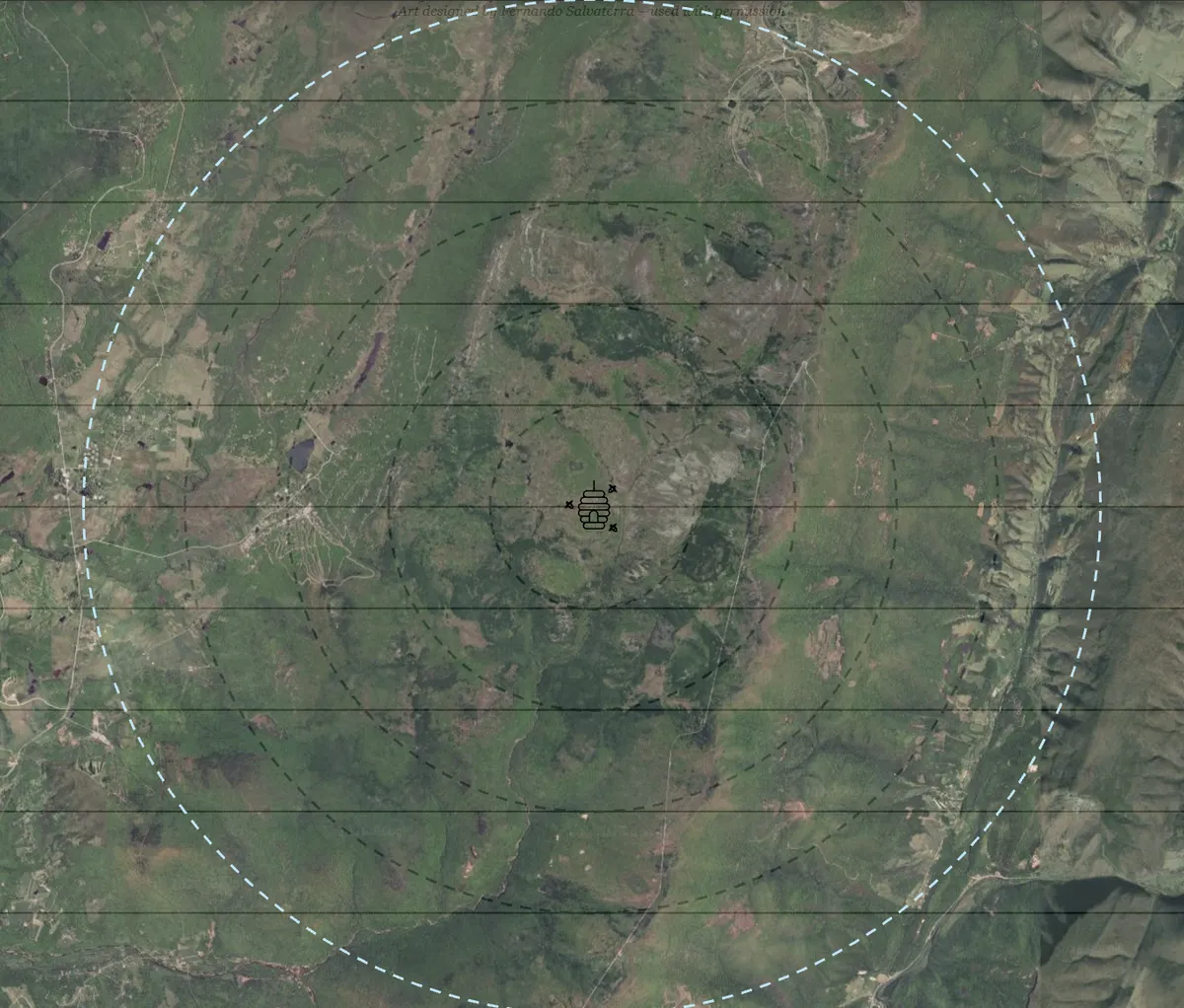
From Google Earth
I took this circle and chunked it into sections based roughly on what I saw on the map, then spent about a day thinking about my older post, Bee-Sized Anchors of Wilderness Play. I still think this was a helpful thought experiment, but with how we have restructured encounters and moved away from hexes it was time to revisit encounters and static keys.
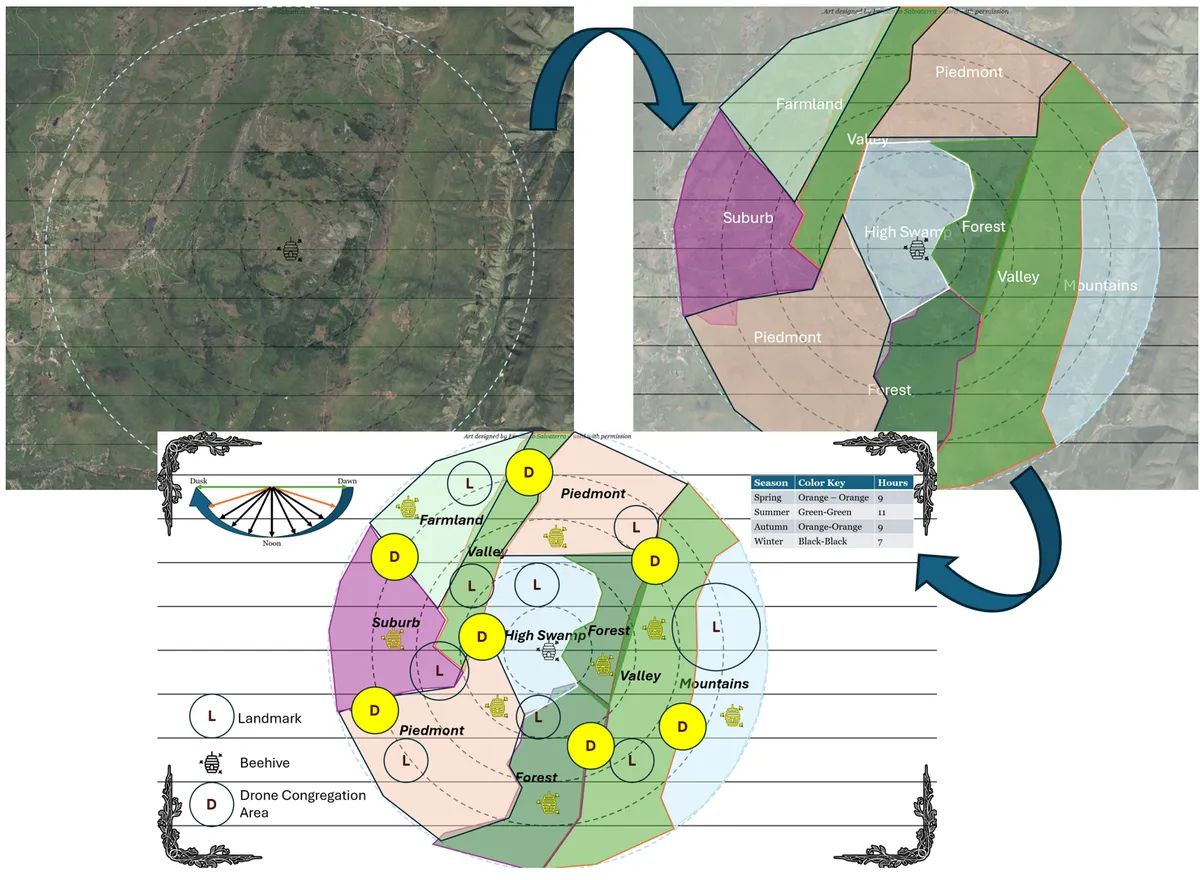
The real function of random encounters in tabletop is that they help to simulate dynamism and natural movement of elements of the game world. In the first playtests, I had rival beehives on my encounter tables and predator nests as static keys on the map; this turned out to be completely ass backwards. The refocus of the game on Queen Bee Ambitions means that other beehives should be part of map prep and predators should be a more organic part of the world. Really, I realized that by moving away from hexes-as-containers, the only things that should be fixed on the map are true Landmarks, rival beehives, and the Drone Congregation Areas I mentioned earlier. This drastic rethinking helped me to compose a first-draft Encounter Truth Table.
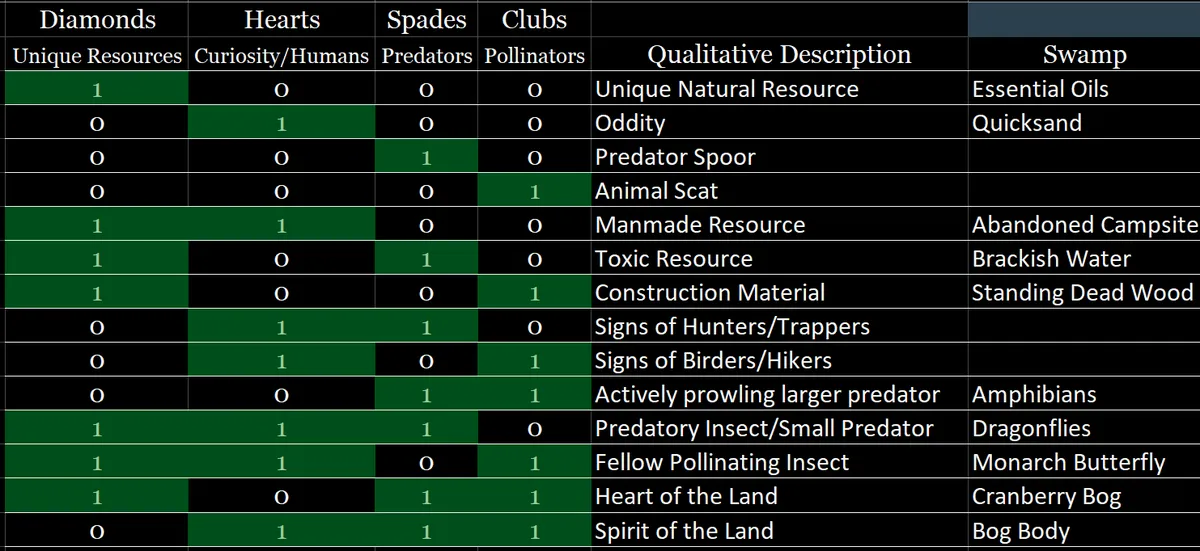
There's a separate column for each biome present in our map
Now, if our core exploration seasons are Spring, Summer, and Autumn, and we believe that an extremely dedicated bee could potentially range about 5 miles and back in a day, then for the hours that we have set aside so far a foraging honeybee probably travels about 1 mile per hour, barring any difficulties with weather. I think this is reasonable - once we have constructed our map and drawn our scale, we can figure out how long a mile is. When I printed out my map, it scaled incorrectly, so my map was about a 6" diameter and 1 mile was about 5/8". We will re-examine our Resource Expedition Procedure in a bit, but this would mean that if a player decides to bumble to a new location, they can move about 5/8" on the paper to show that they moved a mile. If you were playing on a VTT, you would probably just make a unit compass that you rotate every hour in order to move bees around.
I knew in my heart of hearts that once I wrote the Conquest ambition, this would look more like a wargame.
Revisiting Weather
The other pain point I wanted to work through while tackling the Resource Expedition was weather. I talked before about how hex flowers are an aesthetically consonant game engine, but boy howdy are they fiddly to prep and run. When I was chewing on this today, I was reminded of a review of Blood Rains Over the Crimson Jungle, specifically this quote:
First, results matter. A lot of weather tables tell you whether it's rainy, sunny, or windy, but the result often has little effect on gameplay. These tables add an extra procedure to each day of travel, but the players forget about it a few minutes later. Not so here. A day in the Crimson jungle during deep night demands greater caution from the players. Crimson right is outright scary (maybe a touch too scary, but you can always tone it down). Once you roll a 6 the first time, players will start dreading the weather roll. That means they care about it.
Weather events being meaningful makes clear weather fun. Once your players see crimson rain for the first time, rolling no weather will make them feel relieved. It might even change their adventuring behavior. I can imagine a group deciding to push further on a given day because there's no weather and they want to make as much progress as possible before it rains again.
A hex flower has like 19 tiles or whatever and the point is that most of them have little-to-no effect on play. What really matters for bees, according to commentators like this article, is whether it's too rainy, too windy, or too hot/cold to fly. Neither I nor players need to worry if it's hot and hazy other than for flavor, and my friend Random Ape Encounter always says flavor is for cowards. Thus we also retool our weather check at the top of the hour to better focus on this - more on that here at the end.
Bringing it All Together
So let's take the "optimized" navigation procedure we came to in our PEMDAS post and update it for what we've learned here:
The steps of the Resource Expedition are performed each hour:
Game Manager rolls 1d6 and 1d8 to update the weather and advances the Sundial by one step. If the first die is a 6, then check the second die. The d8 table depends on the season, but as an example, the nominal summer season is:
1: Unseasonably cold - staying in place requires spending water (to reflect the metabolic cost)
2-4: Driving rain - Cannot safely travel unless you can fly under cover, drone congregation areas temporarily disperse
5-6: Blustery wind - Wind is blowing faster than bees can fly, everyone must either hunker down or fly with the wind
7-8: Unseasonably hot - travel requires extra water
ELSE - assume uneventful seasonal weather
Each player chooses to either stay in place or travel one bumble, then decrements the water in their Honey Crop accordingly. Players can bumble in a direction based on the current position of the Sundial - either toward the sun, away from the sun, or transverse to the sun (90 degrees relative to current position).
- Players can also bumble toward or away from Landmarks that they have seen.
If a player bumbled, the GM draws 1-3 resource cards (based on biome and season). The GM uses this resource draw to check for encounters.
GM describes what the player senses. If the player is within the vision range of a Landmark or Drone Congregation Area, then describe it and its relative position to the player.
Players decide whether to commit a resource card to their Memory or to their Pollen Baskets.
Committing a card to your Memory leaves a temporary waypoint at your location, making it a valid target for worker placement in the Waggle Dance phase
Committing a card to your Pollen Baskets replenishes 1d6 (maybe 1d4, TBR) water to your Honey Crop. Floral fidelity rules still apply for Pollen Baskets.
I'm excited to bring all of this to playtest! I have pretty mature drafts of at least one ambition per family of ambitions, so I definitely have enough material for when I finish drafting my map key. This feels like a step in a more interesting direction than "Mythic Bastionland with Bees and Board Game Mechanics". Thanks for tolerating my rambling!