Circuit Crawls
WF over at Prismatic Wasteland called for a blog bandwagon back in February to discuss the topic of maps. I perseverated for a while about whether I had anything interesting to say about maps, but I've had a silly idea in the back of my head that feels worth exploring. My colleague Liz at Magnolia Keep wrote a fantastic post on Basic Terrain for Pointcrawls that I have spent a lot of time thinking about. In particular, she poses the idea of One-Way Gates as a tool for driving travel on a pointcrawl map.
This is such an intuitive ludeme! It is a great way to build on elements like Barriers in a Mythic Bastionland hexcrawl. But speaking of a Bastionland, deep in the bowels of the Conductor's Guide for Electric Bastionland, Chris McDowall instructs GMs mapping The Underground to draw colorful, overlapping "circuits". The Underground is supposed to be a printed wiring board undergirding Bastion, so of course it would be a circuit! But If you have the background that I do and you think for too long about circuits, point crawls, and one-way gates, there's only one place you can end up.
Basic DC Circuit Theory for Tabletop
I think simple "Direct Current" circuits are a great model for point crawling, especially insofar as providing ways to think about how adventurers may get affected by hazards and obstacles. I'm going to pitch a few fundamental components, talk qualitatively about how they behave, and then use that as a basis for what that might represent in your elf chess game of choice. This model assumes that you are playing a game with some sort of attrition-based gameplay loop, but I'll bet we could find a way to make it extensible to other loops as well.
As a super quick and dirty primer, we're going to talk about a few terms repeatedly and I don't want anyone to feel too lost or out-of-the-loop. We will introduce a few more ideas as we work through this, but the basic units for talking about electricity are:
- Charge: A discrete element that, when placed in an electromagnetic field, experiences force. Think of it as the EM version of mass, if that's helpful.
- Current: The rate at which Charge flows through a conductor. Sometimes it's intuitive to think about Current as "speed", but it's kind of more like "throughput".
- Voltage: The difference in electrical "potential" between two points. It's not measured in energy units, but your physical intuition when you think about Voltage should be a ball at the top of a hill vs at the bottom of a hill. I'm going to do my best to avoid the "water-in-a-pipe" analogy because I think it's bad, but Voltage really is the place where it feels most useful.
- Resistance: The property of a conductor/medium/material to impede the flow of Current. When Current flows through Resistance, energy is lost in the form of heat.
Sources
In a circuit, a Source is a battery or other power supply that provides enough Voltage or Potential Energy for current to flow. Batteries are a good qualitative model for us because they start at a peak operating voltage and degrade over time, necessitating replacement or recharge.
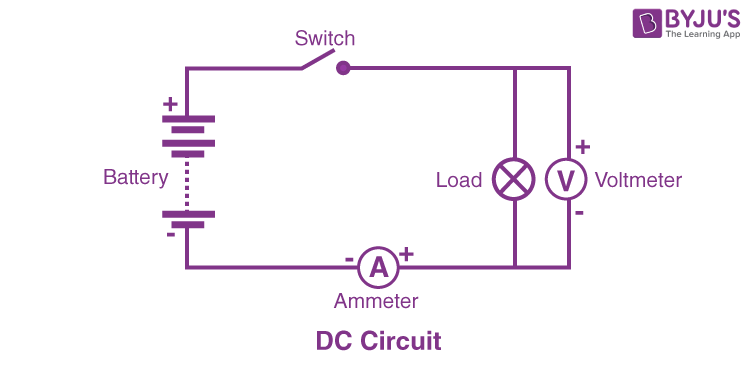
In a point crawl map, a Source is like a hub, a town, or other place of rest where your adventurers can replenish their resources and metacurrencies. It's where you start your journey as stocked up as possible. If your hub/town is an "Ideal Source", then you can always restore your resources to full. If your hub is a Battery, then adventurers need to find ways to keep it refurbished and healthy to get the full benefits of resting or passing through.
Sources with higher voltages can fully restore larger parties and warbands, while a lower voltage Source may only provide partial benefits to a powerful group of adventurers.
Wires/Traces
Wires and Traces are low-resistance connections between points on a circuit. Very little energy is lost in Wires and the energy moves very quickly. In a point crawl, these are our safe roads where we can expect limited resource expenditure and fast travel. As electricity is rate-limited by the speed of light, adventurers are rate-limited by the speed of leg. Your Wires are probably distances measured in hours or days of travel and you may have basic encounters to spice things up, but time spent on Wires is probably hand-waved to get to more interesting circuit elements.
Resistors
Resistors are sort of the bread-and-butter electrical component. They provide a predictable amount of resistance, which means that for a given Current, the relative Voltage drops. This is Ohm's Law, the fundamental equation for circuit analysis.
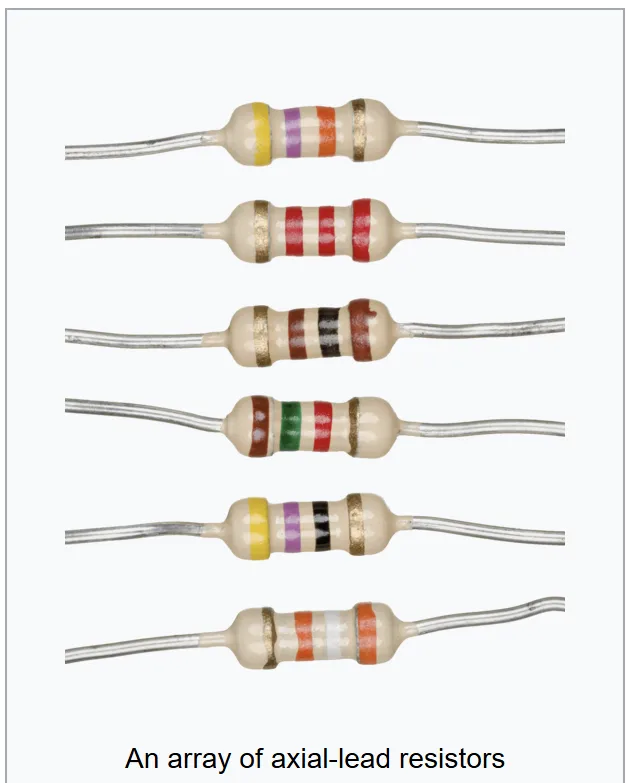
When we discussed Sources, I think we established an analogy that Voltage is the adventuring party's present access to resources. "Heroic Potential" if you will. Rations, spell slots, daily powers, fuel, Hit Die, or whatever you are using as your pacing mechanism. Resistors, then, are a straightforward way to eat into your party's Heroic Potential - their voltage is expected to drop if they go through the Resistor. However! This is only two parts of Ohm's Law! In order to know how much Heroic Potential erodes when going through the Resistor, we need to know how hard they are pushing themselves.
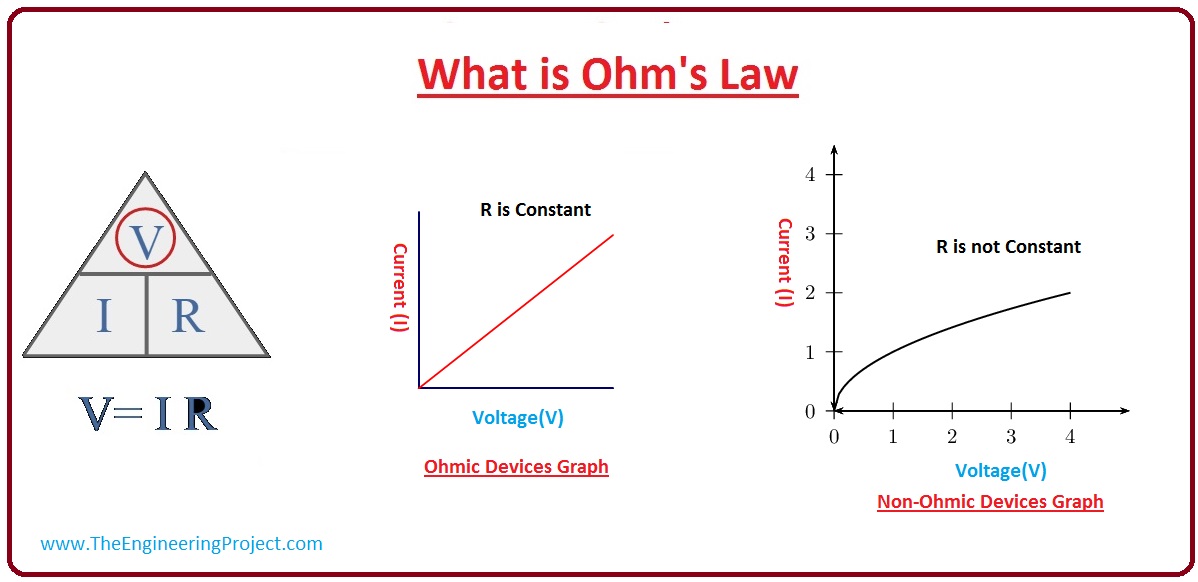
Let's introduce our next sort of cornerstone analogy. If Voltage is Heroic Potential, then Current is something more like Travel Rate, or Reckless Abandon; the more head-on and straightforward the party tackles a Resistor, the more resources they are likely to eat into. If they take it easy and carefully at a lower Current, then they will probably expend fewer resources.
So what are Resistors then on a point crawl map? I think they can be either static obstacles, like hazardous terrain, or they can be planned monster encounters. The fun part of this analogy is that it gives us a clear language for when players sidestep our challenges - in industrial electronics, a "Short Circuit" is when charge finds an unintended low-resistance path, a "short", and barrels into the next series elements with a higher voltage than intended. If your players find a way to smooth-talk your Schrödinger's Ogre and get past her with their resources untouched, then you'll need to account for that higher fighting potential at their next challenge.
Extending the Resistor - Series vs Parallel
I have a quick aside before we move on to more complicated elements. Sometimes in circuit theory you want to have multiple resistors "in parallel" referenced to the same start and endpoint.
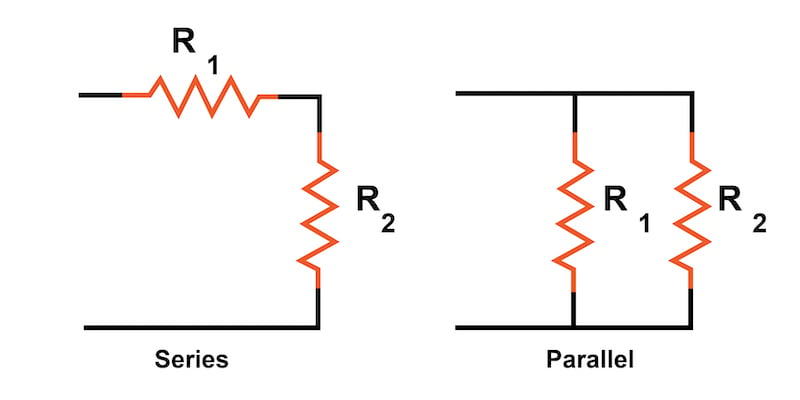
When I started noodling on this idea, I was thinking about times where I have provided my players a destination but given them multiple paths, usually with a semi-calibrated difference in time, danger, environment, etc.

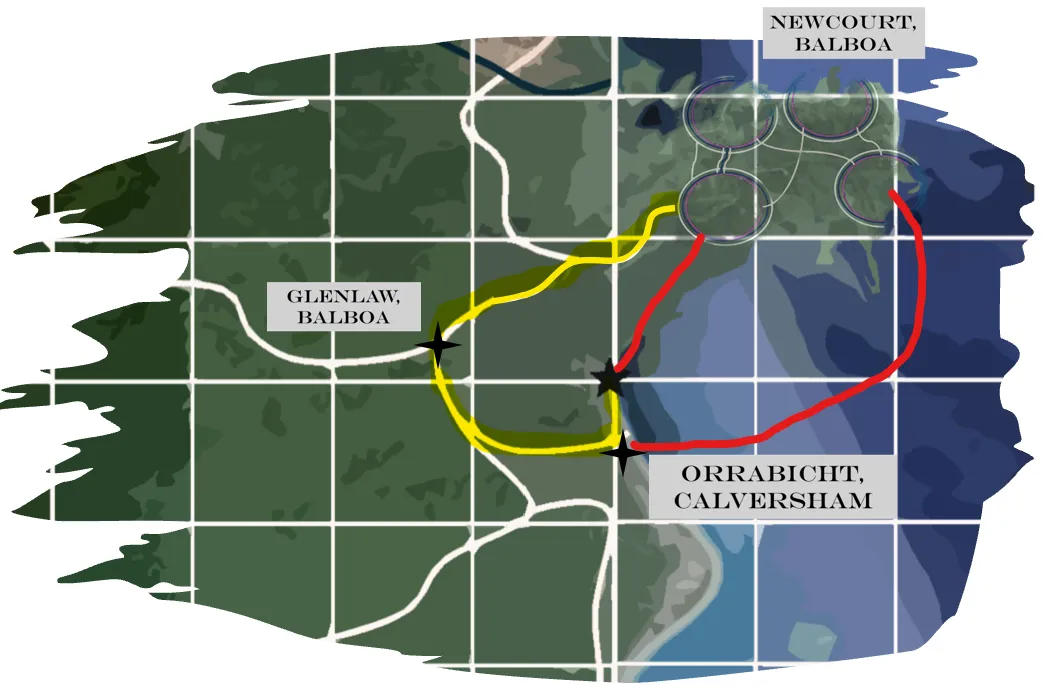
I don't think that is a good model for parallel obstacles because, if the whole party stays together, they're really just choosing a different "current" to all tackle the same level of obstacle. I think parallel Resistors is a better model for splitting the party and allowing the players to try to find the path of least action to handle multiple obstacles simultaneously. In this sort of case, rather than pre-determining the physical principle of who should do what to make sure everyone expends a fair number of resources, the players get to act as their own variational calculus engines to try to "solve" for who should expend resources on which task.
Diodes
Diodes are the component which initially started this thought experiment. A Diode is a semiconductor which allows Current to flow freely in one direction and provides intense resistance in the other direction. In Liz's post, this is the one-way gate. The most intuitive one-way gate is a river; it requires very little energy to float downriver and it is exhausting to try to steam upstream.
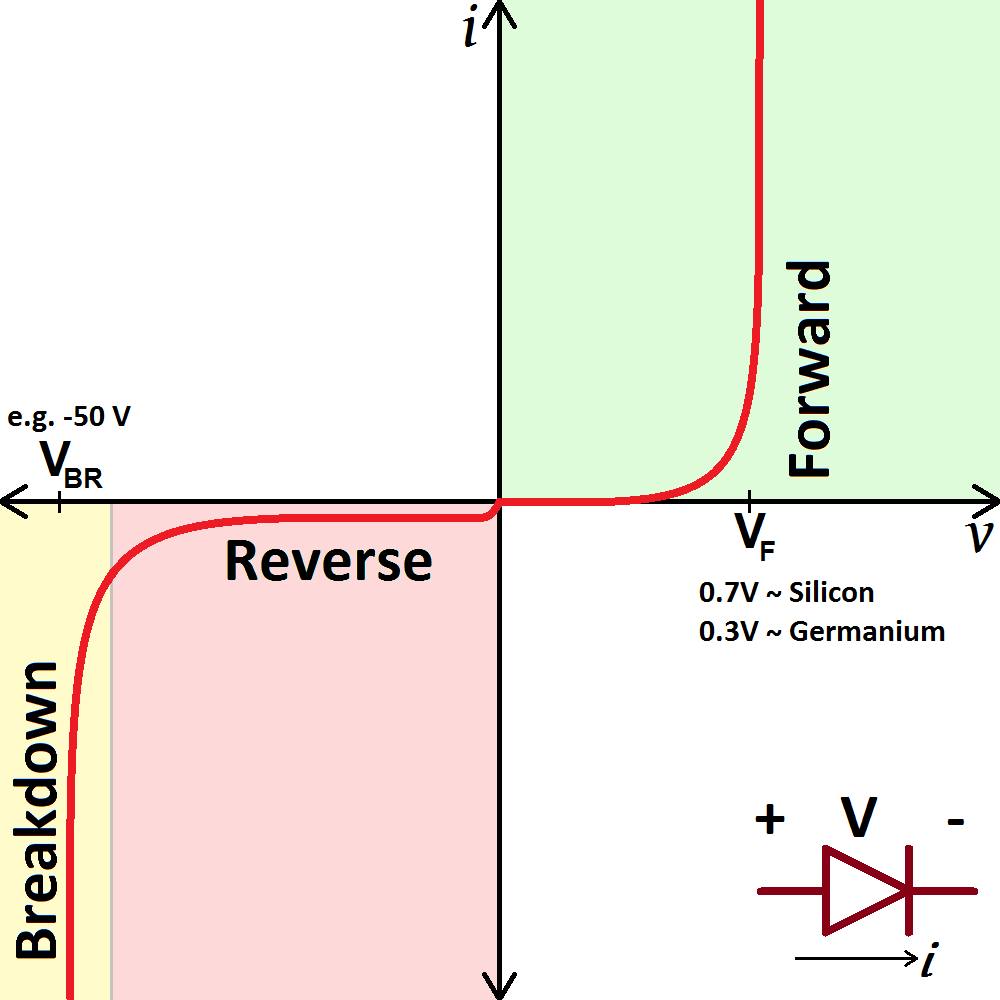
This is actually a dynamite analogy, because all Diodes have a property called "breakdown voltage"; if you run a Diode in the reverse direction with enough energy, the insulative/nonconductive properties are overcome and it basically acts like a wire again. When we place one-way gates in our point crawl, we should be aware that they probably have a breakdown voltage at which point players have sufficient resources to overcome the barrier and move backward.
Capacitors
Capacitors are so crazy dawg. I don't know how much I can get into it, but it's also sort of the case I wanted to explore with this thought experiment. Capacitors are usually visualized as two oppositely-charged plates with a little barrier between them, and they have a few qualitatively interesting properties to think about.
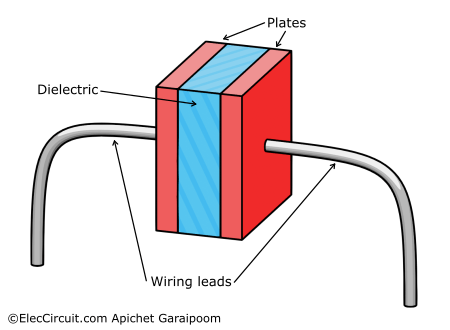
- When a Capacitor is not "charged", it acts like a Wire, so it's really easy for Current to flow through it
- As a Capacitor charges, you build up a voltage between the two plates and it starts to impede Current flow
- When the Capacitor is fully charged, it no longer allows Current to flow through it
- When an external voltage Source is no longer applied, or is otherwise interrupted, the Capacitor begins to discharge its stored energy back into the circuit. This behavior makes it useful for certain types of filters, because it provides enough energy during a "blip" in the voltage to keep the circuit alive
So we are really up a creek on creating an analogy here, but let me take a crack at it.
I think one version of the Capacitor on a point crawl is a sort of pass-through town with a juicy quest hook. The adventurers can breeze through the town and treat it like a road, but if they stick around and ask questions and get involved in the local politics, you can build up a lot of potential energy. The town either drains the party's resources or turns it into a new hub to keep them topped off, depending how they engage with it. This feels a little tortured to me, though, and I think this will probably merit a future revisit.
Inductors
This one is just for me, because Inductors are like the Wario version of Capacitors. Inductors are usually visualized as tightly-wound coils of wire and are used for storing energy in a magnetic field on the circuit. Like we did for Capacitors, here are the qualitative properties we should explore.
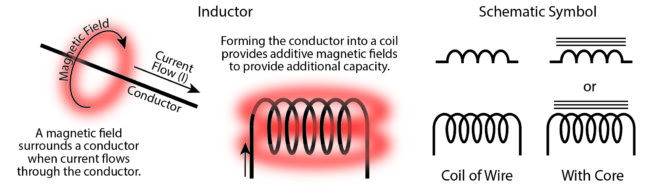
- When an Inductor is not charged, it does not allow any current to flow. In fact, what it does is it resists changes in current
- As an Inductor charges over time, it allows current to ramp up to a steady state at which point it acts like a Wire
- When you remove a Source from the Inductor, it continues to supply some current to the circuit until it discharges
- If you try to rapidly short or switch an Inductor out of the circuit, it produces a big honking spike in energy (I learned this through an extremely expensive mistake at work a few years ago)
This is another tricky component to analogize in adventuring, but one way I have been thinking about it is phenomena like seasickness and "sea legs". Imagine obstacles or events in the adventure where the party has a hard time adjusting to a change in environment at first, but eventually becomes proficient enough to act effectively. I could see a long journey through a swamp, desert, or marsh that requires specialized gear or vehicles as another sort of inductor. Another option would be a canal with a lock system that the players can influence - maybe it requires resource or time expenditure to get started in the preferred direction and then requires another resource to slow down and exit at the appropriate time.
Load

Our last component is the Load. Loads can be lights, motors, lasers, speakers, anything that draws a current or a voltage to turn electrical energy into Work. The rest of the circuit is really here to deliver the right type and flavor of energy to a Load. For our sake in this analogy, the Load is the quest or mission that the players are crawling to accomplish. In classical and traditional adventure play, the game element of overland travel is trying to manage your resources so that you have the heroic potential to accomplish the quest and make it back to your Source in an appropriate number of pieces.
Revisiting our Tortured Analogy
In basic circuit theory, because of Ohm's Law, if you put a voltage Source in line with some amount of resistance, a proportional amount of current will flow from one terminal to the other (or to ground). Like we mentioned in the last section, the goal of circuit design is "Impedance Matching" - you may intuit from the term that this is making sure you adjust the overall resistance of the circuit to deliver energy to the Load. Contemporary encounter-centric games like 2024 5e (especially with MCDM's encounter building rules) and Draw Steel typically expect GMs to plan an intentional Adventuring Day. Barring shit luck or irresponsible player behavior, the system provides fairly solid guidelines for impedance matching. In OSR-style adventure design, the resource management is typically in the players' hands. If they don't have the tools they need for a journey and mission, it's an impedance mismatch due to imperfect information and planning.
This principle of electrical energy delivery has been described for about 150 years, but unfortunately no one has yet discovered how players make decisions. Thus, a GM or adventure designer who wants to write a point crawl must go through a two-step process of impedance matching. There is the theoretical step, which is a dialog between the fiction of the adventure (what should the world be like) and the mechanics of the adventure (what resources should the players have at their disposal). Then there is the tuning step, which is understanding the social contract of your table and whether your players find intrinsic enjoyment in managing their resources during travel or if they prefer to focus on location-centric play.
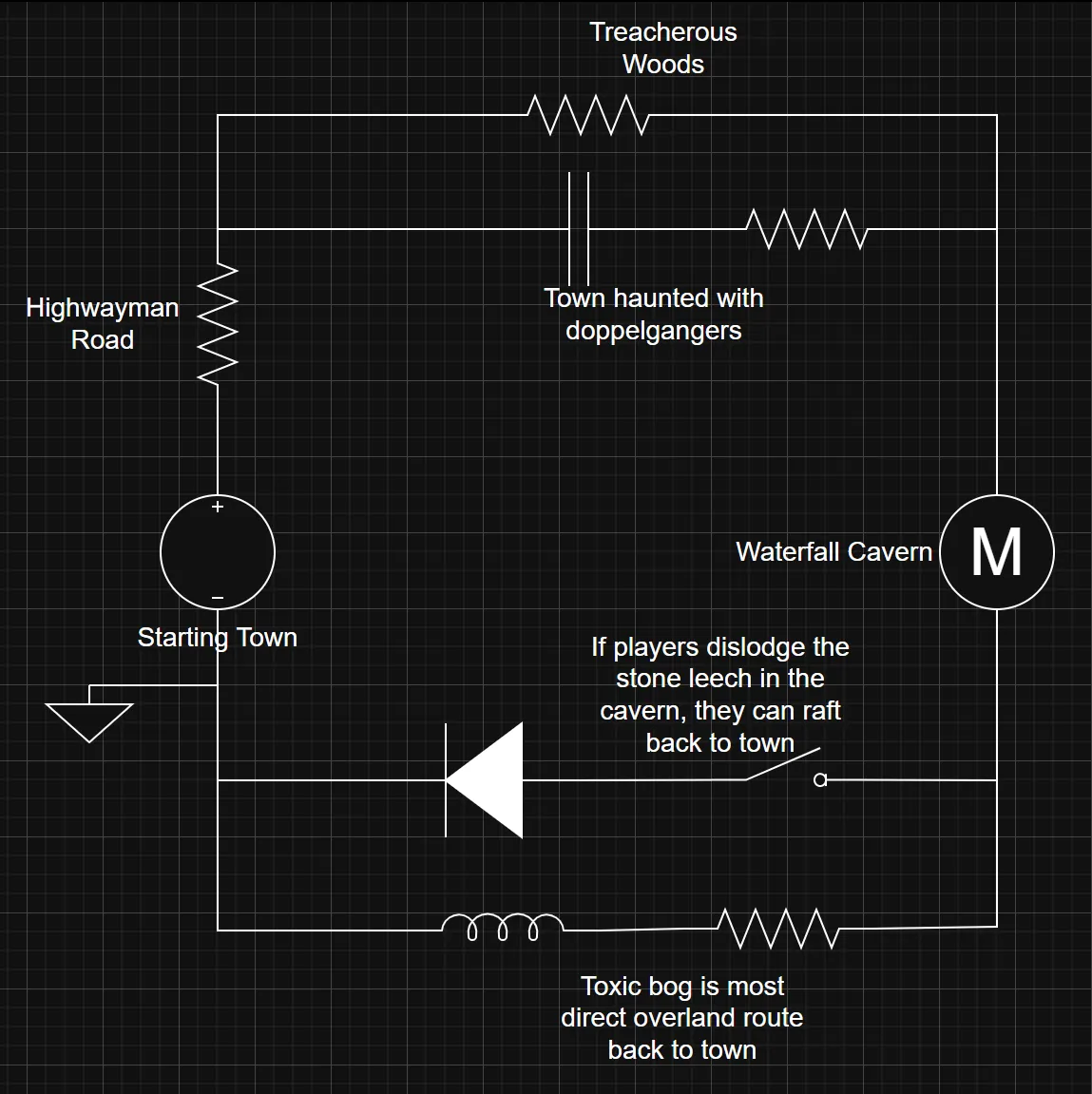 Example circuit adventure
Unlike an electron in a circuit, players and GMs can reassess their Heroic Potential at a given moment and change their approach or behavior from either side of the screen. This is the crucial impedance matching of adventure circuit design, and unfortunately the only people who can do it for you are the people at the table! It may very well be that your table has agreed to a blorb-style play that does not accept overt tuning relative to the prep and players just need to figure out when it's time to turn tail and end up back at a Source to lick their wounds. I think it is a cool tool for a GM's back pocket for players to "find" a Capacitor in the wild that could potentially smooth out their voltage signal!
What do you think? This post went a little longer-winded than I thought, but I want to experiment with this sort of design some time soon if I find myself fiddling with pointcrawls.