Bad Bee-Hiviour - A Framework for a Honeybee Game
Well, both Hellbenders and Random Access Memory are in playtest states and I'm still feeling a nervous creative energy, so I spent the last couple of days ruminating on a few ideas.
- My friend Elmcat of Among Cats and Books has lamented to me before that, in the post-OSR tabletop space, not enough games lean fully into overland exploration as the central lusory project. Mythic Bastionland is probably the modern gold standard exception that proves the rule. The most popular modules in the POSR/NSR space tend to feature overland exploration as more of a means to an end. Travel is the attritive tax that gets a properly exhausted party to the dungeon, which is the actual focus of the game.
- My experiment with RAM and the idea of using cards and card-based ludemes (tricks, poker hands, cribbage scores, and blackjack) as a game-based mode of encoding or advancing the game state have really lodged themselves somewhere deep in my brain wrinkles.
- TTRPG parties tend to be a collection of lovably antisocial ruffians. The players literally composing one body, in the case of RAM, is a fun departure from that mode. To take it in another direction, though, what does it look like if the party members are part of a greater eusocial organism?
If you can't tell based on the post title, this landed me in a roughly 6-hour hole reading about beekeeping and the lives of honeybees on Sunday and I'd like to report out what I've been fiddling with.
My Initial Mindset and How It Informed my Research
I went into this thought experiment considering the oddly procedural lifestyle of honeybees.
- Bee exits hive
- Bee explores surroundings, probably informed by a previously-returned bee's Waggle Dance and looks for resources. Can you say rumor tables?!
- Bee collects resources and brings them back to the hive, then communicates the quality of their haul to the girls back home with her own Waggle Dance
- Resources are used to improve the hive
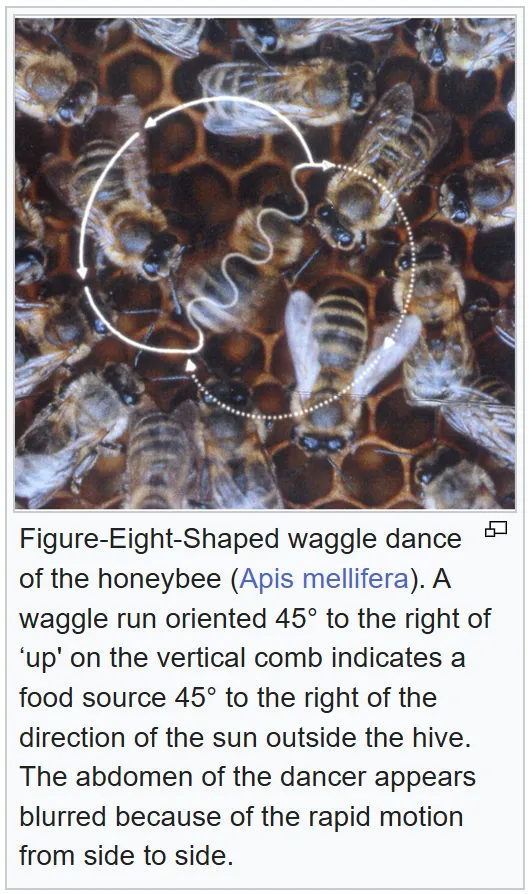
Just by itself, this is a cool loop to gamify! In fact, I just found while tooling around that there's a euro style strategy board game based around the life cycle, but I didn't know that when I started writing and I believe that I'm taking it in a different direction. So let's break this apart into a countable number of subsystems that we can design a cooperative game around.
Exploration Pillar
I want this game framework to really center exploration of the world outside of the hive. This means that the majority of the game complexity at runtime can be allocated to this process. I think modeling (or at least gamifying) exploration as a bee then becomes sort of two core subsystems: Resource Gathering and Travel.
Resource Gathering and Management
In real life, honeybees have to manage four critical resources.
- Pollen, which is their source of proteins and fats
- Nectar, which is their source of carbohydrates and eventually becomes honey
- Water, which is primarily for temperature management of the hive. Bees get most of their personal hydration from nectar. Also a source of minerals and salts though, bees love a saltwater pool!
- Resin, which is used to make a sort of antiseptic and structural glue called Propolis that protects the hive
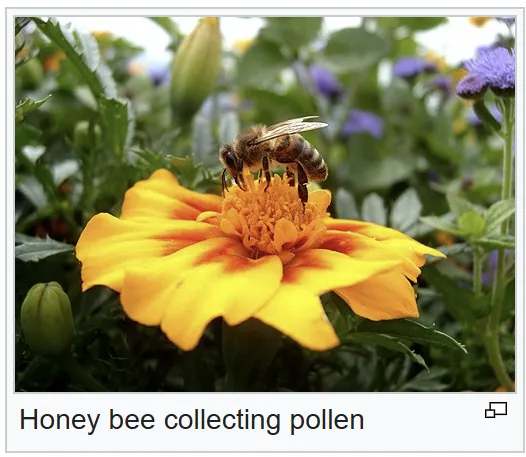
When particularly rich deposits of resources are identified, the players should be encouraged to remember that location so that it can be communicated back to the hive. If there are dangerous features about the location, players should be empowered to act in the scene to mitigate the danger and ensure the safety of future field bees! In my mind, this becomes the problem-solving axis of the game that drives it from card game/board game to role playing.
Travel
Bees can fly. They can fly fast (up to 35 km/hr!), far (over 6 km from the hive) and high. This immediately changes the calculus of traditional hexcrawl games, which are strongly constrained by character ability to trek around terrain at ground level. What does it mean for a game if player characters can cruise around between 15 and 115 feet in the air, basically unmolested by terrain? I think our core travel tenets become:
- Weather is impactful in different ways; visibility and resource taxes become mission critical to maintain pacing and drive decision making
- Terrain should directly impact resource richness and availability, up to and including how seasons should affect when certain parts of the map are fallow or abundant
- Predators and encounters should similarly influence pacing and decision making
Return to Hive and Basebuilding
I am really tickled by the idea of translating some aspect of an excursion/journey into a Waggle Dance that enables other bees to seek out the resources that you discovered, so it was a guiding light for me that this would become a subsystem of the game.
Beyond that though, I want the axis of progression in game to be a collaborative basebuilding/management subsystem that rewards players for maximizing both personal deliveries of pollen and nectar, but also for the quality of the information provided to the other field bees. Plus, it would be fun for basebuilding to happen on its own hex map because of the structure of honeycomb.
Current Iteration - Game Design
What you'll need: 1 deck of playing cards, 1 overworld hex map, 1 hive hex map, pencils and paper
What does prep look like: I think that the Beekeeper should prep the overworld hex map in advance. Hexes should have base terrain and pre-populated landmarks. The season should probably be decided before play, but I think we can come up with a weather system that works at runtime.
What does play look like: Player characters are a crack squad of scout bees who are going out of the hive to tag resource lodes for their fellow bees for the season. Scout bees are smooth, roguish ladies in the hive and get respect for the risk they're willing to take on for their sisters. Bees probably have stats like Brawn, Brains, Bark, and Backbone, yknow something fun.
Key Breakthrough
What really matters is that bees have three types of inventory: Memory, Honey Crop, and Pollen Baskets. Memory is the bee's individual ability to hold landmarks, direction, and distance in her head at a given time. Honey Crop is an organ in the bee's esophagus that can store water and nectar for her sisters in the hive, but the bee herself needs water and the carbohydrates from nectar to keep traveling. Pollen Baskets are structures on her leg which can store either pollen, which gets pressed into little pellets in a fascinating mechanical engineering problem, or resin, which becomes a sticky cement on her legs until a house bee can help turn it into propolis in the hive.
These three types of inventory are used to support three competing minigame objectives during travel:
- The Waggle Dance. The party works together to store high quality directional details in their collective memory so that when they get back to the hive, they can perform a choreographed dance, probably encoded as poker hands, in order to send field bees out to rich locations that they've investigated.
- The Honey Crop. Each individual bee wants to get as much nectar back to the hive as possible, but the act of traveling across the map drains water and nectar from her honey crop. This minigame acts as a timing mechanism and is the primary vector by which bad weather affects travel.
- Floral Fidelity. Bees prefer to only pollinate a single type of flower at a time, so they are trying to maximize how much pollen of a single type they can collect on a trip. A subgame for this system is that, when it is sufficiently warm out, a bee may choose to collect resin instead of pollen, which supports different functions in basebuilding.
Thus, our core gameplay loop becomes exploring the map and gathering resources, primarily in the form of playing cards. Players make decisions about whether those playing cards get stored in the bee's Memory (to build a waggle dance), in the bee's Honey Crop (to extend her travel time), or in the bee's Pollen Baskets (which all must be of a single suit due to Floral Fidelity). The trick then becomes how to dynamically encode resource richness into terrain based on type of terrain, special landmarks, and season.
Advancement and Game State
In my mental model, success in each of these minigames helps to further development of the hive, which then facilitates some form of advancement. I think pollen is probably an analog for experience points because it directly feeds the hive. Surplus nectar becomes honey, which is something of a bargaining chip with other hives or other creatures in the wilderness. Successful encoding of rich resources for the field bees supports overall health of the hive and queen. I still have an orphaned note in my notebook that says "what do bees do for downtime", but that may be where we editorialize how much interiority our player character bees have!
I'm super excited about this, I've been doing a lot of reading about hex flowers and not only because it feels thematically apt. I think it'll help with resource seeding and weather-at-runtime. Let me know what you think!