An Analogy About Rules for Sickos
There is a concept in set theory called cardinality which refers to the number of individual objects in the set. The wrinkle is that sets with an infinite number of members still have cardinality and the size of these infinite sets can be compared. This is how you end up with those weird logic puzzles about, say, a hotel with an infinite number of filled rooms accommodating an additional infinite number of guests.
Hyonklo in Jay Dragon's discord server asked this morning whether you could reasonably think of rules in a tabletop RPG as inherently subtractive, in the sense that you start from the infinite space of conversation and then "carving shape from the marble in the negative space". Earlier this month I talked about rules for Conversation Play as an act of building play, or building a central lusory project, on a foundation of conversation but today I want to experiment with an analogy using the imagery of fractals.

The Mandelbrot set is a well-loved and well-studied figure in math with the property that its boundary is a fractal curve. It is, however, entirely enclosed within a circular disc with a radius of 2. There's an infinite number of points with an infinite amount of complex detail captured along the boundary of the Mandelbrot set, but you have to zoom in to see it.
Let's consider every possible human conversation to be this disc with a radius of 2. Then let's consider every possible conversation that is had as a form of play to be the Mandelbrot set.
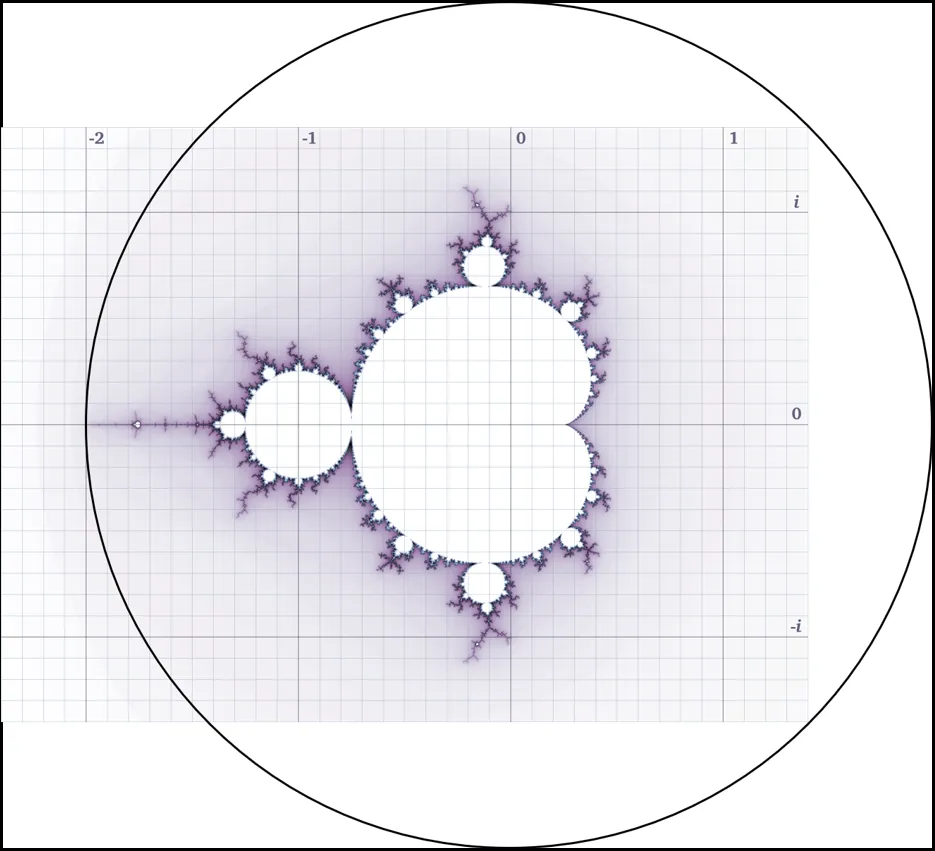
Every possible conversation that is had as a form of play is entirely contained within the set of every possible human conversation. In fact, conversations that are had as a form of play look like they take up a fairly small portion of the total types of conversation! But let's narrow the scope of what we're looking at.
I think I only want to consider human conversations where one person has access to a privileged set of prepared information and one or more other people ask questions to uncover more information about that privileged set of information.
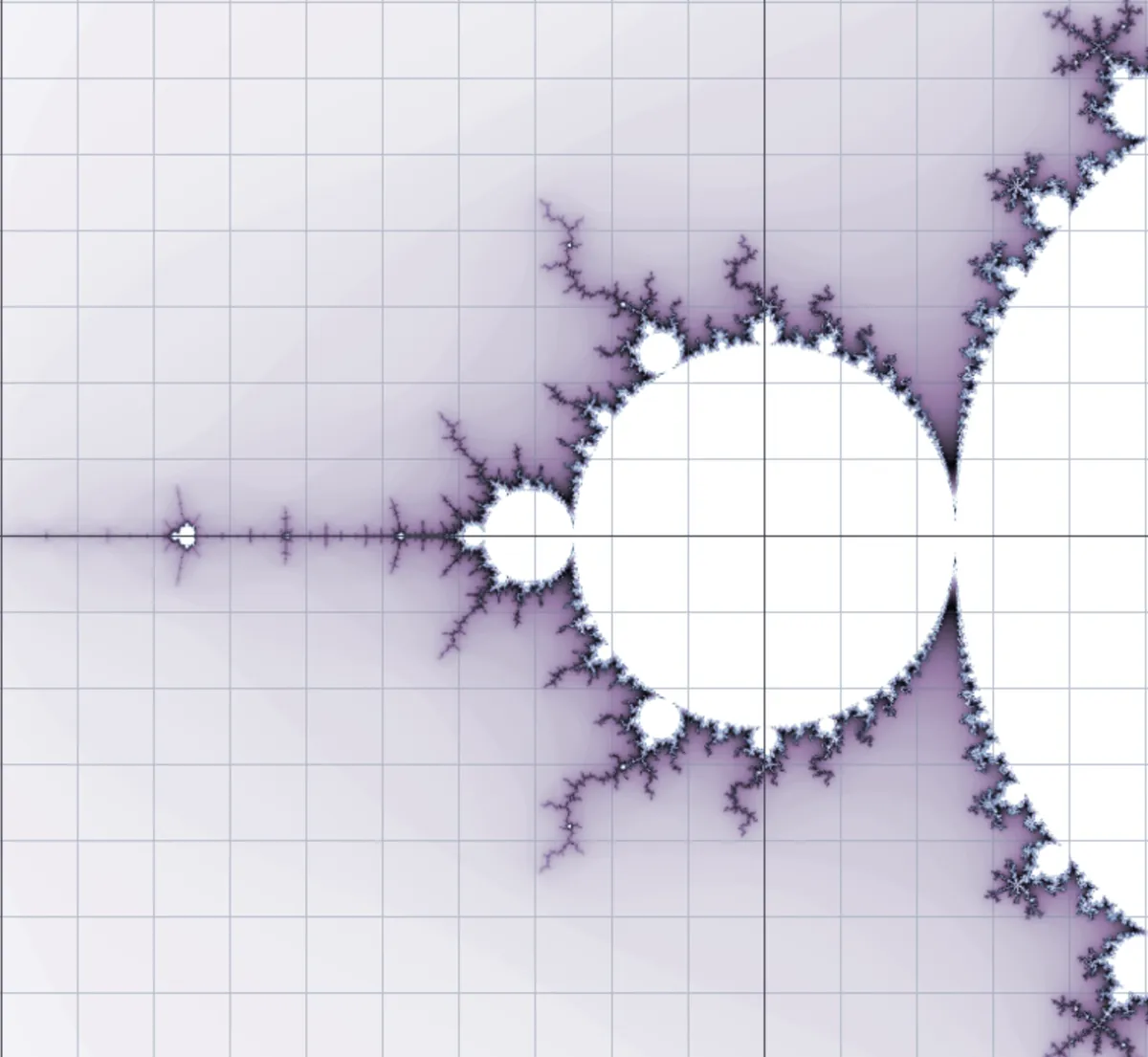
We are now well within the total scope of human conversations but, by applying this rule (one participant has access to privileged information), we have zoomed into our total space of opportunity and can see new emergent details. Notably, not every conversation with this rule is play; tons of conversations are about something where one participant is more knowledgeable about a topic than other participants.
So now let's apply another rule. The participant with access to privileged information should initiate the conversation by providing sensory data that describes their privileged, pre-prepared information and other participants ask hypothetical questions about what would happen if someone interacted with the sensed objects described.
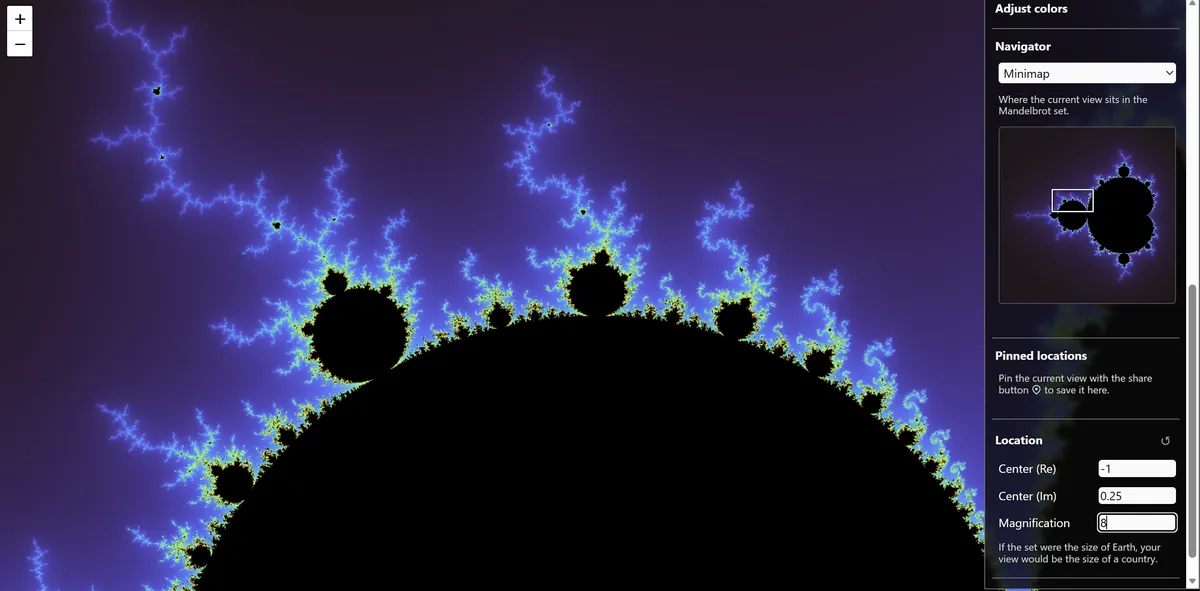
Visualization provided by https://mandelbrot.site/
All of the conversations constrained by these two rules (or really, one specific compound rule) existed previously in our disc, but we see two phenomena as we narrow the scope of types of conversations that we are interested in having.
- First, there is still infinite variation within the conversations available to us. No matter how far you zoom in, you haven't "reduced" the potential for creativity, you have just identified the scope of conversations that you are interested in exploring in your game.
- Second, as you zoom in, more of your aperture is play-shaped and less of it is "other shit you could talk about". If we get even more specific about our conversation rule and say:

Then in our analogy, that can only be His Majesty the Worm, baby