Swimming Rules for His Majesty the Worm
Last winter I put together a draft of rules for swimming and drowning in His Majesty the Worm because I was running Michael Madsen's Caves of Cowardice module, which heavily features rivers and deep pools. I wanted to revisit and compile them for fun for my friend Valeria.

From Michael Madsen's Caves of Cowardice
His Majesty the Worm uses a slot-based inventory that consists of Hand slots, Belt/Body slots, and Pack slots. We will focus primarily on swimming as an inventory management problem so that we don't add too many new moving parts to the system.
Swimming:
When water is above chest height, you may find yourself swimming. A typical adventurer is strong enough to swim in still water, but the gear they depend on severely complicates this ability. The basic penalties which inhibit swimming are:
- Holding an object in either hand (both hands must be free to swim unimpeded)
- Wearing your backpack (you must leave it behind to swim safely)
- Wearing metal armor on your belt (each slot occupied by iron or steel armor is a separate penalty)
- A strong current or turbulence
- Active threats (you have been targeted or threatened within the last round of actions)
Boons
Some things can make swimming easier. You can counteract the above penalties with:
- An aquatic/swimming related motif
- An external source of flotation/buoyancy
- Gear that supports swimming
- The fluid you are in is particularly dense (saltwater, for example)
- A safety line/guideline either anchored to shore or supported by multiple allies
- A successful Test of Swords can offer a momentary burst of strength to continue swimming or prevent drowning
Each occupied hand and each belt slot filled with a metal armor must be individually counteracted, I.e. if both hands are full and you are wearing iron armor, you must find four countermeasures to still be considered safely swimming.
If you are in water and not safely swimming, as in you have more penalties than boons, you are at risk of Drowning.
User Stories
User Story 1
A swordsman in iron armor is wearing a pack, is holding a sword, and is standing on a bridge over a 15’ deep pool of water (no current). Sitting at 4 penalties.
The bridge is rickety and he falls through it. He immediately sinks to the bottom of the lake. He drops his sword (+1), shrugs off his pack (+1), and his quick-thinking allies drop a rope to him (+1). Can he can be pulled out? I think this sequence of events could happen on the scale of time that is stressful and tiring but is not incompatible with life. He is still at 1 penalty, but if the whole party works together on the rope or the swordsman successfully tests swords, he may recover.
User Story 2
A thief (former pirate) in leather armor, with empty hands, wearing her pack is swimming across a river with moderate current with the help of a guideline anchored to the opposite shore. Currently at neutral due to the positive motif and the guideline.
A brigand sees this and cuts the guideline (-1). The thief has gone from swimming to some form of distress. Every action that she takes is going to take some level of effort/exertion to make it to shore.
User Story 3
A heavily armored scholar (-4) is fighting skeletal pirates on a ship in open sea. He is roughhoused off the plank into the water.
I think in user story 1 and 2 you have a solid fighting chance to survive, but our intrepid scholar in user story 3 is probably toast.
Time Fidelity
Swimming and drowning can take place during the Crawl phase or the Challenge phase. If an adventurer ever transitions from Swimming to Drowning, they immediately mark Stressed.
Crawling In My Skin
If an adventurer is attempting to swim during the Crawl phase and begins to Drown, then the party enters a pseudo-initiative. Each adventurer has time to make one split-second action along the lines of a Challenge Action before the swimmer's state is re-assessed. The swimmer may drop anything in their hands for free, but shrugging off their pack occupies an entire action. Doffing mundane armor is not feasible on this timescale.
If the swimmer is still Drowning after the first round of actions, then the swimmer must choose to either burn four Resolve or take a Critical Wound. If the swimmer is still alive, then the party may take another round of actions. A critically wounded swimmer who cannot recover from the Drowning state after a round of actions is claimed by the deep.
Challengers
If an adventurer is attempting to swim during the Challenge phase, she must discard a card at the beginning of the round to represent the effort of treading water. Her current state is assessed at the end of her step in initiative - after she has taken an action and all minor actions have resolved.
If she is safely swimming, then the Challenge progresses. If she has more penalties than boons, then she takes a Piercing Wound. This wound becomes a penalty rolling into the next round of combat.
Final Thoughts
Our goal here was to present an optional subsystem which links into the core mechanics of His Majesty the Worm while honoring the fiction of the adventure. We avoid adding anything into the game beyond inventory management, tests of fate, and wounds, which is good! I can see people finding this to be a little fiddly with the accounting checklist, but even that accounting is really just constructed against my intuition as a former water polo player and lifeguard.
These rules are about as dangerous as I think is appropriate for the use case I have in mind, which is periodically crossing rivers and basins. Some of my colleagues in the HMTW Discord have experimented with more aquatic campaigns - if you wanted to fiddle with diving and underwater exploration, then you would need to think harder about things like breath holding, light propagation, or SCUBA gear.
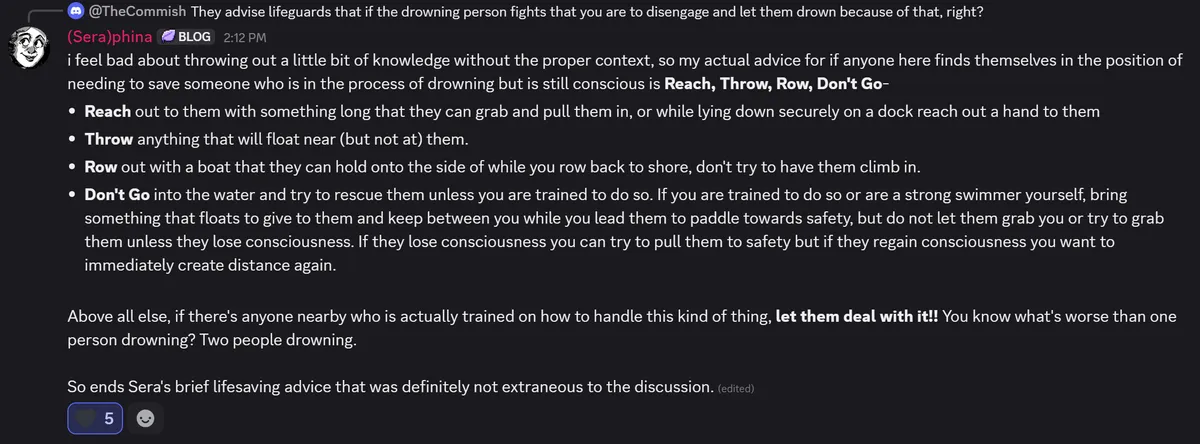
I think directly rescuing a distressed swimmer is so difficult without training and gear that it almost shouldn't be modeled, but if I were to take a swag at it then the rescuer would take an immediate penalty for using a free hand to grab the target and then also assume all of the cumulative penalties that they had.
Sera Says
This post triggered some fun discussion of the real dangers of swimming lifeguarding, so here is a great real-life reminder of how to engage with a distressed swimmer from my colleague Seraphim Seraphina!