Pollen Exclusively Makes Dear Apis Smile: Order of Operations
Meta Image from Michael Q Powell's Photography Blog
I've spent the last few days going back through the notes and feedback from last week's playtests. In The Wax Marches I confidently stated that the mechanical basis of the Resource Expedition functions extremely well. I still mostly believe this to be the case, but since it's the phase of play in which we have spent the most time, it's also the phase of play whose blemishes have been the most exposed.
Today I want to tease at the order of the travel procedure and see where we can find some more thematic consonance. After that, I'm going to work through some ideas I have to improve the encounter system via an operational analysis along the lines of what Binary Star Games proposes in this excellent post. The other source for brain food that I want to lift up is Jay Dragon's piece on the Asymmetrical Board Games in Seven-Part Pact and how Fictional Impact affects the board state; I haven't completed my meditation on this piece but it was a significant influence for today's writeup.
Order of Operations: The Playtest Version
The steps of the Resource Expedition are performed each hour:
- Players pick a location to travel to. If players decide to split up, then encounters are rolled separately for each hex but weather is rolled once per hour.
- The GM rolls 2d6 for weather and encounters.
- Players decrement their Honey Crop based on weather conditions
- The GM describes landmark information about the location.
- The GM draws cards from the resource deck for each location being explored.
- Players discuss where to travel next. If it is the last hour of the expedition, players must Beeline back to a friendly hive
In my mind, this was the minimum viable procedure to get the concept to the table. Let's talk through the functions at play here and why order of operations matters.
I made a design decision during prep to try to find places to streamline oracles along the lines of Prismatic Wasteland's Overloading the Random Encounter Table. Since I was already using a Hex Flower for my weather system, I knew I had a step in my procedure where I would be rolling 2d6. 2d6 makes for an appealing encounter table, so I combined those...but then it didn't make sense to start rolling for encounters until players were already in a hex.
This meant that players traveled before the weather updated, which was fictionally quite silly; the weather should drive fictional decisions for travel at least as much as for navigation in-hex. Then, if players were split up, then I realized that each different hex should have a different encounter, so I ended up having to do a separate dice roll for each hex being explored!
On the topic of fictional dissonance, I was then narrating the landmark information from the hex, rolling in the encounter result, and drawing resource cards which were not used as an oracle. Zak from Bommyknocker Press was the one who identified that it really felt like something was missing; the resource draws didn't have any in-fiction trigger or impact. This all added up to an inefficient procedure which I believe dragged characters out of their roles and solidly into the position of "game player" when I wanted them to be BEES, dammit!
I think I took for granted the effect that the order in which these steps happen is itself meaningful, so here's a pitch for a smoother process.
Order of Operations, Optimized
The steps of the Resource Expedition are performed each hour:
- Game Manager rolls 2d6 to update the weather
- Each player chooses to either stay in place or travel to an adjacent hex, then decrements the water in their Honey Crop accordingly
- If a player is exploring a new hex, the GM draws 1-3 resource cards for the hex (based on biome and season). This draw is used for the encounter check, more on that shortly.
- GM describes landmark information to the players and allows them to decide what to investigate or interact with
- Players decide whether to commit a resource card to their Memory or to their Pollen Baskets. Committing a card to your Memory makes the hex a valid target for worker placement. Committing a card to your Pollen Baskets replenishes 1d6 (maybe 1d4, TBR) water to your Honey Crop. Floral fidelity rules still apply for Pollen Baskets.
So what does this order of operations change for us? First, we scope the hourly weather before players make any decisions and they have a chance for the fiction to drive their choices.

Second, we create a connection between the revealed resources and what is happening in the space where the resources are present. I have enough ideas on this that I need to explore it in the next heading.
Finally, we start to build a little more connective tissue between the intuitive concept of committing a resource to Memory and the in-game action of that. Granted, this decision still mostly exists in the "endogenic" (game state) space, so this is still something I want to explore further.
Revisiting Encounters
I used a 2d6 table for "encounter" checks and other than the aforementioned process drag, this worked fine. There is a separate discussion to be had about whether the hex keys need to be reworked to balance prep detail vs runtime complexity, but this is nominally an OSR blog so I will always go to bat for random encounters and the function they serve in games.
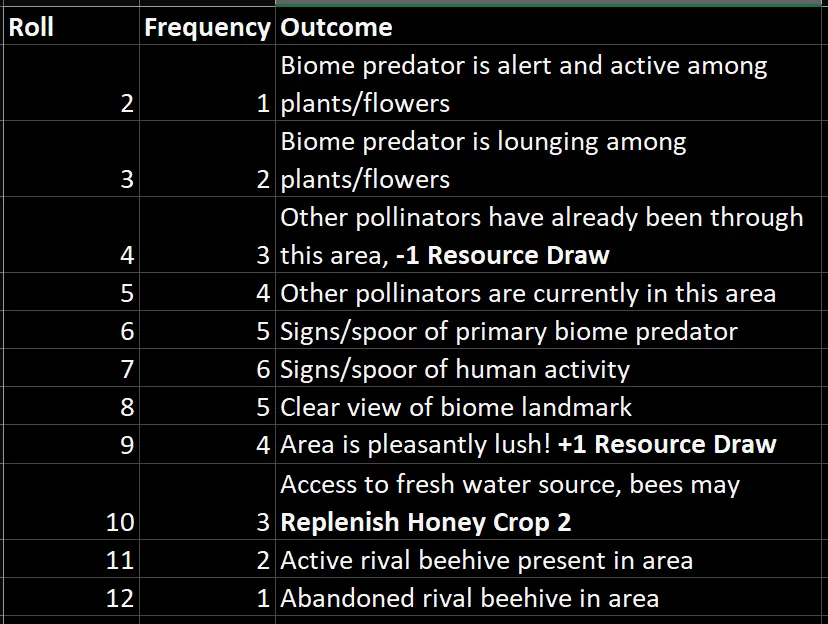
As we have discussed above, the 2d6 roll was only coupled to a weather check, and that then only covered one of two or three hexes being explored. So we had multiple dice rolls per round that were otherwise completely dissociated from the fiction and even, really, from the game state. If I had thought harder about players splitting up, I would have probably intuited this problem sooner! Alas, I was still assuming that players would buzz around together until a day or two before the test. I think the fantasy of acting as a scout bee is much stronger if splitting up is mechanically supported, so we should design around that assumption. Thus, our first order solution is that "encounters" and other local randomness should be driven by an oracle consulted within the hex.
I have two competing visions of what this could look like, and each comes with a set of pros and cons. The first idea is Shoulder Tables, and the other is Truth Tables, and this post is really to assess relative merit for our untitled honeybee game here.
Shoulder(ish) Tables
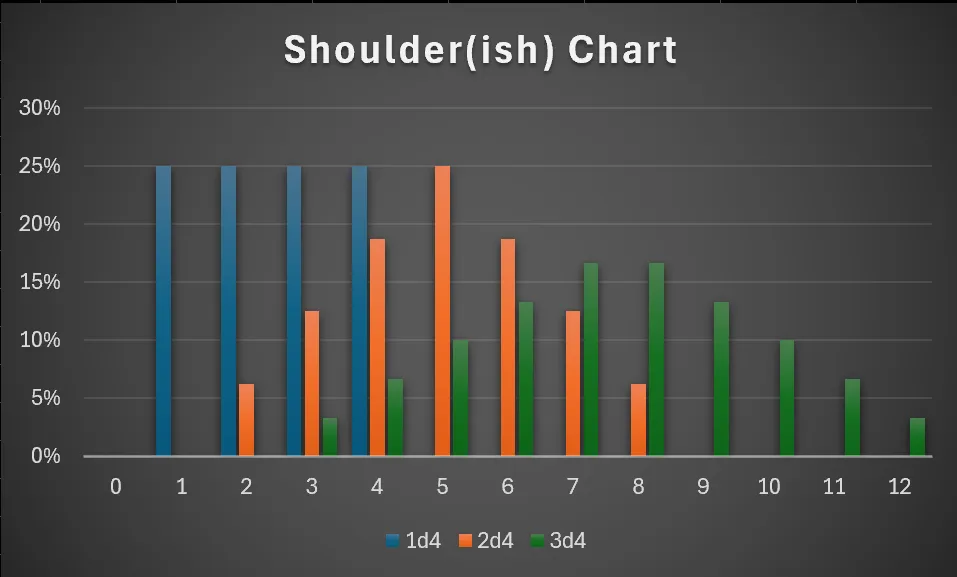
A few months ago, Zak pitched a great approach to random tables with the thesis that "Rolling additional dice allows you to explore the shoulders of a probability distribution." His idea is taking something like a 2d6 table and then rolling 3d6, taking the lower two or higher two based on an in-fiction constraint. This weights the average result away from 7, the center of gravity of a flat 2d6 roll. We are going to borrow from this idea but sort of bastardize it in the process.
Now, our design space is that we are drawing 1-3 resource cards in a hex based on Biome and Season. A desert in the summer has fewer flowers to pollinate for a bee than, say, the mountains in autumn. In-fiction, we are heavily implying that there is less life out and about in that biome when there are fewer resource cards to draw. Another bee in a more lush biome is probably confronted with far more life! Our table design should account for this.
One of the trickiest lessons I've learned from Josh McCrowell and His Majesty the Worm is that you can bend a playing card into some pretty dastardly dice sizes. The easiest to work with are d2 (red/black), d4 (suit), d13 (rank), and d52 (unique card). As an example case of what a shoulder table might look like here, let's treat each resource card draw as 1d4. This means that when a player explores a new hex, they draw 1-3 cards, the equivalent of rolling 1, 2, or 3d4. Qualitatively, we have 12 results with the following features:
| Result | Qualitative Behavior |
|---|---|
| 1 | Only attainable with 1 resource card, 25% of the time. Should be an encounter type unique to low resource availability. Example: abandoned, empty rival beehive |
| 2 | Attainable for 1-2 resource cards. Example: Unseasonably lush for this time of year, draw an additional resource card. |
| 3 | Attainable for any number of resource cards. Example: Signs/Spoor of human activity. Humans present on subsequent draw. |
| 4 | Attainable for any number of resource cards. Example: Signs/Spoor of primary biome predator. Predator present on subsequent draw. |
| 5 | Unattainable for 1 card, average result for 2 cards, unlikely result for 3 cards. Example: Other pollinators have been through this area, discard an unpicked resource this round. |
| 6 | Median result for 2 or 3 cards. Example: Sign or spoor of the Spirit of the Land |
| 7 | Unlikely result for 2 cards, average result for 3 cards. Example: Access to fresh water source, bees may Replenish Honey Crop for 1 |
| 8 | Unlikely result for 2 cards, average result for 3 cards. Example: Other pollinators flocking in the direction of the Heart of the Land |
| 9 | The rest of the results are only attainable when in a lush area (3 cards) and they are above the mean result at that. Example: Active rival beehive spotted in this area. |
| 10 | This should either be a uniquely good or uniquely bad outcome, like "biome predator sleeping in the flowerbed" or "undefended rival beehive with honey stores" |
| 11-12 | It's so unlikely to roll an 11 or 12 on 3d4 that they should probably be considered together, it's like 3/64 (that's almost a 1 in 20, eh). I think this should be a direct encounter with the Spirit of the Land |
Now the difference here between our encounter table and Zak's shoulder tables is obviously that he moves the center of his distribution around while we have some results that are only obtainable if you're in the right biome in the right season. I think this is a fun design space!
Mom: We have Anydice at home
Pros: I think the idea of only getting certain encounter results when you're in a lush biome vs when you're in a sparse biome that doesn't require a bespoke encounter table per season, per biome is an elegant way to thread the needle
Cons: This is honestly a big problem - you need to remember and stick to a consistent mapping of suits to values 1-4. The specific mapping isn't important, but you either need to memorize one or create a lookup table. For all the hay I've made here about streamlining encounter checks, this could be really annoying.
I really like this approach, but I want to explore at least one alternative before I commit to an option.
Truth Tables/4-Bit Encounters
In introductory computer science and computer engineering, you learn basic logical operations with "Truth Tables", where you have a constellation of statements that could be TRUE or FALSE and you test various configurations of inputs to the statements to see how the overall compound statement evaluates.
If we stick with the theme of checking the suits of our resource cards, then we have 4 logical expressions (card==hearts, card==diamonds, card==spades, card==clubs) and between 1 and 3 draws to evaluate to create a 4-bit word. Here's a quick illustration to show what I mean:
| Drawn Card(s) | Hearts | Diamonds | Spades | Clubs |
|---|---|---|---|---|
| 4 of D | 0 | 1 | 0 | 0 |
| 5 of H, Ace of S | 1 | 0 | 1 | 0 |
| 6 of C, 3 of C, King of C | 0 | 0 | 0 | 1* |
* I think if you have multiple draws of the same suit it should just intensify or escalate the result rather than being its own unique result
With 1-3 entries and 4 storage/evaluation bits, we can create 14 unique numbers in binary (we can't represent 0000 or 1111). The biggest difference between this approach and our Shoulder(ish) Tables is that a 3 card draw can now attain any result on the table, while 1- and 2-card draws are limited to subsets of the table. In case this isn't intuitive, here's the whole table.
| H | D | S | C | Attainable By |
|---|---|---|---|---|
| 1 | 0 | 0 | 0 | 1, 2, or 3 cards |
| 0 | 1 | 0 | 0 | 1, 2, or 3 cards |
| 0 | 0 | 1 | 0 | 1, 2, or 3 cards |
| 0 | 0 | 0 | 1 | 1, 2, or 3 cards |
| 1 | 1 | 0 | 0 | 2 or 3 cards |
| 1 | 0 | 1 | 0 | 2 or 3 cards |
| 1 | 0 | 0 | 1 | 2 or 3 cards |
| 0 | 1 | 1 | 0 | 2 or 3 cards |
| 0 | 1 | 0 | 1 | 2 or 3 cards |
| 0 | 0 | 1 | 1 | 2 or 3 cards |
| 1 | 1 | 1 | 0 | 3 cards |
| 1 | 1 | 0 | 1 | 3 cards |
| 1 | 0 | 1 | 1 | 3 cards |
| 0 | 1 | 1 | 1 | 3 cards |
This does make the chance of a 3 card draw achieving results 1-4 extremely low, so you can probably do something similar to the above effort and make results 1-4 things that are more likely in sparse regions.
There are two nice tricks with this. The first trick is that you can create some form of theming that goes along with the card suits that builds some thematic cohesion between the drawn cards and the fiction of the encounter. Something like,
- Spades indicate human presence
- Clubs indicate the biome predator
- Diamonds indicate other pollinators
- Hearts indicate the effects of the Heart/Spirit of the Land
The second trick directly follows on from the first, that you don't need the cumbersome steps of converting the card draws to numerical values, then adding the values, then looking up the result. I think a direct lookup/truth table is more elegant and builds a better intuition for players of the fiction.
There is still some dissonance here, that the cards represent pollen and memory of landmarks, but the card suits are used to determine the encounter, but I don't see that as insurmountable. The presence of other things in a hex can be both cause and effect for the available resources, and if we are clever with how we construct the encounter table we can imply that the presence of these abundant resources is what drove the encounter.
When I started writing this post I was dead certain that I was going to end up doing the Shoulder(ish) tables but I've managed to convince myself otherwise - I think the next playtest will use a variant of this truth table approach along with our cleaned up travel procedure.
Thanks for reading! I know that my friend at A Shrike for My Dreams and I have been torturing playing cards as oracles for a few months now but I haven't seen an approach like the two above yet - let me know if this sparks any ideas for you!