On The Nature of Treasure
I've been thinking about loot for the past two days, ever since Sandro wrote The Loot Sicko's Dilemma. I think Sandro's interests and touchpoints vary from mine, so it was a good prompt for me to reflect on my own preferences.
I want to think about loot and treasure as functional systems in games, that is, what purposes do loot and treasure serve in play and how do they shape behavior.
Treasure Communicates the Fiction
Treasure as Legibility
Treasure acts as a grounding function. It conveys the genre conventions of the campaign. If we are playing a game about pirates, we need to be on the hunt for gold doubloons. If we are in space, we need to interact with some form of credit that is inscrutably fungible on all Senate-aligned core worlds. Specie and the lack thereof sets an expectation for what rewards and penalties may be in store in this game. When you do jobs for the setting's currency issuer, you are rewarded with legal tender. When you do jobs for a rebel faction or for a cash-poor kingdom-in-exile, you are rewarded with favors and bolts of cloth.
Treasure as Worldbuilding
I usually think about worldbuilding and setting as exercises in legibility, so this is closely related to our first point. However, this is more about specificity. Lore delivery is a challenge for players. You have a limited attention span to share and receive proper nouns with one another before you start losing signal. Character creation is an incredibly efficient way to deliver information about the setting because it is a time where you have maximal undivided attention. I see treasure as a comparably efficient mechanism for lore delivery, because you can couple the feeling of excitement and reward with the experience of learning some new proper nouns that hopefully raise more questions than they answer.
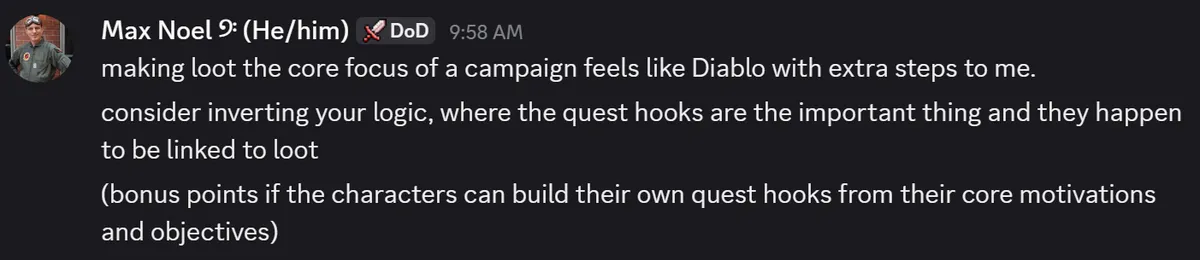
This philosophy of treasure helps convert a secret discovered on one adventure into a follow-on adventure, if players are willing to bite the bait.
Treasure Shapes Player Behavior
Treasure as Currency
One of the fastest ways to put a pep in the step of your players is to establish their debt history at character creation. Electric Bastionland and Traveler come to mind. This is an incredibly legible way to tell them that their mission is to earn money that can be used to escape the debt burden. This search for specie is an externalization of the otherwise intrinsic motivation to seek and accumulate treasure.
This functional subsystem is tricky, however, because it relies on the game having some form of economy or economic incentives. If treasure is fungible for some amount of specie, then there must be merchants able to execute that transaction, and the specie must then be useful for other things.
Many games aim to split the difference here to varying degrees of success. His Majesty the Worm does a good job with treasure as currency, worldbuilding, and legibility. The megadungeon is the source of all of the specie in The City. This gold is taxed by the city guard, it is used to pay for accommodations, and it can be invested into long-term projects, but you never have to count out coins to purchase basic adventuring gear because the cost of your, say, rations, are rolled into the cost of living.
Too many games handle this subsystem poorly to merit enumeration, but I think a lot of people's disappointment with treasure as currency stems from games with baffling economies that were designed to occupy the correct page count and not designed to facilitate play. This sort of fungibility requires consideration of relative value, or at least some number of benchmarks that players can use to interpolate and extrapolate relative value. When my HMTW players discovered a treasure chest full of 2000 gold, they knew that it would fund a fruitful retirement for the guild. If I found 2000 gold in a fifth edition Dungeons and Dragons game, I might know whether this would fund a small handful of player revivals, but otherwise it just occupies a line on my character sheet.
Treasure as Character Augmentation
The next two points are going to be a quick examination of a thesis I've come to recently. I see a core function of "loot" as a mechanism for a game runner and/or an adventure to provide characters with abilities that are outside of their intrinsic capability. This gets into a bit of a quibble about the Venn diagram between "gear", "loot", and "treasure", but that can be a topic for another day.
Treasure as Short-Term Gain
Consumable items are one of my favorite types of treasure because of my experience with the Cypher system. The challenge with consumables is whether players will remember to use them or whether they will be hoarded. I'm incredibly guilty of failing to ever use potions or elixirs in JRPGs and CRPGs because you never know if you'll have enough or when the next is coming. Cypher does a good job with this because:
- GMs are encouraged to give cyphers out frequently
- Cyphers tend to be incredibly specific, so when a situation comes up you may as well use them
- Characters can hold a very small number at a time (more on this later)
Short-term benefits are fun. It's exciting to be in a hairy situation and then have just the right tool for the job and it's exciting to make it past an harrowing obstacle by the skin of your teeth. Additionally, as a gamerunner, you do not need to worry about handing out something "game breaking" that could come back and spoil future challenges.
Treasure as Advancement
When people think of capital-L Loot, I think this is the point that they are most passionate about. Treasure is a vector of character advancement that permanently, or at least as long as the loot is possessed, augments or modifies the capabilities of the holder. This point includes the humble +1 sword as well as items rolled on Chris Tamm's 300 Useless Magic Items.

I think the significance here is that, whether it is a strict numeric change to character attributes or a boot that randomly changes footprints to a different creature every 100 yards, this is a change to the character's abilities that is independent of their intrinsic capability. Now, in fifth edition, a Fighter may achieve the same numerical bonuses to hit rolls and damage rolls that a +n sword provides over the course of a campaign, but those attributes automatically change whether or not said character is holding that item.
I love treasure as a vector of character advancement because I primarily run games that do not center intrinsic, i.e. set/leveled, advancement for character abilities. This then drives advancement-minded players to seek out treasure and loot that augments their abilities. It also means that character advancement becomes a function of level design; if your adventure does not include loot in its rewards, then you have failed to meet the advancement-minded players' expectations. I do not blame some players for not enjoying or not trusting this paradigm. I resent the expression "mother may I" as a descriptor for the paradigm, but I do understand where that mistrust may come into play.
One anti-synthesis of treasure-as-advancement and treasure-as-currency is, of course, the original iteration of experience points. The first editions of dungeons and dragons used the gold value of treasure returned to town as the numerical basis for leveling, which then provided a set advancement track for your character class. My assessment of this mechanic as anti-synthesis is not a value judgment; the balancing act of paid hirelings, minimalist character advancement, and encumbrance mechanics weighed in coins produces a novel system in motion. I would call it fragile!
This Is Probably Where We Should Talk About Crafting
A few weeks ago I read an interesting post about the Draw Steel crafting rules. The thrust was that, in promise, crafting rules present players with tools to drive their own loot/gear-based advancement in accordance with their vision of their character. This is a positive vision of a non-GM- or non-adventure-mediated treasure-as-advancement paradigm. It is low-friction in-fiction for the GM to seed appropriate crafting materials into the world. Players can then seek out these materials on their adventure and put the materials toward projects that interest them. In practice, claimeth the author, the recommended pacing of the Director advice and of adventures is numerically incompatible with this objective and players cannot craft anything substantial without the heavy hand of the Director guiding them.
I love player-driven projects because I love downtime phases as chances for extended characterization and role play. Augmenting your character's abilities is a reasonable reward for characterization, role play, and resource management. Even in games that are not "about" numbers going up, I'm for a good crafting system.
Treasure as Decision-making
I think my core approach to game design and analysis is that I want game systems to encourage players to make interesting decisions. When the topic of treasure comes up, there is a lot of discussion about whether to roll on tables to generate the right number of amulets and goblets and gems for the character's level or whether to just hand the players a lump sum of gold. If there's no decisions or opportunity cost to carrying that loot, then you might as well just tell them that their Wealth Score went up by a gorillion and have them move on. Each of the above points is really about understanding treasure as a tool for different types of abstract decisions, so here I'll focus on a more mechanical view.
A foundational approach, in my view, of making treasure an interesting element of gameplay is ensuring that you have an encumbrance system. I don't play weight-based encumbrance games, I focus on slot-based inventories, but there should be a cost to walking out of the dungeon with coins spilling out of your pockets. The excitement of finding a hoard is only amplified by the thrill of planning how to heist it out and figuring out what equipment you need to leave behind. Additional complications, like treasure that is particularly bulky or heavy and thus requires multiple sets of hands or tools to safely extract, is a fun problem to solve.
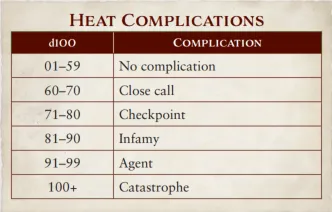
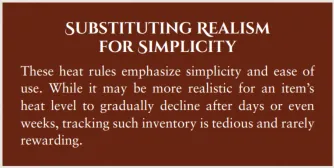
Arcadia 11, available on MCDM's Patreon
Encumbrance is not the only way to make treasure interesting. MCDM's Arcadia magazine for fifth edition D&D had a great article called "Good Fences Make Good Neighbors", which introduces a GTA-style "Heat" subsystem. The goal was to attach some level of risk and challenge to converting stolen treasure into gold, and in turn providing a way to procure questionably legal goods. This reintroduces the challenges associated with ensuring a legible economy, but I think Blades in the Dark and its ilk do a good job with abstracting the concept of Heat away from the vulgar value of the stolen goods. Regardless, it's exciting for players to have to weigh the risk of a score against the value of what's being stolen!
This is also a reasonable place to talk about buildcraft. Treasure as an aspect of your character build is a form of decisionmaking, especially if you have action taxes for swapping items around in a tense situation! Anyone who has read this blog knows that this isn't my preferred mode of play but it's obviously a big part of the hobby. Assessment and optimization of treasure and tools is absolutely play.
Basically, I think that if you want treasure and loot to be a part of your game, I think you should be intentional and critical about how that interacts with the ability of the players to make decisions. If your game is about character advancement on a set track, your loot should probably focus on short-term consumables and worldbuilding. If your game is about extracting treasure from dangerous places, loot should be fun and tricky to extract but should improve the characters' capabilities in the world. If your game is about telling a story, treasure may not be foregrounded at all!
Treasure as Fun
At the end of the day though, collecting gewgaws and doodads is fun. I think inventory management and puzzle solving are fun parts of role playing, which is why I've said the most in here about OSR-style expressions of loot, but I'd love to hear about other peoples' interests in treasure as systems of play.