Monsters and a Heterarchy for Game Design
Something I didn't realize before I plunged into the tabletop blog scene is that the term "game design" is fraught. It's partially fraught because nearly every hobbyist has their own definition of game, and it doesn't help that most people have their own pet definitions of design, so we have something on the order of n log(n) competing standards for what game design is.
Having a language of game design does not guarantee that you will be able to design good or interesting games in the same way as knowing a foreign language such as French does not guarantee that one will say interesting things even if the pronunciation and grammar are correct.
Patterns in Game Design, Bjork and Holopainen 2005
But I'm not here to offer one more hobbyist definition of game design. I want to explore a delineation proposed in a (sadly delisted) blog post from Knight at the Opera, wherein Dwiz proposed that it's often useful to speak more specifically about System Design and Level Design. Before you start raising hell, I want to issue an additional disclaimer - I intend to talk here about lenses and not boxes (as my friend Seraphina says, vote for her as a 2027 Ennies judge). This isn't an attempt at any exclusive taxonomy, just a way to look at things. While I talk through my thoughts I will also lean some on Staffan Bjork and Jussi Holopainen's Patterns in Game Design (2005) because it provides useful framework language. Let's take a look at that framework:
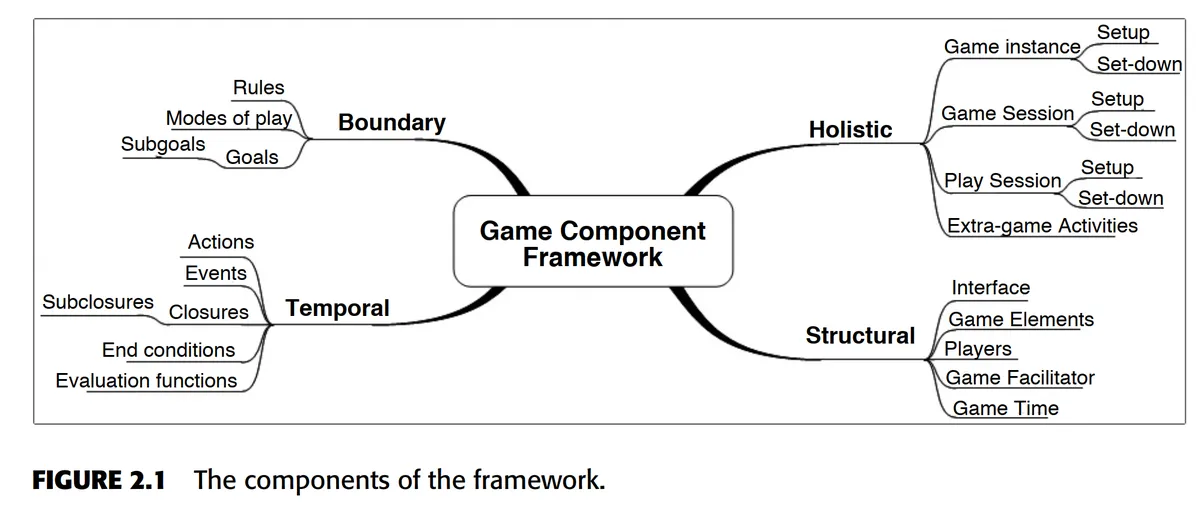
Lightning round summary time. If the act of play only happens in the "magic circle"
- Holistic Components tell you when you are inside or outside of the magic circle.
- Boundary Components tell you what activities are constrained or incentivized within the magic circle. An aside here is that Bjork and Holopainen take a less expansive view of "rules" as Boundary Components than Stenros and Montola in The Rule Book.
- Temporal Components tell you the order in which things happen within the magic circle.
- Structural Components are the objects you play with when you're in the magic circle.
I don't want this entire post to be my restating arguments made by the book, so if you have any terminology quibbles I would recommend reading the first chapter or two of the book here. With that in mind, I want to annotate this framework in the context of how I look at System Design and Level Design in the tabletop games with which I'm familiar.
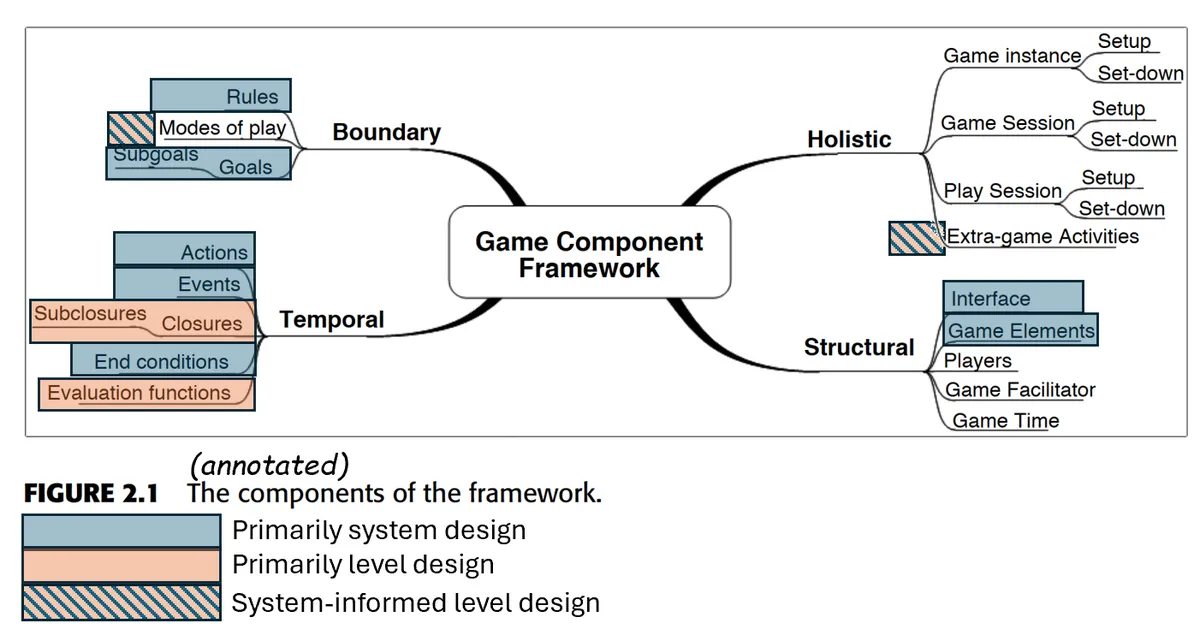
Both system and level design obviously sprawl across this game component framework. The game system typically encompasses (error-handling) rules, codified goals, expected player interface, and codified actions and procedures. In other words, what we would more broadly call "the rules", or what Stenros and Montola would call formal rules. In contrast, or rather complement, level design in tabletop games is the scenario presented to the players which provides the potential energy necessary to initiate play. In the PIGD component framework, this is primarily Closures and Subclosures because, per their definition:
Closures are quantifiable and meaningful player experiences usually associated with game state changes. Closures may be associated with achieving goals but do not have to be so; a closure might instead be the point when it becomes obvious that a goal cannot be reached. Another relevant difference between goals and closures is that the goals are within the game definition and do not exist at a particular point of time. The closures are always tied to a particular point of time in the gameplay. To put it another way, goals are part of the game, closures happen when playing the game.
Although they can usually be defined as particular changes in the game state, closures do not have to be dependent on the game state, as they can also be a player’s subjective experiences. Those closures that are defined by changes in the game state are usually non-reversible; once they have been achieved, the game state will not revert.
Hopefully you are picking up what I am putting down here - when I am talking about level design, I am including:
- A dungeon level in a classic diy elfgame
- A job in Blades in the Dark
- A show in Under Hollow Hills
- A negotiation in Draw Steel
- A sitrep in Lancer
- A Realm in Mythic Bastionland
- A Caravan Quest in Ultraviolet Grasslands
- A party in Good Society
I'm being intentionally long-winded here because I want to avoid letting my word choice of "level" constrain our thinking.
System-Informed Level Design
You also saw in my annotation that I invented a category for "System-informed level design" to describe where Modes of Play and Extra-game Activities fall in this framework mapping.
When I am talking about Modes, I'm talking about what is often described in D&Dism as, like, their "pillars" - combat, exploration, and social play. As an explicitly encoded example, Trespasser has "Frames" of play that span from downtime actions in a town to moment-to-moment combat actions. Blades in the Dark or Flying Circus switch between freeform narrative modes and high-stakes mission modes. Cypher, Heart, or Apocalypse World never have that explicit "freeze frame" where things enter a new mode, because the resolution system for all given actions is essentially unified (at a macro level, these three games are very different when the rubber hits the road).
I say all of this because, if I am a game facilitator who intends to run one of these systems, I need to understand the rules surrounding these modes of play (or lack thereof) to prepare scenarios or "levels" that may invoke those modes. Game prep is often a critical extra-game activity where the "level" is prepared, assessed, and refined in response to your knowledge of your preferences, your player preferences, and the modes of play you intend to tap.
So What is a Bestiary?
I've been chewing on this today because I haven't been sure where "monsters" or "encounters" fit into the lenses of System Design and Level Design. Games that involve contending with beasts and monsters often either have them in their core text, in an appendix, or in a required game mastering book like a monster manual. The point I've arrived at is that things like stat blocks are a similar type of synthesis between system and level design to the modes of play discussion above - they are system-informed level design tools.
For my money, a good bestiary provides tools for the GM to create interesting mechanical interactions or social dilemmas for the players to deal with. The mechanical interactions are system design but creating the scenario in which the monsters are encountered and the evaluation conditions by which the encounter ends is level design. In more political or domain-centric games, a robust list of factions serves the same function of system-informed level design. What I mean by robust is that the factions are not just named institutional entities, they are arranged in a constellation of relationships that the players must stumble through and navigate in play.
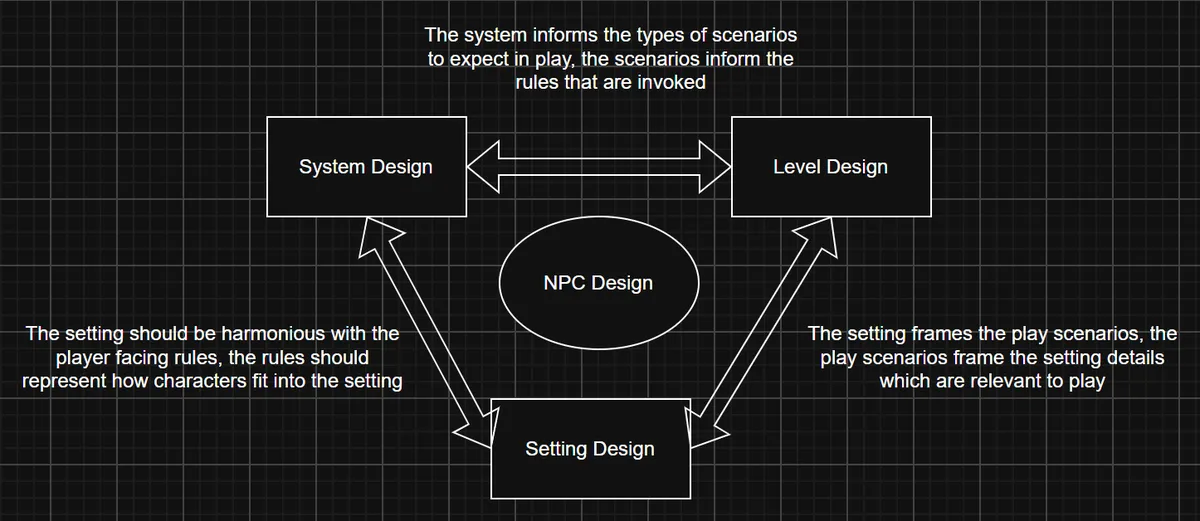
To more fully capture my feelings here, I do want to bring a third element into this game design heterarchy: Setting Design. I think the setting of the game, whether it is implied or explicit, World-of-Darkness-maximalist or anti-canon, is a critical part of the connective tissue that places a scenario in a game world. How many times have you read a supplement or an adventure that just doesn't fit with your project. It can be mechanically compatible with the rules of the game, it can provide potential energy for play, but the fiction presented violates the "internal rules" of the players or the setting. I may love the Mothership module Year of the Rat but I would not run it in Beecher's Bibles because I can't find any primary sources that indicate Bleeding Kansas had space casinos.
At their best, I'd argue that bestiaries meet in the middle of these three columns. They are subject to the game rules (except when they violate them in interesting ways), they can form a focal point for a "level" (or session, or scene, yadda yadda), and they communicate setting to the players.
When Have You Designed Enough "Game"
I think this also informs the gut feeling gamerunners have when they read a system core book and judge whether there's enough "game" there. An MC running Under Hollow Hills doesn't need the HP and attacking prowess of the Wolf King of Winter, she just needs to know his wants, needs, and proclivities because so much of the game centers the changes in player relationships. A skirmish game like Lancer or Draw Steel, however, needs NPCs that are capable of threatening players in unique ways that force the players to cooperate and make plans without overburdening the gamerunner. When the central fantasy of a game is constructed on conflict or on relationship-building, a bestiary or a faction list provides a setting-appropriate tool kit for a gamerunner to assemble scenarios with enough potential energy to ignite when introduced to players.
I contend that this aforementioned gut feeling is really "does this core text prepare me and excite me to undertake the activity of level design".
When that answer is no, your options are limited to either sourcing a supplement that fills that gap or giving up on the game.