Extending Blackjack as a Resolution Engine
Last week I presented a framework for what I called a Simple Heroic Adventure Game. The core concepts I want to explore were creating a heroic archetype from a simple matrix, a blackjack-based resolution engine inspired by my Hellbenders work last year, and a basic set of heroic principles of play. If this game concept feels sticky enough to continue exploring then I will probably keep writing about the archetype matrix and the heroic principles, but today I want to expand on the blackjack engine.
I was in a minimalist mood last week so I described action adjudication with a modified version of Chris McDowall's action resolution procedure and a modified set of rules for blackjack. In particular, I described three basic outcomes for the hand of blackjack: failure due to caution, success, and failure due to recklessness.

The natural extension is that the path to heroic success is a narrow threading of the needle between two opposed failure modes. What I like about this model is that, when you strip the face cards from the deck, it solidly puts the player in control of which failure mode they are more comfortable accepting. When you pair that with storytelling principles that heroic failure is more about externalities and consequences than about your own life and limb, I think it opens the door for players to make informed decisions about their characters and their risk tolerances.
An Arthurian Aside
Then, in the last few days, Seraphina released her Dice Exploder interview with Caleb Zane Huett about Pendragon's Traits. This was a mind-expanding hour of radio and I highly recommend giving it a listen. Most episodes of the show give me a lot to chew on - the recent interview with John Harper was another standout - but this in particular hit me right as I was recognizing that the balance between caution and recklessness in my small blackjack game was only one axis of tackling a challenge. Traits are a family of opposed Vices and Virtues which characterize knights, so my first-order thought was to create a similar family of opposed...something...to characterize these heroes.
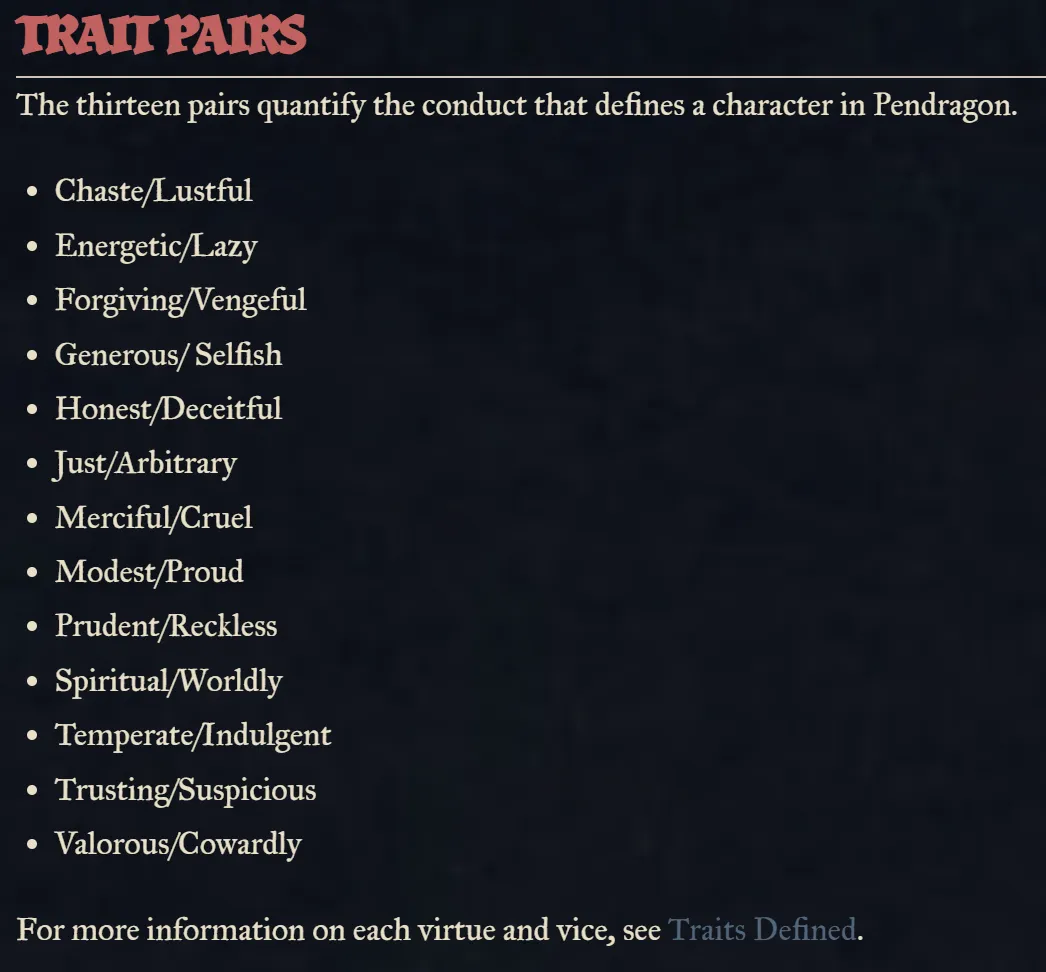
Now in Pendragon, Traits are a tool that help players determine a character's intent in a scene. In the Baker IIEE model, it is a rule that intervenes before the first 'I'. I think the reason I stalled out at "opposed something" for this game is because my sterling example of opposed tendencies comes into play at a completely different step of the IIEE model.
By the time you are balancing caution and recklessness, you have already decided your intent and initiated your course of action. Depending how we apply heroic principles, we even already know that the task is executed! We are just determining the external consequences and effects!
The other failure of comparison here is that there is no middle path for Traits. No one tells legends about the knight who perfectly balances chastity and lustfulness, that's just being a guy with intermittent access to a cold shower. If this blackjack engine feels fruitful enough to develop, then we need to take a step back if we want to apply something useful from Traits.
Time, Tools, and Knowledge
In the OSR, the commonly transmitted and received wisdom is that it is Good to avoid rolling dice, which should be reserved for moments of particular consequence. With that wisdom in hand, the more didactic instruction is that when characters have the time, the appropriate set of tools, and the know-how to do something, then It Just Works. Move on and adjudicate consequences.
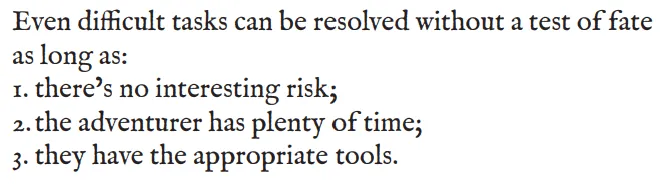
His Majesty the Worm, Josh McCrowall, pg 5
I think this is a great model and it fits nicely into something like the Bastionland action procedure. When you lack the time, tools, or talent to try something, that becomes a skill check, save, test of fate, or whatever other divination technique your game of choice uses. This is a great model, so let's reinvent the wheel anyway.
Let's think about the capacity for our heroes to act in the fictional space as a balance of time, tools or techniques, and the knowledge required to accomplish the task. That is, once we have set our intention, we negotiate to construct this triangle. If we can reasonably justify that we have all three legs of the triangle when we attempt to act, then it just works.
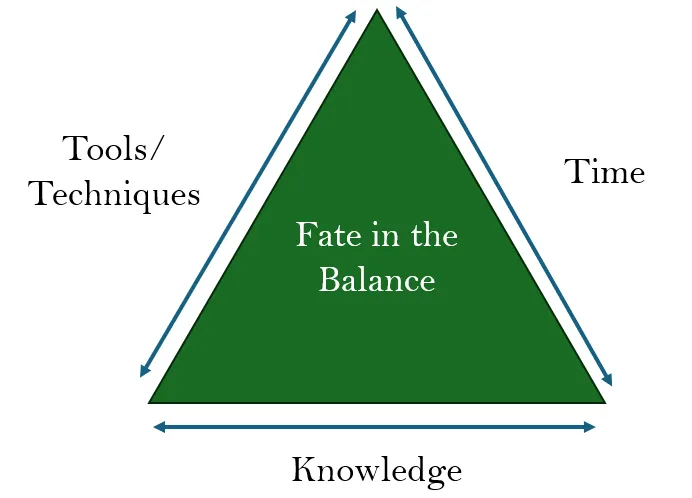
When we establish that we are missing a leg of the triangle but still want to attempt the task, we define an Approach to compensate for the missing element. An Approach is a balancing act between two potential failure modes, usually characterized as an excess and a paucity set in contrast. A single hero can attempt to compensate for a single missing leg of the triangle, but if more than one leg is missing then additional heroes must contribute to the task at hand.
Example Approaches might be:
<Cautious - Reckless>, to compensate for a lack of time<Delicate - Brutal>, to compensate for using the wrong tools<Broad - Deep>, as in a search for subject matter knowledge<Insecure - Arrogant>, to compensate for a lack of interpersonal knowledge
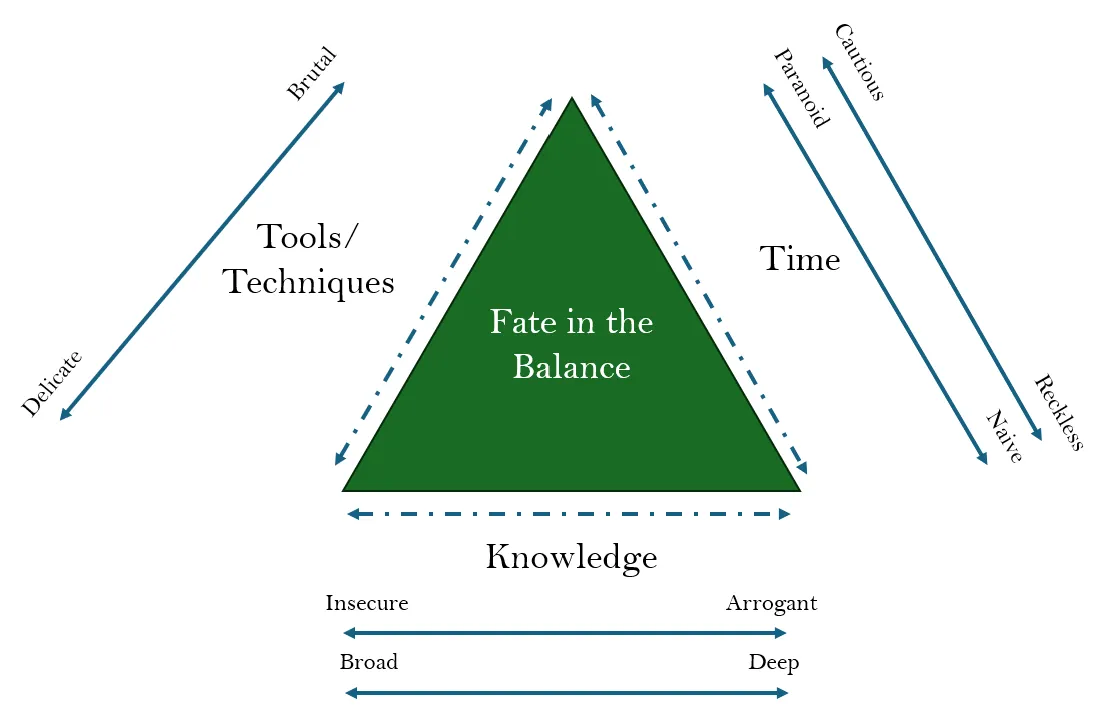
Difference in Approach
So what's the point? I think this is where we learn from the tradition of storygaming, specifically something like Vincent Baker's PBTA thought experiment on Controlling Outcomes.
Asking players to define their Approach to the situation should naturally establish the fictional stakes against which they are gambling in our blackjack engine, and this can be augmented by tying leading questions or prompts to the opposed failure modes for each Approach. Intuitively, players should have an idea of what may happen in the fiction if they rush into a situation or cautiously drag their feet and they can model that behavior with how they play out the blackjack engine.
With face cards removed (and ignoring high aces for the sake of simplicity), drawing a blackjack hand from a 40-card deck is equivalent to rolling 2d10. If our success band is 16-21, then we have fairly narrow odds of avoiding low-end consequences on our initial draw - about 15% on 2d10, so our odds are probably a little better if you allow high aces. Maybe a 1 in 5 chance.
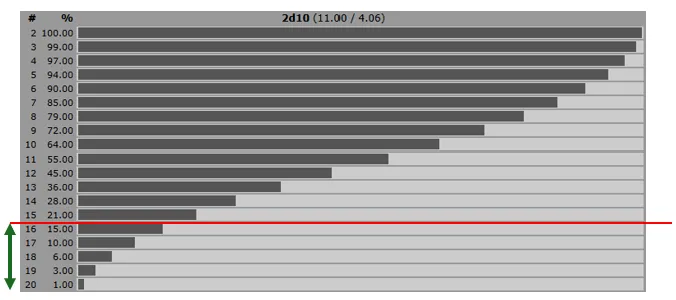
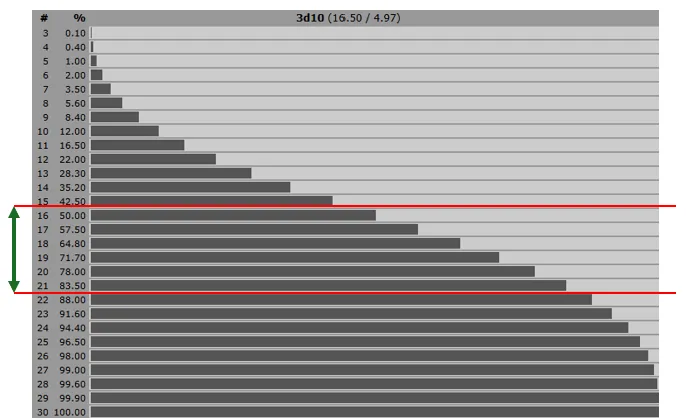
When you draw a third card, you're now looking at something like a 50% chance of exceeding 16...and a 17% chance of busting, a chance which did not exist if you played conservatively and stayed at 2 drawn cards. If the fictional consequences of one extreme end of your Approach are intolerable, you can guarantee that you prevent them, in exchange for a low probability of success or by invoking the alternative betting mechanics of Sacrifice or Changing your Fate.
This basic premise feels like an exciting path to continue to approach. I also think it opens up design space for how characters may develop mechanical affinities for certain Approaches and their extreme outcomes. Maybe that changes the types of questions that are asked in case of a failure, maybe that changes the band of success up or down to encourage different play behavior!
I think what we've secretly done here is created a framework to make a specific set of custom Moves - one can imagine reframing the